.svg)
.svg)

%201.webp)
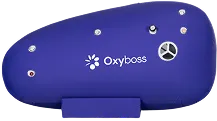

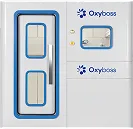
Oxyboss OB-H401
2.0 ATA Hard Shell Clamshell-Form Hyperbaric Chamber
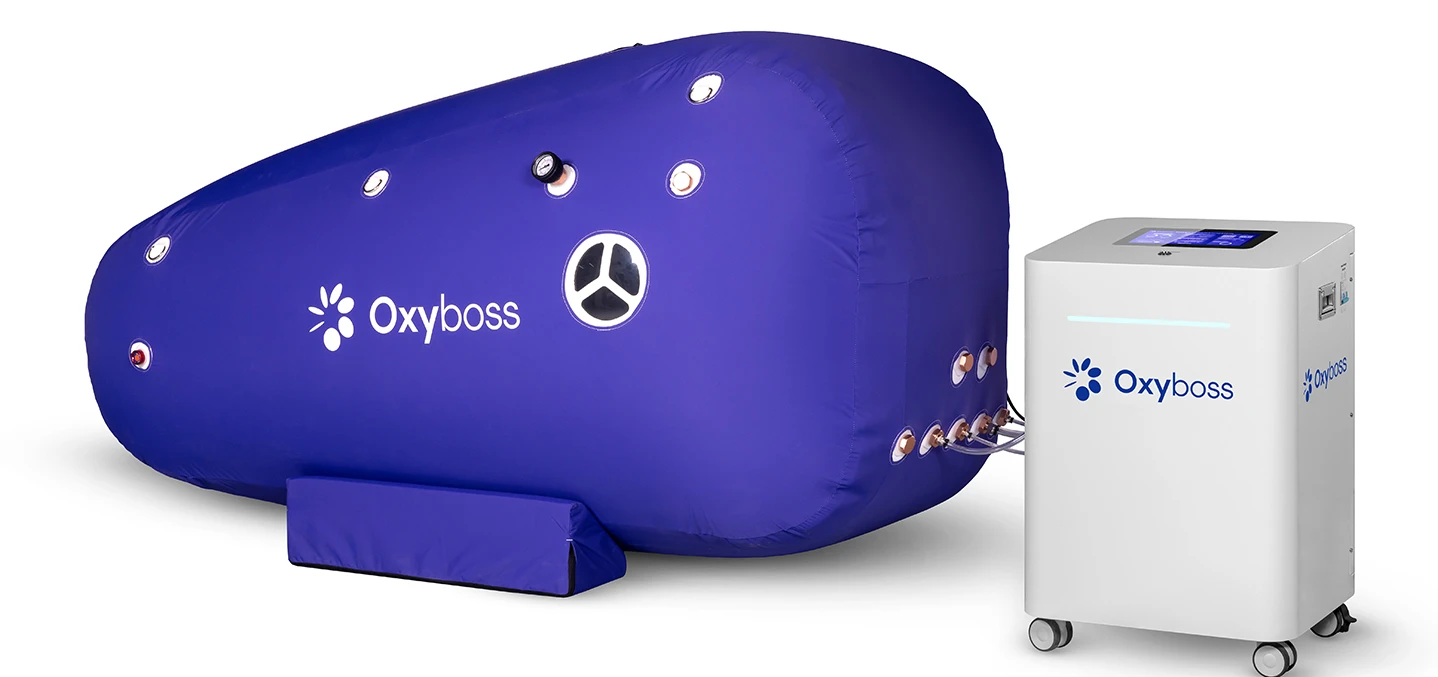
The OB-H401 is a single-seat, 2.0 ATA hard shell hyperbaric chamber with the concentrator, compressor and cooling unit all built into one 0.42 m² cabinet. It's a pressurized oxygen environment for personal wellness. Not a clinical device.
Aluminum alloy shell · adjustable 1.1–2.0 ATA · 3-in-1 oxygen source built in · CE · ISO 13485 · ISO 9001
.webp)
Aluminum Clamshell-Form Chamber
You'll see the phrase "metal hyperbaric chamber" a lot online. It sounds specific. It isn't. The metal that actually matters is the alloy, the wall thickness, the weld process and how the vessel gets pressure-cycled at the factory. HERO LifeCare's material breakdown puts it plainly: stainless is durable and heavy, aluminum is lighter and easier to place, carbon steel is heaviest and needs anti-corrosion coating.
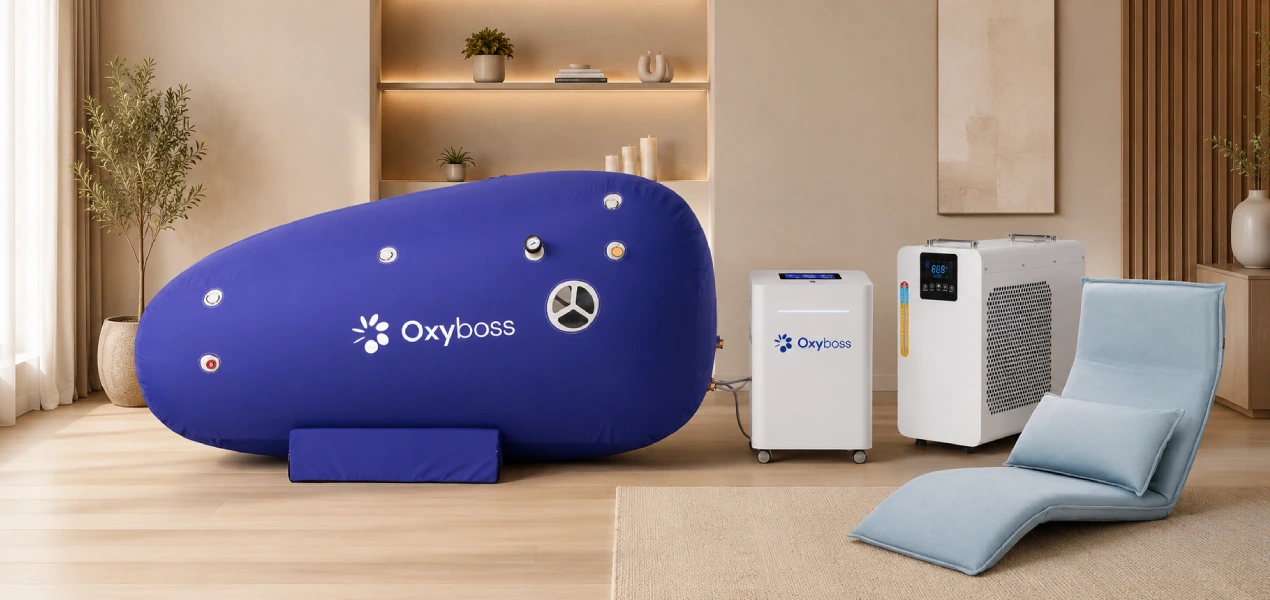
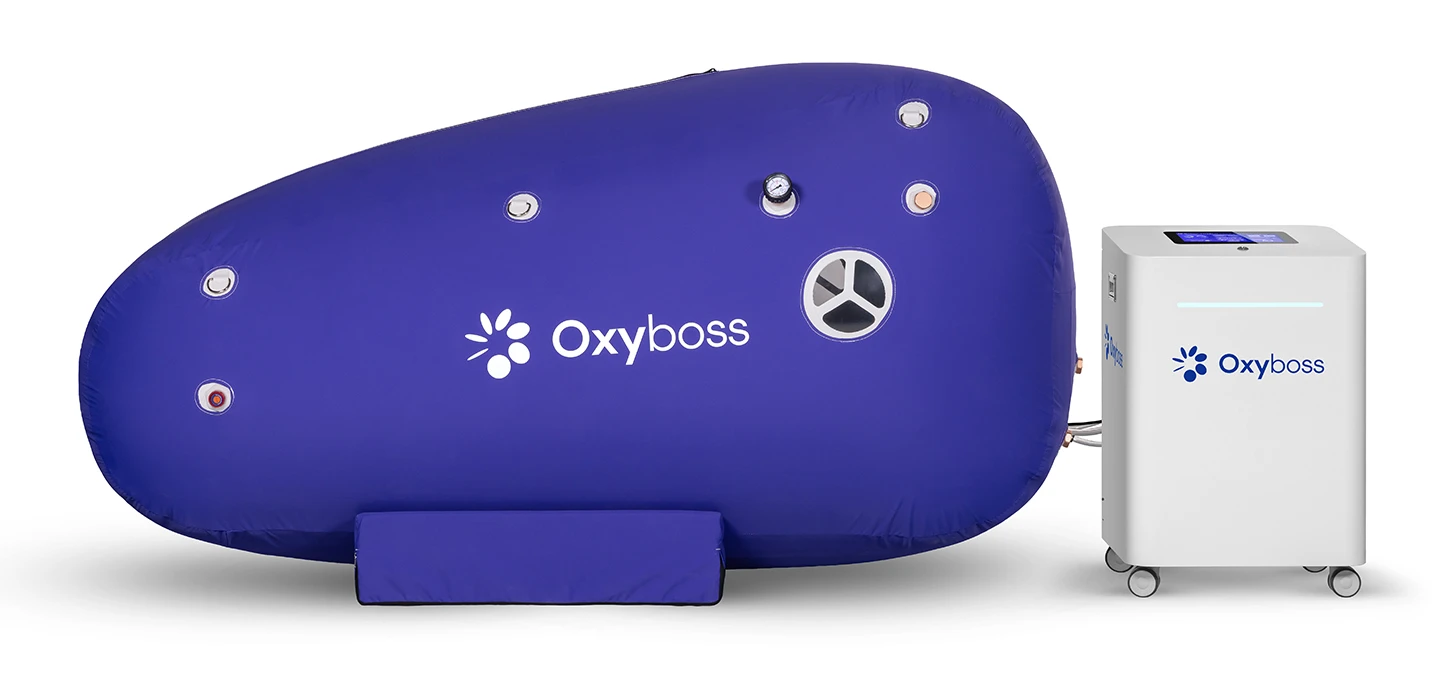
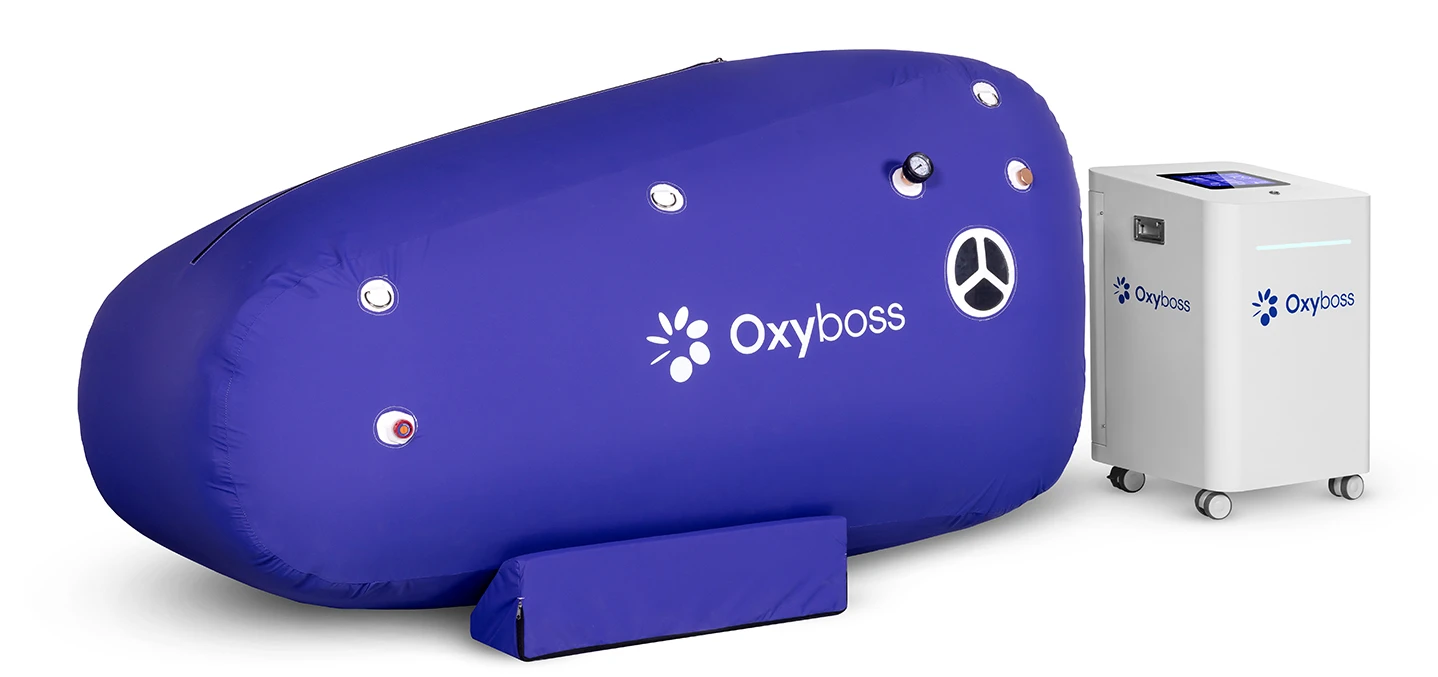
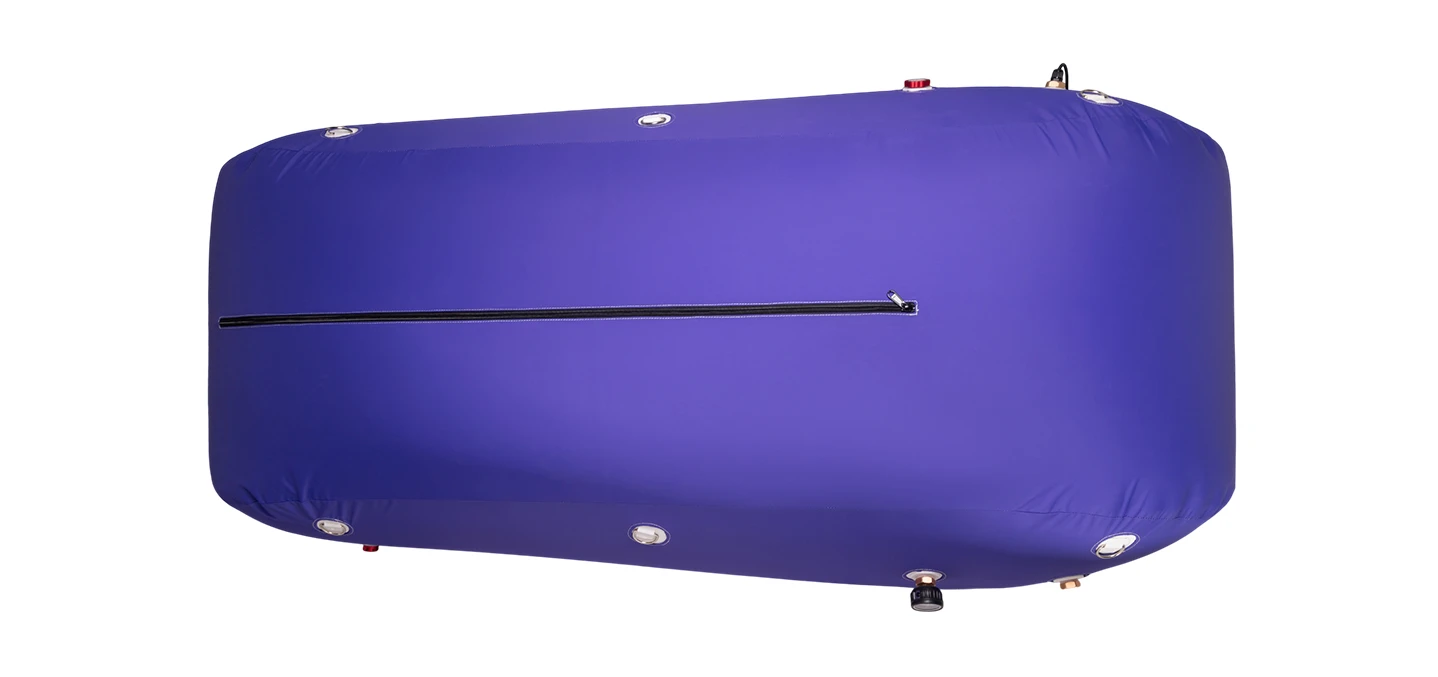
The OB-H401 is built in a clamshell form , the same geometry used for pressurized aircraft cabins and undersea submersibles. Curved pressure vessels distribute stress more evenly than flat panels, which is why you don't see rectangular pressure chambers.
The shell is aircraft-grade aluminum alloy. That choice is deliberate. At 2.0 ATA and single-seat volume, you don't need the mass of a 900 kg carbon steel room-type chamber. Aluminum in this class runs 40–50% lighter than a comparable steel shell, which means:
- 400 kg total weight — a single-seat carbon steel chamber of similar size would be roughly 800–900 kg
- Realistic to place on a properly rated ground floor without structural retrofits
- No anti-corrosion coating required
- Easier for two or three movers to bring in on rollers
Outside dimensions: 200 × 98 × 190 cm (78.7 × 38.6 × 74.8 in). Engineering reference: designed to ASME PVHO-1 (Pressure Vessels for Human Occupancy) standard family. See the ASME link in the certifications section below for the standard family.
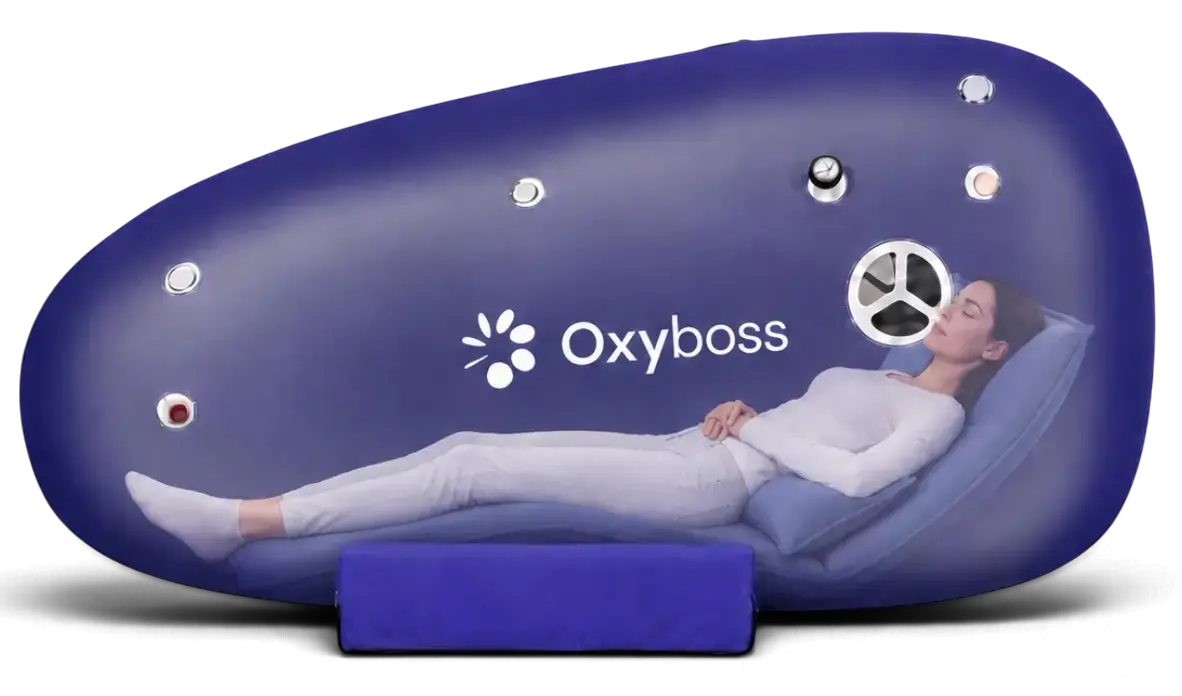
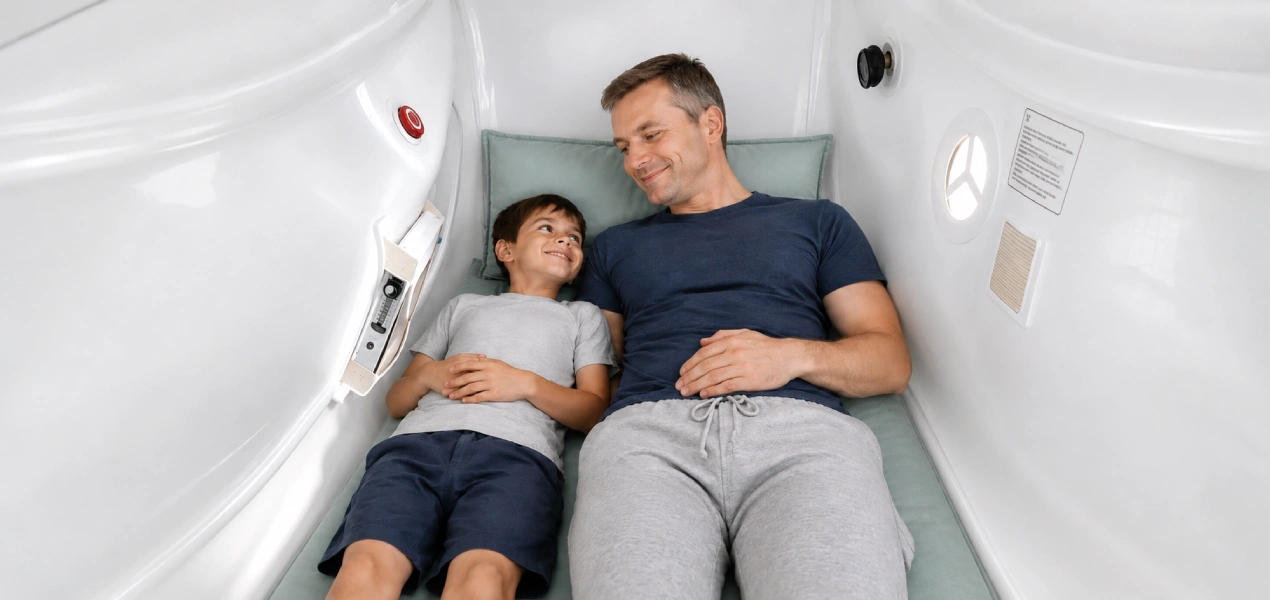
The OB-H401 has two round acrylic viewing windows built into the shell — one Ø35 cm (13.8 in) and one Ø45 cm (17.7 in) — plus a 115 × 63 cm (45.3 × 24.8 in) sliding acrylic door that's essentially a full-view panel. You can see out. Someone outside can see in.
The interior stays daylit instead of feeling like a submarine.Interior seating is a reclining electric leather sofa, adjustable from 90° (upright) to 160° (near-flat). Wipeable, sweat-resistant. Not "medical" — it's a chair you'd sit in for an hour without thinking about.
The interior lining is anti-static. That matters because you're breathing an oxygen-enriched atmosphere, and any spark risk in that environment is a serious safety problem.
The lining is there so the friction between clothing and interior surfaces doesn't build up a static charge in the first place.The door is air-cushion self-locking — pneumatic, not electromagnetic. It pressure-locks during a session and doesn't jam if the power goes out.
Two Acrylic Windows and a Full-View Door
Every hard chamber buyer we talk to eventually admits the same worry: "Am I going to feel closed in?" Fair question. A blank metal shell is a hard sell for anyone with even mild claustrophobia.
Most personal chambers on the market pair the shell with two or three separate boxes on the floor: an oxygen concentrator, an air compressor, sometimes a chiller. That means more cables, more failure points, more square footage. Ours consolidates all three functions into a single cabinet.
Oxyboss 3-in-1 oxygen source (standard on OB-H401):
.svg)
10 L/min PSA oxygen concentrator
Pressure-swing adsorption, 90% ± 3% O₂ delivered continuously while the chamber is running.
Oil-free air compressor
No oil vapor in the supply line, which cuts a whole category of maintenance out of the picture.
Water-cooled air conditioner
Precise interior temperature control for long sessions.
6-panel sound-damping module
Brings audible in-cabin noise down to around 60 dB, roughly conversation-level.
Cabinet footprint
930 × 450 × 920 mm — about 0.42 m². For reference, a traditional three-piece external setup takes up 0.9–1.2 m². The main unit weighs 130 kg, runs on 110 V / 220 V / 240 V, draws 10 A, rated at 2200 W. The whole thing is modular. If something fails — say a compressor fan or a control board — a technician swaps that module out. You don't ship the whole unit back to China.
Optional add-on
BIBS (Built-In Breathing System) mask for supplemental direct-to-mask oxygen delivery. Available on request.
Safety — Passive, Mechanical, Works When the Power is Out
Oxyboss builds all safety components as passive systems. Meaning: they don't need power to work. If the room loses electricity while you're inside, the safety valves still function because they're pure mechanical hardware.
- Manual pressure-release valve — 30–60 second rapid depressurization, operable from inside the chamber and outside. No electricity required.
- Automatic pressure-release valve — opens if pressure exceeds the set point; keeps the chamber inside the design envelope.
- Air-cushion self-locking door — pressure-locks pneumatically, not with an electromagnetic latch. Loss of power doesn't jam it open or shut.
- Anti-static interior lining — eliminates static charge buildup that could otherwise create ignition risk in an oxygen-enriched cabin.
In the event of a power loss, the manual vent remains fully operable from inside the cabin.
What the Factory Actually Tests Before Your Chamber Ships
Every OB-H401 leaves the factory only after five documented tests:
- Pressure hold and leak check — the chamber is pressurized and monitored for pressure decay over time.
- Oxygen concentration calibration — sensor reading confirmed inside 90% ± 3%.
- Compressor and A/C functional test — full-load run.
- Display synchronization test — inside and outside touchscreens mirror each other correctly.
- Three-voltage power-on test — 110 V, 220 V, 240 V all confirmed at full boot.
We don't send a paper test report with each unit. Reports are easy to fake and hard to verify. Instead, the factory records the testing of your specific unit on video and provides that footage before shipment. The video is matched to a serial number, so it isn't a stock clip. If you want a third party present at the factory for outgoing inspection — SGS, Bureau Veritas, TÜV — we accept that too, at buyer's expense.
Compared to what's typical in this category — where "quality tested" is usually just a phrase in the footer — this is the specific answer to "how do I know this thing actually holds pressure?"
Certifications — Exactly What We Hold
Engineering reference, not certification: the OB-H401 shell is designed toASME PVHO-1 (Pressure Vessels for Human Occupancy) as an engineering reference standard. "Designed to" is not the same as "certified to," and we won't blur that line.
Superhuman Chambers put it plainly in their own buyer guide: "'Medical grade' is a marketing phrase, not one certification." We agree. If a seller can't tell you exactly which certification and which authority issued it, that's a signal.
Product positioning: the OB-H401 is a personal wellness device. Not a medical device. It does not diagnose, and is not a substitute for medical care. Talk to your doctor before you start any pressurized oxygen routine.
Delivery — DDP door-to-door, all-in

We ship every OB-H401 as DDP (Delivered Duty Paid) door-to-door. That means:
- Customs duties: paid by us
- Import clearance: handled by us
- Broker fees: paid by us
- You never get a second bill from a customs agent, port, or freight forwarder
Delivery timeline to the continental US 48 states: 35–45 days by ocean freight, plus 15–20 working days of production before that. Shipping origin: Shenzhen, China. If you're in Alaska, Hawaii, or somewhere less mainstream, ask us — the timeline changes and we'll quote it specifically.
Other destinations on request:
- Europe by sea: 45–55 days
- Air freight (global): 15–20 days
- Trucking within the EU: 20–30 days
Packaging: each chamber ships in a heat-treated wooden crate (fumigation-free, ISPM 15 compliant) sized 212 × 110 × 186 cm (83.5 × 43.3 × 73.2 in). Total crated weight is meaningfully more than the 400 kg bare weight — plan for crating and pallet mass on top.
Now the part most sellers hide — the last 100 feet
Once the truck pulls up to your address, the driver is done at the curb. A 400 kg chamber does not slide off the truck by itself, and it does not walk itself into a house.
You have two choices, and we'd rather you know now than at delivery:
- Two or three able people plus a moving dolly — for a ground-floor room with a level path from the curb. This is doable for most single-family homes if the door and hallway are wide enough (see the site check below).
- A local rigging or moving service — for stairs, tight corners, upper floors, or long carries. In most US markets this runs a few hundred to about one thousand dollars for a single-piece move of this weight class. Get one quote before you buy, not after.
We don't offer white-glove US delivery ourselves. We could quote it into the sticker price and call it "included," but that's just an extra thousand you're paying without knowing it. Being upfront about the last 100 feet is how you get a fair total number.
Setup — no electrician, no installer
The chamber ships pre-assembled at the factory. On-site, you connect the shell to the 3-in-1 cabinet with the plug-and-play cable that ships in the crate, plug the cabinet into a standard outlet (110 V / 220 V / 240 V — the unit accepts all three), and the touchscreen runs a self-check.That's it.
No hardwired power. No installer visit. No electrician's certificate.If you're placing this in a light commercial space and your local code requires a permit for the room, that's a separate conversation with your inspector — the OB-H401 itself doesn't require electrical modifications to the building.

Site check — will it fit in your space
The single most useful thing you can do before ordering is confirm the space. Here's what to measure:
If any of those numbers are close to your reality, tell us during your inquiry and we'll walk through it before you commit. This is the actual reason we prefer inquiries over one-click checkout — the wrong dimensions are a very expensive mistake if you catch them at delivery.

Warranty and support — three years, module-level service

- 3-year warranty on the chamber and 3-in-1 oxygen source. Global — we don't split it by region.
- Consumables not covered — oxygen masks, mattress, pillows, soft padding, seals. These are lifecycle-replacement items. We publish the replacement intervals and stock them for order.
- Modular service — when something fails, a technician replaces the affected module, not the whole chamber.
- Real-person quote turnaround — every inquiry gets a written quote from a person within one business day.
- Documentation on request: maintenance guide, certificate originals, filter and seal replacement instructions.
Who this chamber is not for
We'd rather tell you now than have you return a 400 kg crate. Talk to your physician before you begin any pressurized oxygen routine, especially if any of the following applies. The contraindications and pre-session safety practices are drawn from the Mayo Clinic HBOT overview (linked in the section above) and the FDA consumer update (linked in the certifications section above):
- Recent or untreated pneumothorax (collapsed lung)
- Active or recent ear or sinus infection, or recent ear or sinus surgery
- Severe sinus congestion or an inability to equalize pressure
- Advanced COPD or other uncontrolled respiratory conditions
- Uncontrolled heart failure, recent heart attack, or severe uncontrolled hypertension
- Certain medications and courses — again, your doctor is the right person to check with
Before each session (standard hyperbaric operating practice, see Ocala Wound Care & Hyperbaric Center's pre-session guidance): no oil-based skincare, hair gel, perfume, or alcohol-based products on the body; no lighters, matches, or ignition sources inside the chamber; no smoking (smoking works against what pressurized oxygen sessions are meant to do anyway).
Also Considering the OB-H402 (Two-Person) or OB-D201 (Cylinder)?
Every OB-H301 order ships as a complete, ready-to-run system. Nothing else needs to be purchased separately.
Optional add-ons: BIBS system, 20 L concentrator upgrade for extended sessions, custom logo, custom color, extended hose kit.
- OB-H402 — two-seat shell chamber, 200 × 148 × 170 cm, 480 kg, 2.0 ATA. Same 3-in-1 source, upgraded to 20 L/min output.
- OB-D201 — two-seat cylinder-form chamber with a sliding door, 230 × 178 × 170 cm, 500 kg, 2.0 ATA.
Ask about either during your inquiry — we'll send specs alongside the H401 quote.

For Distributors and Agents
The OB-H401 is bought by recovery studios, wellness centers, chiropractic practices, athletic performance facilities, and multi-unit distributors as well as individual households. If you're evaluating a multi-unit purchase, dealer terms, or a private-label arrangement, mention that in your inquiry. Dealer support includes single-territory exclusivity, minimum retail pricing protection, and full sales collateral. Same inquiry form, same one-business-day response.

Chamber Parameters
Oxygen Machine Parameters
Other Parameters
Get a Quote for The OB-H401
Tell us your destination address, ceiling and door dimensions, and any options. We'll come back with a written all-in DDP quote in one business day.
Common Questions
A hard shell hyperbaric chamber is a rigid, self-supporting pressure vessel — it doesn't need air to hold its shape. That's the whole difference from a soft chamber. Soft chambers top out around 1.3–1.5 ATA because the walls flex; hard chambers can hold 2.0 ATA and higher because the walls don't move. See Superhuman Chambers' hard-shell chamber breakdown for the structural comparison.
ATA stands for "atmospheres absolute." At sea level, you're already sitting at 1.0 ATA. Inside the OB-H401 at its top setting, the air pressure is twice that — roughly the pressure you'd feel diving 33 feet underwater. In more familiar units, 2.0 ATA is about 202.65 kPa absolute, or 29.4 psi absolute (roughly 14.7 psi above the pressure in your living room right now). For the unit conversions, see NIST's pressure conversion tables; for clinical context see Mayo Clinic's hyperbaric oxygen therapy overview.
A quick note on "higher is better" — it isn't. Airvida Chambers puts it well: "A higher number usually doesn't mean it's better." The right pressure depends on what you're doing and how your body reacts, which is why the OB-H401 is adjustable from 1.1 to 2.0 ATA, not locked at the top. You control it from a touchscreen inside the chamber, and a synced screen outside so an operator can monitor from the room.
Compression is gradual, not instant:
Numbers vary a little chamber-to-chamber based on internal volume.
No. HBOT — Hyperbaric Oxygen Therapy — is a clinical medical treatment delivered in a licensed facility under a physician's protocol. The OB-H401 is a personal wellness device. Same underlying physics (pressure + oxygen), different regulatory and use context.
Weight, room fit, and cost. Stainless makes sense for high-cycle clinical use where 20–25-year lifespan and full-weld repairability are the priority (see the HERO LifeCare material comparison linked in the section above).
Aluminum makes more sense for a single-seat personal chamber where placement, transport, and floor-loading matter. Both are fine at 2.0 ATA when the alloy, thickness, and welds are right.
No. The 3-in-1 source runs on 110 V, 220 V, or 240 V. Standard outlet is fine at the appropriate voltage for your region.
Weekly wipe-down of interior surfaces and view ports; monthly check of seals, filters, and hose connections; annual professional pressure-cycle inspection. We supply the maintenance guide and replacement intervals with delivery.