.svg)
%201.webp)
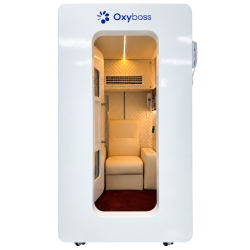
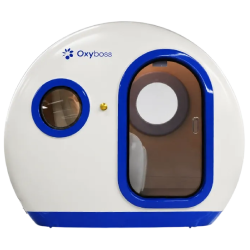
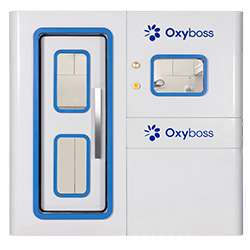
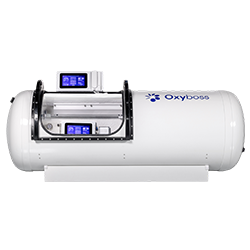
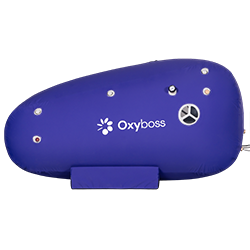
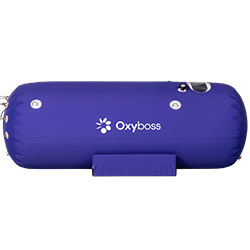
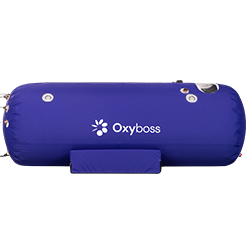
Sitting & Recliner Hyperbaric Chambers
Compare six Oxyboss sit-in and recliner-style hyperbaric chambers — soft-shell and hard-shell, 1.5–2.0 ATA, with one integrated 3-in-1 oxygen source.

What the 3-in-1 is
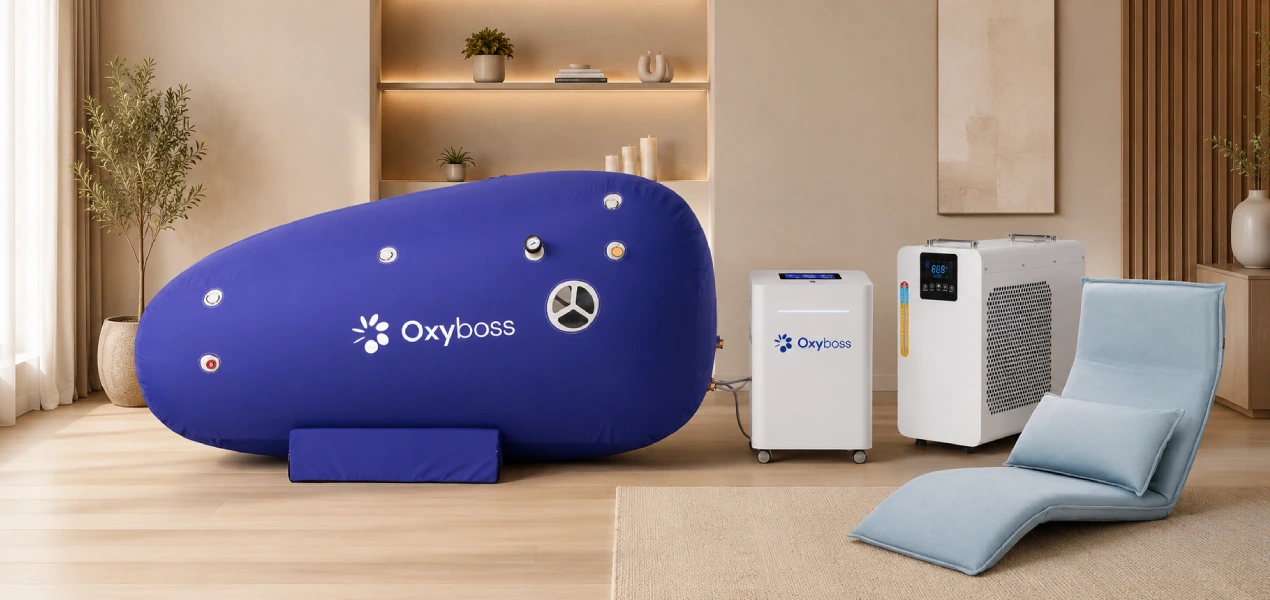
One integrated unit that combines three functions that other consumer chambers ship as separate pieces:
- Oxygen concentrator (10 L or 20 L). Pulls room air, separates oxygen via pressure-swing adsorption, delivers 90% ± 3% oxygen through a mask line. The 10 L unit outputs 10 L/min; the 20 L unit outputs 20 L/min and is standard on the H402 and D201 two-seat models so each seat gets 10 L/min.
- Oil-free air compressor. Pressurizes room air into the cabin to the operating pressure you set (1.5–2.0 ATA depending on model). Sized specifically for the cabin volume.
- Cabin-side air conditioner. Circulates cooled, dehumidified air through the cabin. Controllable from the internal touchscreen.
Pressurization time benchmarks (factory data, by cabin size): 5 minutes to 1.3 ATA, 10–12 minutes to 1.5 ATA, 20–25 minutes to 2.0 ATA.
Why it matters — the four buyer pain points it solves
All models share the same oxygen concentrator (air flow: 205 L/min, power: 2200 W, O₂ concentration: 90% ± 3%), so parts are interchangeable, maintenance procedures are uniform, and spare parts costs stay predictable.
- "I had to buy a separate compressor and it was the wrong one." Other consumer chambers ship with only a concentrator. Buyers source a compressor themselves and frequently get the wrong CFM rating, wrong connector, or wrong pressure ceiling. The 3-in-1 eliminates this — the compressor is matched to the cabin at the factory.
- "Setup took a technician three hours." Three separate units mean three power cords, three connections, and three points of failure. One 3-in-1 unit means one power connection, one startup sequence, one warranty.
- "The cabin got hot by minute 25." Without active cooling built into the source, chambers rely on passive ventilation. The 3-in-1's A/C module runs cooled air through the cabin continuously.
- "I needed an electrician to add a circuit." Three separate units can pull 30 amps combined and may need a dedicated circuit. The 3-in-1 is sized to run on a standard 10 A / 110–240 V household circuit in most home installations.
Explore the Sitting & Recliner Oxygen Hyperbaric Chambers
Features & Benefits
We designed our chambers around actual user feedback rather than theoretical specs, eliminating common hassles. Here is how each engineering choice solves a real-world ownership challenge.
.svg)
Sit-in chair with adjustable electric recline
Fixed seats get uncomfortable by minute 40. Every hard-shell sit-in chamber (H202, H401, H402) uses an electric recliner, adjustable from upright to lounging angle and controlled from the internal touchscreen. Read, watch a tablet, nap, or shift position every 15 minutes.

Internal touchscreen — no outside operator required
Chambers that need an outside operator feel "I can't use this alone." Every Oxyboss chamber has full controls inside the cabin — pressure, timer, oxygen flow, A/C, emergency stop. An external panel duplicates the controls for an attendant if one is present, but is not required for home use.

PED Category III pressure equipment compliance (EU shipments)
European buyers worry about CE marking and pressure-equipment compliance. Oxyboss hard-shell chambers carry PED Category III (Pressure Equipment Directive) conformity for EU shipments — PED certificate 10.07.12722, issued by EUROCERT S.A. (Notified Body 1128) under 2014/68/EU Annex III (Module H)..
Home wellness routine, single user

The most common pattern: a single adult at home, 60–90 minute sessions, 2–4 times a week, anchored to a regular time of day (late afternoon, post-workout, or pre-sleep). Sit-in form factor solves the "I just ate lunch" and ear-pressure problems that put people off lying-type chambers.
Couple or two-person household, shared sessions
Two adults want to sit together. The two-seat models (H402, D201) eliminate back-to-back session scheduling and turn the session into shared time rather than a queue.

Commercial operator (spa, recovery studio, fitness center)
A chamber that runs multiple sessions per day, every day, with turnover between clients. The hard-shell line is rated for the daily-cycle load. Two-seat chambers (H402, D201) double throughput per session and are the most common commercial pick in our shipment data. A 20–30 minute rest between sessions is recommended; consumables (masks, mattress covers) are replaced per client.
Mobility-limited or post-surgical home use
Buyers who find it hard to climb into a lying-type chamber — older adults, post-surgical recovery, joint or back conditions that make lying flat uncomfortable. Sit-in and recliner chambers are entered at chair height, no climbing, no lying down. The adjustable electric recliner (H202, H401, H402) lets the user shift position every 15 minutes.

The process below is the same whether you're a first-time home buyer or a commercial operator ordering multiple units.
.svg)
Send an inquiry
Email us at sales@oxyboss.com or use the contact form on this page. Tell us which model you're considering, your delivery country, and whether you're a home user or commercial operator. We respond within one business day.
Confirm the spec and configuration
We confirm operating pressure, cabin size, oxygen source size (10 L vs. 20 L), and voltage / plug type for your country. For OEM / private-label orders, confirm logo and color requirements at this stage.
Receive a formal quote
Quote includes unit price, shipping (sea or air, DDP or FOB), estimated duties for your country, and any add-on (BIBS mask upgrade, third-party inspection, on-site installation). Standard payment: 50% deposit before production, 50% balance after production confirmation and before shipment. Credit card payment accepted.
Production and quality check
Soft-shell chambers ~7 working days; hard-shell ~15–20 working days. Every chamber undergoes a 5–7 day continuous factory acceptance test before shipment. We send photos and the test video before the chamber leaves the factory.
Shipping and customs
Default is DDP (door-to-door, duties and import taxes included). We handle export documentation. For EU shipments, the PED Category III conformity file is included. For U.S. shipments, FDA establishment registration applies. Transit time depends on mode and route — see shipping options above.
Installation and first session
Chambers ship pre-assembled; on arrival, connect the cabin to the 3-in-1 main unit with the supplied plug-and-play cabling, run the touchscreen self-check, and the chamber is ready. No electrician needed for most home installations. Most home installations complete in under an hour. Commercial buyers can opt for on-site installation by a regional partner.
Contact Oxyboss for a Quote
Contact Oxyboss and tell us your country, intended use, and the type of hyperbaric chamber you are interested in.
Whether you are looking for a chamber for personal wellness, home use, or a commercial application such as a spa, wellness center, gym, or recovery facility, Oxyboss will provide suitable product recommendations, pricing details, catalogs, and professional support.
Frequently Asked Questions
A sit-in chamber holds you in an upright seated position — like a business-class airline seat. A recliner chamber lets you recline the seat back from upright to a lounging angle (the H202, H401, and H402 all have adjustable electric recliners). A lying-type chamber is a flat cabin you lie down in, similar to an MRI tube.
Sit-in and recliner chambers have a smaller footprint, are easier to enter (chair-height access), and are typically preferred by buyers with mobility limits or buyers who don't want to lie flat after eating. Lying-type chambers offer more cabin space and are typically chosen for longer sessions or by buyers who prefer to lie down.
Children can use the chambers with an adult present, no nasal congestion, and able to swallow-yawn-pop their ears. Family use is recommended to start at 1.3 ATA or below for slow adaptation. Older users should consult a clinician first, especially with cardiac, pulmonary, or ear-pressure history. Seat weight capacity is 150 kg.
The 3-in-1 source delivers 90% ± 3% oxygen at the mask (10 L/min for 10 L sources, 10 L/min per seat for the 20 L source on H402 / D201). The cabin itself is pressurized with normal air (about 21% oxygen).
You breathe the enriched oxygen through the mask; the cabin atmosphere is normal air. This is the standard configuration for consumer hyperbaric chambers and is different from pure-oxygen clinical cabins.
You can run sessions alone. Every Oxyboss chamber has a full control touchscreen inside the cabin — pressure, timer, oxygen flow, A/C, emergency stop. An external control panel is available for an attendant if one is present, but is not required for home use.
The cabin has both internal and external pure-mechanical manual pressure-relief valves, so the door can be opened from inside or outside after pressure release even if power fails.
Three situations in particular.
If you're looking for treatment of a diagnosed medical condition — Oxyboss chambers are personal wellness devices, not FDA-cleared medical devices. The U.S. FDA has cleared hyperbaric oxygen therapy for a defined set of conditions (decompression sickness, serious infections, wounds that won't heal), but that clearance applies to medical HBOT delivered in a hospital or clinic, not to consumer chambers.
If you're comparing to a "medical-grade" hyperbaric chamber — medical-grade HBOT chambers run at 3.0 ATA and above, require a prescription, and are operated by trained clinical staff. Oxyboss chambers run at 1.5–2.0 ATA, are operator-optional, and are not medical devices.
If your clinician has prescribed pure-oxygen cabin delivery — some clinical HBOT protocols fill the cabin itself with 100% oxygen. Oxyboss chambers use pressurized air with mask-delivered oxygen. For pure-O₂ cabin delivery, you need a clinical facility. In all three cases, please talk to your clinician about a medical HBOT referral.