.svg)
.svg)
Before you read
If you're an owner or operations lead setting up a chamber, a Hyperbaric Safety Director (HSD) building the first assessment, or an engineer or fire-protection consultant reviewing one — this article is for you.
Two things to know upfront.
One. Peer content on this topic is mostly about item-level checks: is this dressing allowed, is that ointment allowed, what does NFPA 99 say about lighters. That's useful, but it's about 20% of the actual job. The other 80% — the room, the pressure envelope, the air supply, the ventilation, the fire systems, the people, the documentation — gets glossed over. We fix that here.
Two. The regulatory picture has a live disagreement you should know about. NFPA 99 Chapter 14 says it covers any chamber operating at 0–100 psig. TIA Log 1735, which would have carved out a sub-5-psi exception for soft-sided chambers, was voted down 17-to-0 in 2024. So the current code applies, full stop. But several state fire marshals (Minnesota is the published example) are interpreting things differently at the AHJ level. We'll cover that in section 11.
Read this end-to-end and you'll be able to run, or review, a facility-level risk assessment that holds up in front of an inspector.
1. What "facility-level" assessment means (and what it is not)
A facility-level assessment looks at the whole room the chamber sits in, not the items that go in with the person.
Most published guides on this topic do the opposite. They start with "is this blanket allowed", "is this phone allowed", "is this e-reader allowed", and they treat that as the risk assessment. The item-level questions are real and we'll get to them, but they only make sense after you've pinned down the bigger system.
The facility layer covers seven things:
The item layer (what people bring in: phones, blankets, ointments, electronics, fabrics) sits underneath the facility layer, and it's only meaningful once the facility layer is solid. We'll come back to items in section 6.
This split is the single thing most peer content gets wrong. They mix the layers, they teach item-level judgment, and they leave the facility layer to the inspector.
2. Scope: does your chamber fall under NFPA 99 Chapter 14?
The short version: yes, almost certainly.
NFPA 99-2024 §1.1.12 (unchanged from 2021) says:
"Chapter 14 covers electrical, fire, pressure, and gas hazards associated with hyperbaric facilities that are used, or intended to be used, for medical applications and experimental procedures at gauge pressures from 0 kPa to 690 kPa (0 psi to 100 psi)."
The code doesn't care whether you're a hospital, a wellness studio, a clinic, or a residential installation. NFPA 101 §8.7.5 reinforces this: "all occupancies containing hyperbaric facilities shall comply with NFPA 99." That includes your facility.
The four thresholds that decide whether you need to read the rest of this article:
If your working pressure is in this 0–100 psi band — and almost every chamber on the market is — Chapter 14 applies to your facility, period. The same pressure range also pulls your chamber into ASME PVHO-1 if it runs at 2 psi differential or higher, which most do. Two standards, both binding.
Note on the "5 psi" number you may see floating around. TIA Log 1735 (proposed 2023, voted down 2024) tried to lower the applicability floor from 0 psi to 5 psi, in part to exempt soft-sided mild hyperbaric chambers. It failed to reach a three-quarters majority. So 5 psi is not a code threshold; it's a number that several state AHJs are informally using to make case-by-case calls. Check with your AHJ, but treat 0 psi as the rule.
3. Who owns the assessment
This part is not optional. NFPA 99-2024 §14.3.1.3.2 names three specific roles, and the code is clear that the assessment is a deliverable, not a one-person job.
Hyperbaric Safety Director (HSD). Every facility with a chamber needs an HSD. The HSD is on-site, with the authority to limit or remove anything that creates a hazard — including overriding an attending physician on an item-level decision. The HSD owns the use list, the do-not-use list, and the risk scoring. If you're operating without a designated HSD, the assessment isn't valid. Source: NFPA 99-2024 §14.3.1.3.2.
Hyperbaric Medical Director (HMD). Named by NFPA 99 alongside the HSD for facilities operating under a medical license. Even where your positioning is non-medical, name a medical advisor for material clearances and incident review — somebody with the credentials to speak authoritatively on item-level decisions, in an advisory role. Don't skip the role; redefine its scope to fit your positioning.
Governing body. NFPA 99-2024 §14.3.1.3.3 puts the safety responsibility on a committee, not an individual. The committee reviews the assessment, signs off, and reviews it again on triggers. If you're a small operator, that committee can be two people plus an outside reviewer — but it has to be a committee, with minutes.
Other participants the assessment should pull in:
- A facility engineer or HVAC contractor (ventilation verification)
- A fire-protection engineer or your AHJ (means of egress, suppression, extinguisher selection)
- Your chamber manufacturer's field service lead (pressure envelope, IFU limits, inspection intervals)
- Your gas supplier (medical air quality, supply monitoring)
Most peer guides list the HSD alone and stop. That's the second-biggest gap in this topic.
4. The seven-step process
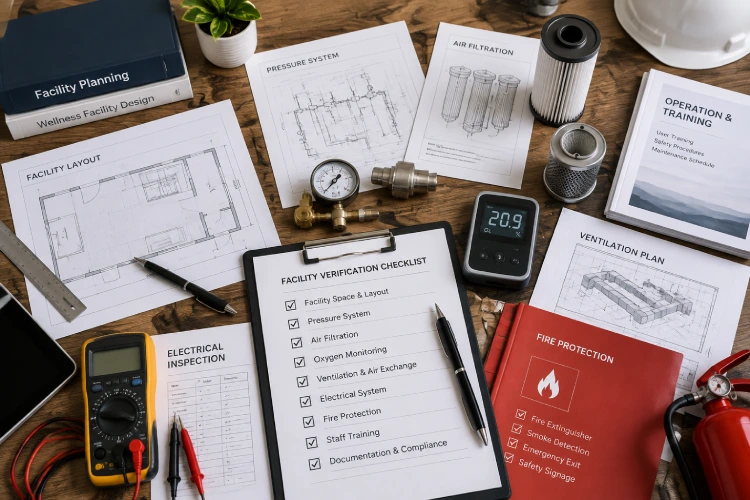
This is the section peer content skips almost entirely. Across the five guides we surveyed, only one had any kind of partial process diagram, and it was buried.
Here's the full thing. Each step names who does it, what the input is, what the output is, and what evidence you keep.
On step 4, the math. The Burman scoring system (from the UHMS Risk Assessment Guide) scores each hazard on three axes — probability (1–5), exposure (1–5), consequence (1–5) — and multiplies them. A score of 60 (3 × 4 × 5) is the typical action threshold; a score of 20 (1 × 4 × 5) is acceptable without further control. The math is straightforward; the discipline is applying it to every entry. Source: UHMS Risk Assessment Guide, 6th ed.
On step 7, do not write "annual review" as the trigger. Five sources claimed annual review; only one of them (a generic EHS site) backed it up. NFPA 99 doesn't pin a frequency. The right framing is event-driven: equipment change, occupancy change, incident, code revision, manufacturer field notice, training gap. That keeps you honest and audit-ready.
5. How to actually identify hazards
Step 3 is where most assessments fail in practice. People write down "fire" and "oxygen" and stop.
There are four engineering methods worth knowing. None of them are required by code. All of them are sharper than "brainstorm with the team."
- HAZOP (Hazard and Operability Study). Works through nodes of the system and applies guidewords (no, more, less, reverse, other than) to find deviations. Best for the air supply chain and the oxygen injection path.
- FMEA (Failure Mode and Effects Analysis). Goes part-by-part, asks how it can fail, what the effect is, how you detect it. Best for the chamber pressure envelope and the electrical service.
- Fault tree. Top-down from "loss of containment" or "fire in chamber" and works back through AND/OR gates to basic failures. Best for the worst-case scenarios you need to convince a reviewer you've thought about.
- JSA (Job Safety Analysis). Step-by-step through each operator task (start-up, compress, decompress, emergency vent), one hazard per step. Best for human-factor issues.
Don't try to use all four on every system. Pick the method that fits the system. For most facilities, HAZOP for the air/oxygen chain, FMEA for the chamber and electrical, JSA for operator tasks, and a fault tree only for the fire-in-chamber scenario — that's a workable combination.
Don't forget the non-technical hazards either. The five guides we surveyed all listed training as a topic; none of them wrote it as a hazard register entry. It is one. Fatigue at shift change, communication across language barriers, handover between operators, competency gaps after long gaps between sessions — these are the ones that show up in incident reports.
6. Item-level assessment: where it actually fits
Item-level assessment belongs here, not at the top of the page.
The flow is:
- Pull the SDS (Safety Data Sheet) for the material or a chemically similar reference material. Section 9 (physical and chemical properties) is what you need.
- Look up the NFPA 704 rating. The 0–4 health, flammability, reactivity, and special-hazard scale gives you a quick read.
- Check ignition temperature (AIT, ASTM G72) and heat of combustion (HoC, ASTM D4809) if the item is going to see elevated oxygen partial pressure.
- Estimate the fuel load in the chamber — total mass of combustible material per unit chamber volume. Above a certain mass, even a low-flammability material becomes a problem.
- Identify ignition sources in the chamber (static, electrical equipment, hot surfaces).
- Run the result through the Burman scoring from section 4.
Two operational rules to put in writing in your assessment:
- No items in without being on the use list. The use list is positive: it's what you've approved, not what you haven't banned. NFPA 99-2024 §A.14.3.1.6.4.3 makes this explicit.
- Exceptions are double-signed. If you must allow an item that's not on the use list, both the HSD and the attending physician sign a written exception. NFPA 99-2024 §14.3.1.6.4.4. Keep the exception log; it's the first thing an inspector asks for.
There's a useful operational rule of thumb that most peer content skips: the item-level decision is a snapshot. A material that passes at 1.3 ATA may not pass at 2.0 ATA, because the higher pressure increases the partial pressure of oxygen and lowers the energy needed to ignite many materials. Treat every pressure change as a re re-evaluation.
7. Engineering controls you actually have to verify
This is the section where the article does the most work for you. Most peer guides list these topics and stop at "make sure they're correct." You need to verify, not list.
Oxygen monitoring. Chapter 14 sets the OEA threshold at 23.5% O₂ by volume (NFPA 99-2024 §3.3.137). Anything above that is oxygen-enriched and the rules change. The control isn't a number on a sticker — it's a measurement with a defined sampling point, a defined interval, and a defined alarm threshold. Most published guides give you the 23.5% number. None of them give you how to verify you're actually below it. Ask your installer for the sampling point location, the instrument calibration date, and the alarm setpoint in writing.
Ventilation. Two separate ventilation problems. The chamber room needs enough air changes per hour to prevent leakage from building up to OEA levels. The chamber interior, if the oxygen is being injected inside, needs enough flow-through to keep the average O₂ below 23.5% over the session. These are different calculations. Ventilation engineering judgment goes here — get your HVAC contractor or the chamber manufacturer to put the calculation in writing, with the assumed oxygen injection rate.
Grounding and bonding. Static is one of the few ignition sources you can engineer out completely. Every conductive surface the operator or the occupant can touch should be bonded to a common ground. Verify with a bonding test, not a visual inspection.
Fire detection and suppression. The chamber room needs smoke detection tied to the building alarm. Suppression depends on occupancy; consult NFPA 13 and your AHJ. Don't assume the building sprinkler coverage is sufficient for the chamber room.
Fire extinguisher. NFPA 99-2024 §14.4.1.7 specifies a minimum 2-A:10-B:C portable extinguisher in the chamber room. That's a code minimum, not a recommendation. Verify it's there, it's inspected, and it's the right class for the room contents (note: not for use inside an occupied chamber — the rules there are different).
Pressure relief and interlocks. Each chamber has manufacturer-specified relief devices. Verify they're present, sized correctly, and not bypassed. The interlock between door closure and compression should prevent compression with the door unseated. Verify by test, not by trusting the panel.
Means of egress. Two exits from the chamber room, on different sides, with paths that don't pass through the chamber. For soft-sided chambers at low pressure, the zipper may serve as the emergency egress (per NFPA 99-2024 A.14.4.3); for hard-shell chambers, the door and the pressure release sequence matter.
8. The documentation an inspector will actually ask for
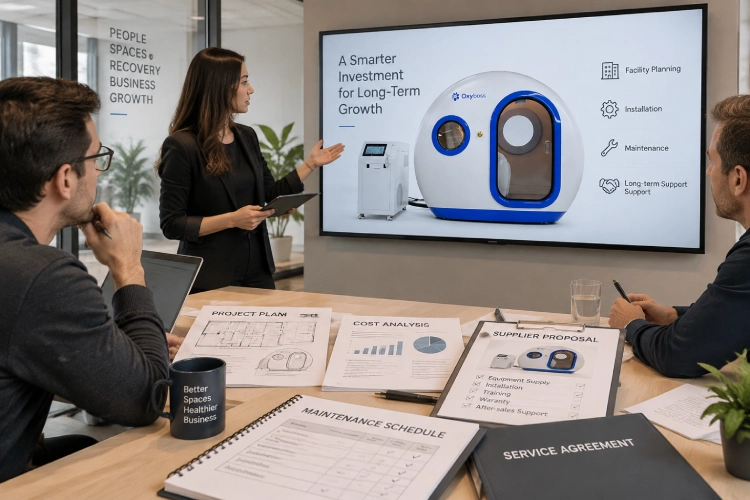
The mistake most facilities make is keeping the assessment document but not the evidence. The document is the cover; the evidence is what holds up in a survey.
Here's what an inspector reaches for first, in roughly this order:
A useful way to think about it: every line in your risk register should produce at least one document, and every document should answer one of the inspector's questions. If a line in your register has no document, the line isn't closed.
9. Emergency drills and what to rehearse
Inspectors don't ask whether you have a drill plan. They ask when you last ran it and what you learned.
The minimum set worth running annually, each with a defined success criterion:
For each drill, write down the gap you found and the action you took. The drill log without the action items is a record, not a system.
10. The three things nobody writes about: budget, vendor, service
This is the section peer content skips the hardest. Across the five guides we surveyed, none of them covered any of these three. That's the gap.
Total cost of ownership (TCO), not just purchase price. The chamber unit price is typically 30–40% of the five-year cost. The rest is installation, electrical work, ventilation work, training, ongoing maintenance, consumables (filters, sieve beds), calibration, and (if applicable) the medical gas system. A useful internal split:
TCO is also the lever that makes the next two points actionable.
Vendor evidence quality — what you can ask for. The chamber vendor should be able to produce, on request:
- ASME PVHO-1 documentation for the chamber (most chambers above 2 psi differential pressure require this; see section 2)
- ASTM G72 or equivalent ignition-temperature data for materials in the oxygen path
- IFU and the maintenance manual
- A list of consumables with replacement intervals
- Field service response time in writing
- Documented training curriculum for operators
If the vendor can't produce these in writing, that's the vendor. The risk passes to your facility.
Service and response commitments. This is where the assessment plugs into the rest of your vendor relationship. A written service-level commitment — what response time, what uptime, what loaner policy, what escalation path — is part of your operational risk register. Without it, a single compressor failure can put you out of service for a week. The risk register entry should name the commitment, the owner of the commitment, and what happens if it's missed.
If you have a separate post on how to evaluate vendor SLAs, link to it here. The two pieces — what you assess for, what you hold the vendor to — form a closed loop.
11. Soft-sided and mild-pressure chambers: the live regulatory question
This section is the most delicate in the article and worth reading carefully.
The current code position. NFPA 99-2024 §1.1.12 covers chambers from 0 psi to 100 psi. There is no lower carve-out. ASME PVHO-1-2024 §1-2.1 applies to anything above 2 psi differential. TIA Log 1735, which would have added a "Category 4" carve-out for sub-5-psi chambers, failed to reach a three-quarters majority vote in 2024. The technical merit ballot was 17 DISAGREE to 0 AGREE.
The AHJ state. State fire marshals have leeway in how they apply the code. The Minnesota State Fire Marshal division has published a formal interpretation (May 2024) that says: any chamber operating above normal atmospheric pressure falls within Chapter 14's scope, and any chamber above 2 psi differential falls under ASME PVHO-1. That's a stricter reading, not a looser one. Other AHJs are informally allowing soft-sided chamber installations with reduced documentation — there's no consistency.
The honest operational position. If you're operating a soft-sided chamber in the 1.3–1.5 ATA range:
- The code says Chapter 14 applies, and ASME PVHO-1 applies if you're above 2 psi differential pressure.
- Most soft-sided chambers are 4–5 psi differential, so PVHO-1 applies to almost all of them.
- A vendor claiming "not covered by ASME PVHO-1 because it's mild pressure" is making a claim that contradicts the published PVHO-1 §1-2.1.
- A vendor claiming "FDA cleared for home and clinic use" is making a clearance claim, not a code-compliance claim. The two are different regulatory regimes. FDA clearance speaks to device safety in normal use; the NFPA / ASME regime speaks to facility-level fire and pressure safety.
- The right step is to ask your AHJ, in writing, how they apply Chapter 14 to a soft-sided chamber in your occupancy. The answer will vary by state and by inspector.
For your risk register, that AHJ response is an entry. It belongs in the governing body minutes. It doesn't replace the assessment, but it makes the assessment defensible.
12. Putting it together
A facility-level risk assessment that holds up in front of an inspector has nine properties:
- It names the HSD, the HMD, and the governing body, with letters on file.
- It cites NFPA 99 by edition (we worked against NFPA 99-2024; some states are still on 2012).
- It runs the seven-step process end-to-end, with evidence for each step.
- It uses a structured method (HAZOP, FMEA, JSA, fault tree) for hazard identification, not just a brainstorm.
- It scores risks (probability × exposure × consequence) and assigns controls by hierarchy.
- It documents the engineering controls with verification readings, not assertions.
- It maintains the use list, do-not-use list, exception log, and training records as live documents, not as one-time submissions.
- It includes the cost, vendor, and service entries, because that's where the operational risk actually lives.
- It triggers re-review on events, not on a calendar date.
If you can tick all nine, your assessment is in better shape than most of what's published on this topic.
Source and verification notes
Primary regulatory sources (verified 2026-09):
- NFPA 99-2024 §1.1.12 — scope and applicability of Chapter 14: https://test.responderhelp.com/nfpa-99-health-care-facilities-code (mirror of the published text) and quoted verbatim by UHMS at https://uhms.org/pressure-other-articles/1542-consumer-warning.html
- NFPA 99-2024 §14.3.1.3.2 — HSD designation and authority (text via Wound Reference, https://woundreference.com/p/topic?id=understanding-the-nfpa-99-chapter-14-administration-and-maintenance)
- NFPA 99-2024 §14.3.1.3.3 — governing body responsibility (same source)
- NFPA 99-2024 §A.14.3.1.6.4.3 — use list and do-not-use list (text via UHMS, https://www.uhms.org/pressure-other-articles/1301-prohibited-item-risk-assessment.html)
- NFPA 99-2024 §14.3.1.6.4.4 — exception documentation (text via UHMS)
- NFPA 99-2024 §3.3.137 — Oxygen-Enriched Atmosphere definition (text via TIA Log 1735 documents at https://docinfofiles.nfpa.org/files/AboutTheCodes/99/99_2024_HEA_HYP_Log1735_tiaballot_final.pdf)
- NFPA 99-2024 §14.4.1.7 — portable fire extinguisher minimum (text via TIA Log 1735 documents)
- NFPA 99-2024 A.14.4.3 — soft-sided chamber emergency depressurization (text via TIA Log 1735 documents)
- NFPA 101 §8.7.5 — applicability across occupancies (text via UHMS)
- ASME PVHO-1-2024 §1-2.1 — 2 psi differential pressure threshold (text via UHMS at https://uhms.org/pressure-other-articles/1542-consumer-warning.html)
- TIA Log 1735 final ballot result — voted down 17-0: https://docinfofiles.nfpa.org/files/AboutTheCodes/99/99_2024_HEA_HYP_Log1735_tiaballot_final.pdf
- Minnesota State Fire Marshal interpretation, May 2024: https://dps.mn.gov/divisions/sfm/fire-code/fire-code-interpretations/mild-hyperbaric-oxygen-therapy
- UHMS Consumer Warning on soft-sided chambers: https://uhms.org/pressure-other-articles/1542-consumer-warning.html
- FDA guidance on HBOT device safe use: https://www.fda.gov/medical-devices/letters-health-care-providers/follow-instructions-safe-use-hyperbaric-oxygen-therapy-devices-letter-health-care-providers
- FDA classification of hyperbaric chambers (Class II, CBF): https://www.accessdata.fda.gov/scripts/cdrh/cfdocs/cfpcd/classification.cfm?id=95
- OSHA 1910.104 — oxygen service equipment: https://www.osha.gov/laws-regs/regulations/standardnumber/1910/1910.104
Peer-reviewed and industry references:
- UHMS Risk Assessment Guide, 6th ed. (Burman scoring system: probability × exposure × consequence) — referenced via UHMS education materials
- ASTM G72 (ignition temperature): https://www.astm.org/Standards/G72.htm
- ASTM D4809 (heat of combustion): https://www.astm.org/Standards/D4809.htm
- ASTM G125 (oxygen index): https://www.astm.org/Standards/G125.htm
A note on positioning
This article is published by a manufacturer of non-medical hyperbaric chambers. We don't perform risk assessments, we don't certify HSDs, and we don't replace the HSD's authority. What we do is build equipment that supports the assessment: chambers manufactured to ASME PVHO-1 where applicable, IFUs that document the operational envelope, and field service that you can write into your service-level commitments.