.svg)
.svg)
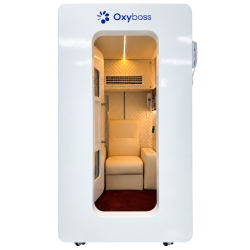
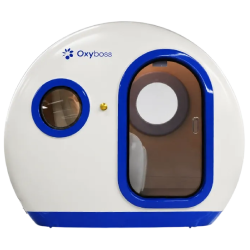
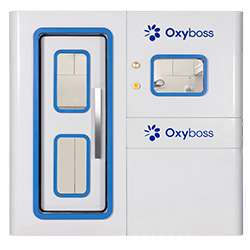
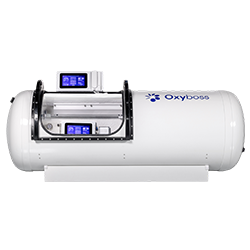
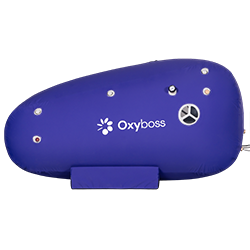
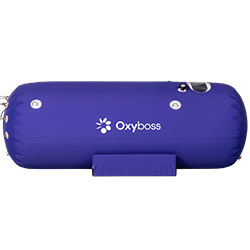
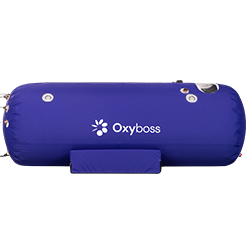
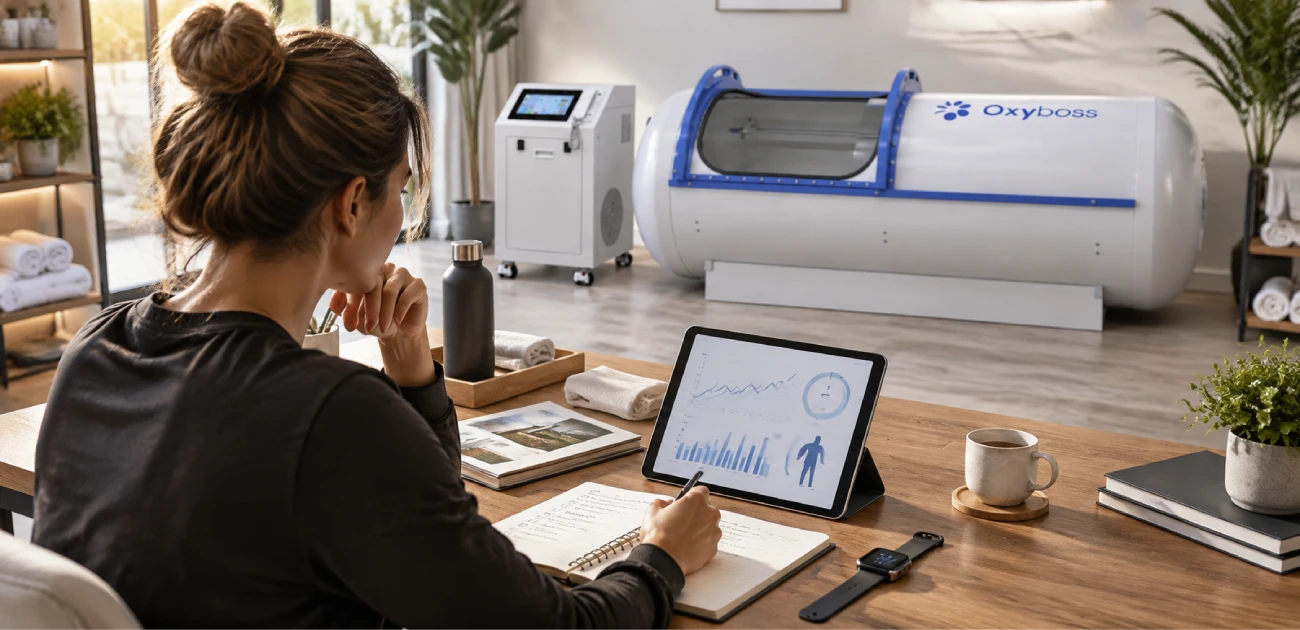
You're three weeks into using a hyperbaric chamber. You feel different — maybe sleeping better, maybe recovering faster — but when someone asks "Is it working?", you realize you don't actually know how to answer that.
Here's the thing: feeling better matters, but it's not the same as knowing whether the chamber is doing what you hoped. And when you're putting time and money into this, you deserve better than guessing.
This guide walks you through how to track results in a way that's actually useful — what to measure, when to measure it, and how to tell real progress from noise.
First: What Your Chamber Actually Is (and What It Isn't)
Before we talk about tracking, let's get one thing straight.
If you're using a home chamber at 1.5 ATA with ambient air, you're not doing the same thing as a clinical hyperbaric oxygen therapy (HBOT) session at 2.0–3.0 ATA with 100% oxygen. The physics is different, the oxygen delivery is different, and the evidence base is different.
Here's the comparison:
What this means for you: The research showing wound closure rates, neurological improvements, and specific biomarker changes? Most of that was done at ≥2.0 ATA with high-concentration oxygen. Using a 1.5 ATA chamber and quoting those studies is like reading a marathon training plan while jogging around the block — not wrong, just not the same event.
So why does this matter for tracking? Because your expectations need to match your setup. If you're at 1.5 ATA, you're not going to see the dramatic wound healing metrics from clinical studies. But you can track sleep quality, HRV trends, and subjective recovery — and those are legitimate, just different.
One more thing: If your chamber came with an oxygen concentrator as an add-on, know that concentrators are not part of the FDA clearance for soft-shell chambers (which is limited to compressed air only). We're not saying don't use it — just be aware that's operating outside the cleared scope.
The Baseline Problem (Why Most People Skip This and Regret It)
Here's the most common mistake: people start using the chamber, then try to remember what their sleep or energy was like before.
Your memory is terrible at this. You'll unconsciously adjust your "before" story to make the "after" look better — or worse, depending on your mood that day.
The fix: Spend one week before your first session tracking whatever you plan to track later. Just one week. That's your baseline. Without it, you're flying blind.
What to capture:
- Sleep: Duration, wakefulness, how you feel when you wake up (rate 1–10)
- Recovery: Resting heart rate (RHR) first thing in the morning, HRV if you track it
- Physical: Any specific issue you're targeting (e.g., joint pain, energy dip at 3 PM, post-workout soreness)
- Cognitive: Focus, brain fog, reaction time — whatever matters to you
Write it down. Use an app. Use a spreadsheet. Use a notebook. Just record it before you touch the chamber.
What to Track (Three Tiers)
Tier 1: Start Here (Free, Takes 2 Minutes)
These are the basics. If you do nothing else, do these.
Resting Heart Rate (RHR) Take it first thing in the morning, before you get out of bed. Use your phone, a wearable, or just count your pulse for 60 seconds.
Why it matters: RHR is a proxy for recovery. If it's trending down over weeks, your body is adapting well. If it spikes, you're either overtraining, stressed, or fighting something off.
What you're looking for: A gradual decrease of 2–5 bpm over 4–6 weeks, or a stable, low RHR. Sharp increases = red flag.
Session Log Write down every session:
- Date, time
- Pressure (1.5 ATA, 2.0 ATA, etc.)
- Duration
- Any oxygen supplementation (yes/no, flow rate)
- How you felt during (fine, lightheaded, ear discomfort, etc.)
Why it matters: Patterns only show up when you have data. If you feel awful after 90-minute sessions but fine after 60, you need that written down to see it.
Subjective Energy & Sleep (1–10 Scale) Every morning: rate your sleep quality and your energy level. That's it. Two numbers.
Why it matters: Yes, it's subjective. But consistent subjectivity is still useful. If your sleep scores jump from 4/10 to 7/10 over three weeks, that's signal.
Tier 2: Add This If You Have a Wearable
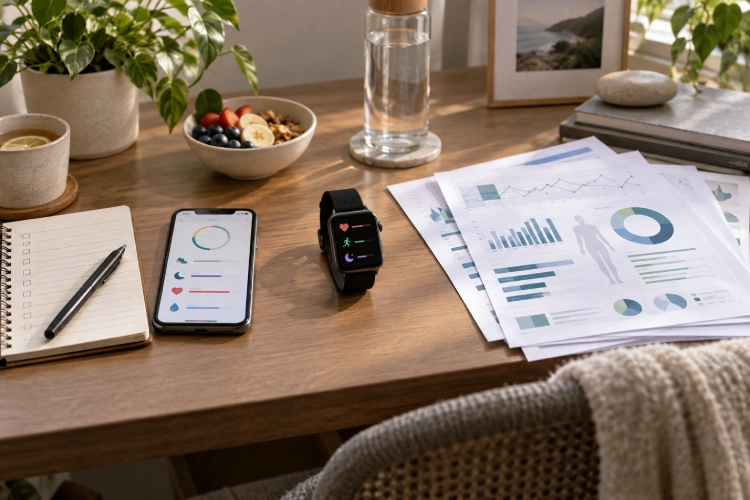
If you own an Oura Ring, WHOOP, Apple Watch, Garmin, or similar — you're already collecting data. Use it.
Heart Rate Variability (HRV) This is the gold standard for tracking autonomic recovery. Higher HRV generally = better recovery.
What you're looking for: An upward trend over weeks, or a return to baseline if you started with low HRV. Day-to-day swings are normal; focus on the 7-day rolling average.
One warning: Different devices measure HRV differently (some use RMSSD, some use SDNN, some use proprietary scores). Don't compare your number to someone else's. Compare it to your own baseline.
Sleep Stages Most wearables break sleep into light, deep, REM. Track:
- Total sleep time
- Deep sleep duration (this is the restorative phase)
- REM sleep duration
What you're looking for: Increases in deep sleep over 4–6 weeks. Some users report 15–30 more minutes of deep sleep per night after consistent chamber use.
SpO₂ (Blood Oxygen Saturation) If your device tracks it, glance at it. Normal is 95–100%. Anything below 90% consistently is a medical issue — call a doctor, not a hyperbaric chamber.
Respiratory Rate Tracks how many breaths you take per minute during sleep. Lower is generally better (means you're relaxed). A drop from 16 to 13 breaths/min over weeks = good sign.
One critical thing about wearables: They're great for trends, terrible for diagnosis. If your HRV goes up and your RHR goes down, that's useful. But don't claim the chamber "improved your cardiovascular health" based on a wearable — that's not what these devices are cleared to do.
Tier 3: If You're Serious (Costs Money or Requires a Pro)
Before-and-After Labs Get blood work done before you start and again at 8–12 weeks. Useful markers:
- Inflammatory markers: hsCRP (high-sensitivity C-reactive protein)
- Metabolic panel: Fasting glucose, lipids
- Complete blood count (CBC): Hemoglobin, hematocrit, white blood cell count
Why it matters: If you're using the chamber for inflammation or metabolic health, you need objective data. "I feel less inflamed" doesn't cut it.
What you're looking for: Reduction in hsCRP, stable or improved metabolic markers. But remember: diet, exercise, sleep, and stress all affect these too. The chamber is one variable, not the only one.
Cognitive Testing (If That's Your Goal) If you're using the chamber for focus, memory, or post-concussion recovery, use a validated test:
- Montreal Cognitive Assessment (MoCA): Free, 10 minutes, tests memory and executive function
- Reaction time apps: Simple Go/No-Go tasks, Stroop tests
Baseline it before you start. Retest every 4 weeks.
Progress Photos (For Skin or Visible Conditions) If you're targeting skin health, take photos in the same lighting, same angle, same time of day. Every week. It's the only way to see subtle changes.
How Often Should You Use the Chamber?
Most protocols suggest 5 sessions per week for the first 4–8 weeks, then taper to 3–4 per week for maintenance.
Why that schedule? Because consistency matters more than intensity. Doing one 2-hour session a week won't do much. Doing 60–90 minutes, five days a week, gives your body repeated exposure to adapt.
Session length: Start with 60 minutes and see how you feel. Some people do 90. Clinical protocols often run 90–120 minutes, but those are at higher pressure with 100% O₂. At 1.5 ATA with ambient air, 60–75 minutes is a reasonable starting point.
How long before you see results? This varies wildly depending on what you're tracking:
- Sleep/HRV changes: 2–4 weeks
- Subjective energy: 3–6 weeks
- Inflammatory markers (if measuring via labs): 8–12 weeks
- Wound healing (clinical HBOT at ≥2.0 ATA): Measurable changes in ~5 sessions, but you'd need clinical assessment
If you see nothing after 8 weeks of consistent use? It's worth re-evaluating. Either your metrics aren't sensitive enough, or the chamber isn't delivering what you hoped. That's not failure — it's data.
When to Stop (or Pause)
Here's what nobody talks about: knowing when to quit.
Pause if:
- Your RHR suddenly jumps 8+ bpm and stays there
- You feel consistently worse (fatigue, headaches, irritability) despite adjusting session length and frequency
- You develop new symptoms (ear pain that doesn't resolve, sinus pressure, chest tightness)
Stop entirely and consult a doctor if:
- You have untreated pneumothorax (collapsed lung) — hyperbaric pressure can worsen it
- You're on certain chemotherapy drugs (like doxorubicin or bleomycin) — some don't mix well with hyperbaric environments
- You develop severe claustrophobia or panic during sessions
Reassess at 12 weeks. If your tracked metrics haven't budged at all — no HRV improvement, no sleep changes, no subjective shift — ask yourself: is this worth continuing? Sometimes the honest answer is no. That's fine. You tried, you tracked, you learned.
What the Research Actually Says (and What It Doesn't)
Let's be clear about what we know versus what we hope.
Strong evidence (clinical HBOT at ≥2.0 ATA, 100% O₂):
- Wound healing: Diabetic foot ulcers show measurable improvement (30% reduction in wound area after 30 sessions, per multiple RCTs). This is why Medicare covers HBOT for certain wound types.
- Carbon monoxide poisoning, decompression sickness: HBOT is standard of care. No debate.
- Radiation injury (late effects): Helps with tissue damage from cancer radiation. FDA-cleared indication.
Emerging evidence (still being studied):
- Post-concussion symptoms: Some small studies show cognitive improvement, but results are mixed. Not yet standard of care.
- Post-COVID neurological symptoms: Early trials are promising, but sample sizes are small.
Weak or absent evidence (for mild hyperbaric at 1.3–1.5 ATA):
- General wellness, aging-related claims, athletic performance: Mostly anecdotal. Some small studies on HRV and sleep, but nothing definitive.
- Autism, Lyme disease, longevity claims: No solid evidence. Some practitioners promote benefits; the research doesn't back it up at this pressure/O₂ level, and the FDA has specifically warned consumers about these claims.
Here's the key distinction: Peer-reviewed reviews have pointed out that hyperbaric protocols below 1.5 ATA are not as well-studied as clinical HBOT at higher pressures, and it's a mistake to assume they produce the same effects. That doesn't mean mild chambers are useless — it means the evidence bar for clinical claims hasn't been cleared yet.
What does this mean for you? If you're using a mild chamber for wellness or recovery, you're the study. Your tracked data is your evidence. Just don't confuse that with clinical proof.
The Data Export Problem (and Why It Matters)
Let's say you've been tracking everything for 12 weeks. Your HRV is up, your RHR is down, your sleep scores look great. Now you want to show this to a coach, a doctor, or just keep it for your records.
Can you actually get your data out?
This is where wearables differ:
- Oura Ring: Exports CSV via desktop. Full access to raw data.
- WHOOP: Exports via the app. Good access.
- Apple Health: Exports XML. Clunky, but doable.
- Garmin, Fitbit: Both allow export, though Fitbit's is less granular.
Why this matters: If you can't export your data, you don't really own it. And if you ever want to analyze trends beyond what the app shows, you need raw numbers.
Pro tip: Set a reminder to export your data every month. Keep a backup. Wearable companies have shut down services before (RIP Jawbone, Pebble). Your data shouldn't vanish with them.
Safety: What to Check Every Session
Hyperbaric chambers are generally safe, but you still need to pay attention.
Before every session:
- Equalize your ears. If you can't clear your ears (like on a plane descent), don't pressurize. Forcing it can rupture your eardrum.
- No flammable materials. No lotions, no petroleum-based products, no wool (static risk if using supplemental oxygen). Cotton clothing only.
- Check the chamber. Look for tears, zipper damage, valve issues. If anything looks off, don't use it.
During the session:
- If you feel sharp ear pain, stop pressurizing. Equalize again. If it doesn't clear, end the session.
- If you feel lightheaded, nauseous, or your vision gets weird — depressurize slowly and get out.
After the session:
- Mild fatigue is normal, especially in the first week. You're asking your body to adapt.
- If you have a pounding headache, chest tightness, or feel significantly worse, that's not normal. Skip the next session and reassess.
One thing the FDA flagged in August 2025: Fire risk related to hyperbaric chamber use, with reports of serious injuries and fatalities. If you're using an oxygen concentrator with your chamber, make sure you're following the manufacturer's guidelines exactly. Oxygen + enclosed space + any ignition source = very bad outcome. This is not a hypothetical risk — it has happened in the US in recent years.
Who should not use a hyperbaric chamber:
- Untreated pneumothorax (collapsed lung)
- Active fever or infection
- Certain chemotherapy regimens (ask your oncologist)
- Severe COPD with CO₂ retention (ask your pulmonologist)
- Pregnant women (not enough data on safety)
When in doubt, ask a doctor who's familiar with hyperbaric use. Not your GP who's never heard of this — find someone who actually knows the contraindications.
Building Your Tracking System (5 Minutes to Set Up)
Here's a simple starter template you can adapt:
Spreadsheet (Google Sheets, Excel, whatever):
That's it. You don't need a fancy app. You need consistency.
Set a reminder: Every morning, log your RHR, sleep, and energy. Every session, log the details. Do this for 12 weeks. At the end, you'll have real data to look at.
Monthly review: Every 4 weeks, look at your averages. Is your RHR trending down? Is your HRV going up? Are your sleep scores improving? If yes, keep going. If no, change something (frequency, duration, timing of sessions).
The Placebo Question (Yes, It Matters)
Here's an uncomfortable truth: some of what you feel might be placebo.
You spent money on this chamber. You're dedicating time to it. You want it to work. So when you feel better, you attribute it to the chamber — even if it's actually because you're sleeping more consistently, or you cut back on alcohol, or you're just paying more attention to your health in general.
Does that mean the chamber isn't working? Not necessarily. But it means you need to be honest with yourself.
How to check:
- Track confounding variables. If you also started a new supplement, changed your diet, or reduced stress, write that down. You need to know what's actually driving changes.
- Look for objective metrics. Subjective feelings are useful, but they're also easy to bias. RHR, HRV, lab work — those don't care about your expectations.
- Be willing to say "I don't know." If your metrics are flat after 12 weeks, maybe the chamber isn't doing what you hoped. Or maybe your tracking isn't sensitive enough. Either way, don't force a story onto the data.
Bottom line: Placebo effect is real, and it's not nothing. If you feel better and your life improves, that's worth something. But if you're making claims about what the chamber "does," you need more than just how you feel.
Wrapping Up: What "Working" Actually Means
Here's the question you probably started with: Is my hyperbaric chamber working?
After 12 weeks of tracking, you'll be able to answer that with real information:
- Your RHR dropped from 68 to 62.
- Your HRV went from a 7-day average of 42 to 58.
- Your deep sleep increased by 20 minutes per night.
- Your subjective energy scores went from 5/10 to 7.5/10.
Or you'll see:
- Your metrics are flat.
- You feel about the same.
- You spent 60 hours in a chamber and have no measurable change.
Both are valid outcomes. The first one means you've found something that works for you. The second one means you tried, tracked honestly, and learned that this particular intervention isn't your thing.
What's not valid: Saying "I feel like it's working" with zero data to back it up, or quoting clinical HBOT studies while using a 1.3 ATA chamber with ambient air.
Track. Be honest. Let the data tell you the story.
References & Further Reading
- FDA Consumer Update on Hyperbaric Oxygen Therapy – Overview of cleared indications and safety warnings https://www.fda.gov/consumers/consumer-updates/hyperbaric-oxygen-therapy-get-facts
- Undersea and Hyperbaric Medical Society (UHMS) – Safety standards and position statements on HBOT https://www.uhms.org/resources/featured-resources/hbo-indications.html
- Systematic review: Hyperbaric oxygen for wound healing (Cochrane) – Evidence base for diabetic foot ulcers Kranke P, et al. Cochrane Database Syst Rev. 2015.
- Mild hyperbaric oxygen: Pre-conditioning and multiple exposures enhance antioxidant defenses (MDPI review) – Discusses 1.3–1.5 ATA evidence gaps https://www.mdpi.com/2076-3271/14/3/360
- FDA Safety Communication (August 2025) – Fire risk and injury reports related to home hyperbaric devices https://www.fda.gov/medical-devices/safety-communications
- Heart Rate Variability and Recovery Tracking – Overview of HRV as a recovery biomarker Bellenger CR, et al. Sports Med. 2016.
Disclaimer: This article is for informational purposes only and is not medical advice. Hyperbaric chambers are not intended to diagnose, treat, cure, or prevent any disease. Always consult a qualified healthcare provider before starting any wellness regimen, especially if you have existing medical conditions. The author and publisher are not responsible for any adverse effects or consequences resulting from the use of any information in this article.