.svg)
.svg)
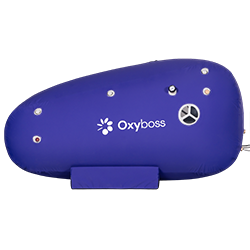
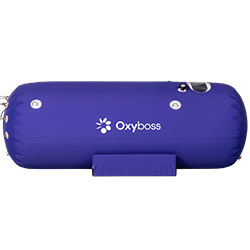
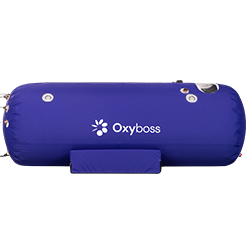
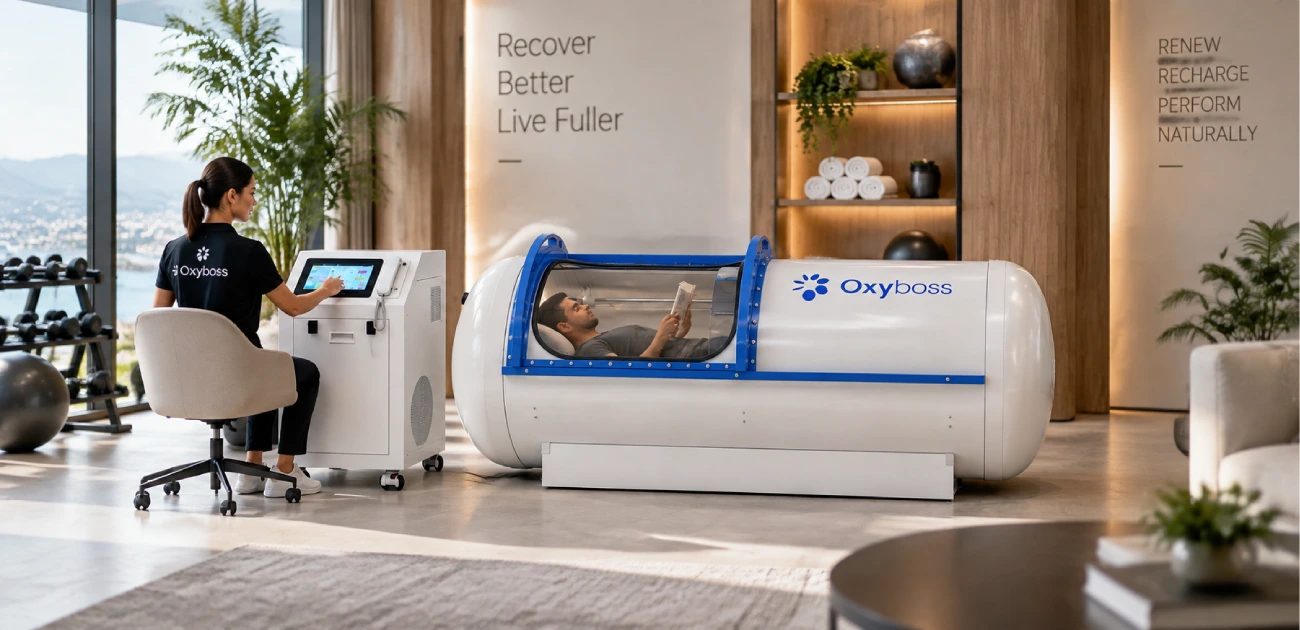
Quick answer: a hyperbaric chamber doesn't have one volume. It's loudest while the pressure is changing and while air is being flushed through. At steady pressure with the vent off, it can be quieter than a dishwasher across the room. In the biggest published in-chamber study we have — 41 hospital multiplace chambers — measured sound ran from 40.5 to 100.4 dB(A), and most sessions sat between 70 and 85 dB(A). [1]
That's a range of nearly 60 dB. Which tells you the real question isn't "how loud is a hyperbaric chamber?" It's "how loud, where, and at which moment?"
Short version
- Compression and decompression are the noisy parts. Steady pressure is the quiet part.
- Ventilation — flushing air through the chamber — is the single biggest noise maker. Same chamber, vent on versus off, can differ by about 20 dB.
- Most "quiet chamber" numbers you see online are measured at the compressor, not at the user's ear. Those two numbers are not the same thing.
- Nothing with moving air and moving pressure is silent. Anyone promising a silent chamber is guessing, not measuring.
- If you want to compare two chambers, don't compare their decibels. Compare their test conditions.
Why one number can't answer this
Which decibel?
Sound gets measured with weightings, and the weighting changes the number.
dB(A) — A-weighting. Cuts out a lot of the very low and very high frequencies, because human hearing is less sensitive there. This is the standard number for "how loud does this sound to a person." [1]
dB(C) — C-weighting. Keeps much more of the low-frequency energy. This is the one you use for short, punchy events — a valve cracking open, a vent firing. [1]
LAeq — the equivalent continuous level. It flattens a fluctuating sound into one average over a set time window. Think of it as the "on average" number. [1]
LCpeak — the instantaneous peak, C-weighted. This is the loudest single spike, lasting milliseconds. If your ears twitch at one moment, this is the number that explains it. [1]
Here's the thing: most chamber pages online print a bare "dB." No weighting, no time window, nothing. A bare dB is not a measurement — it's a marketing input. You cannot compare it to anything, including another bare dB.
For comfort during steady operation, ask for LAeq. For venting and valve events, ask for LCpeak too. A single "70 dB" with no weighting and no time basis is not enough to compare one chamber against another. [1]
Where was the meter standing?
This is the part almost every product page skips, and it's the part that decides whether the number means anything.
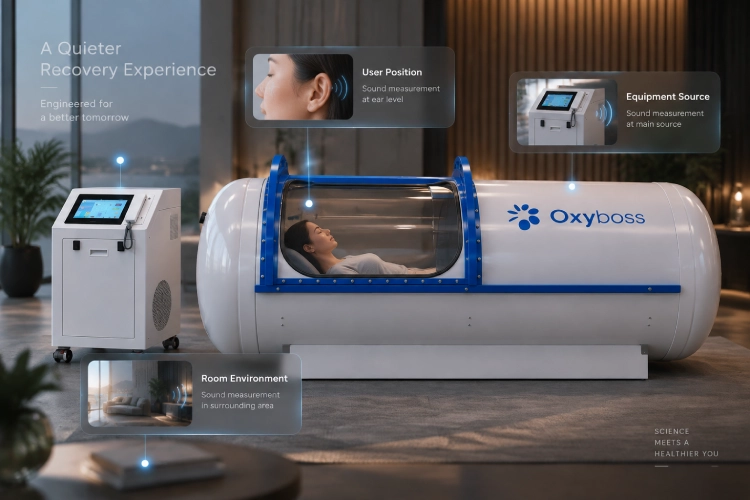
Three very different places to put a sound meter:
- At the user's ear — the number that actually describes the experience.
- One metre from the compressor — a machine spec. Useful for engineers. Tells you nothing about the ear.
- Outside the chamber, in the room — the number that decides whether your neighbours hear it.
A compressor rated at 46 dB and a compressor rated at 55 dB are not "quieter" and "louder" chambers unless you know the distance, the weighting, and whether the compressor is even in the same room. The same source, measured at 1 m and then at ear level, gives you two different numbers, and neither is wrong. [4]
The 41-centre study did this properly: the meter sat about 130 cm above the floor, roughly the ear height of a seated occupant. [1] That single sentence is why its numbers are worth quoting and most product-page numbers aren't.
Rule of thumb: if a chamber's dB figure doesn't say where, when, and with what weighting, treat it as decoration.
The four phases, and what each one actually sounds like
A session isn't one continuous noise. It's four different acoustic states. Measured across those 41 centres: [1]
The highest LCpeak recorded across those chambers was 113.6 dB(C) — a short spike, not a sustained level. [1]
Compression and decompression usually take somewhere around 10 to 15 minutes each. [2] On newer systems the pressure ramp is handled by a controller, so it's a smooth even climb. Older cabins leave it to an operator turning a dial by hand, which is where you get uneven ramps — both for your ears and for the noise. [2]
One thing that surprises people: during compression the air inside warms up, often by around 5°F, and during decompression it cools back down. [2] So the typical compression experience is warm, hissing, and slightly pressurised in the ears — not, as most people imagine, cold and clinical.
Ventilation is the loudest thing that happens
If you take one number off this page, take this one.
In the 41-centre study, every single centre got louder when the ventilation was switched on. Not some. All of them. [1]
The gap is roughly 20 dB on the same chamber. Remember the 3 dB rule: every 3 dB increase doubles the sound energy. A 20 dB difference isn't "a bit noisier" — it's a different experience entirely.
Why? Ventilation means pushing a large volume of air through the chamber to keep it fresh and to stop CO₂ building up. High-velocity flow through inlet and exhaust ports, plus valves cycling, equals broadband rushing noise. Add turbulence in the pipework and you have the loudest condition a chamber will ever produce in normal operation.
So when you read a chamber's noise spec, the first question is: was the vent on or off? A number without that label is off by up to 20 dB. That's not a rounding error. That's the whole answer.
Where the noise actually comes from
Three sources, and they behave differently: [3]
- Airflow. Inlet and exhaust ports, valves, tubing, the flush system. This is the variable one — it changes with phase and ventilation setting.
- The compressor. The constant one. This is the main mechanical noise source in any setup. [3]
- The shell and the material. Which matters more than people expect — see below.
Add alarms, intercoms, monitors, and vibration carried down through tubing, frames, floors and walls, and you have the full picture.
Compressor types, roughly
Compressors are not all the same volume. Rough published ranges, measured at the machine: [3]
Useful as a rough guide, but treat it as a rough guide. Those are machine-level figures without a stated distance or weighting, so they don't translate directly to what's at your ear.
And one hard rule: a standard shop compressor is not a substitute. They're built for tools, they're oil-lubricated, they're not filtered for breathing air, and they're loud. [3]
Home chamber versus hospital chamber
Worth separating, because the numbers people compare usually come from different worlds.
Hospital multiplace chambers — the ones in the 41-centre study — are large steel vessels holding several people. Rigid cylindrical interiors are, acoustically, close to a drum: they reflect sound instead of absorbing it, and airflow is high because there are multiple occupants and an attendant. That's how you get to 70–85 dB(A) as a normal figure, and 100.4 dB(A) at the worst moment. [1]
Home and wellness chambers are a different setup entirely. Smaller volume, lower pressure, soft shells, and frequently a single integrated compressor-and-concentrator unit. Manufacturer figures for home soft chambers commonly land in the 50–55 dB range. [5]
Two cautions on that 50–55 dB figure, and we'd rather say them than not:
- It's often measured at the compressor or in the room, not at the occupant's ear inside the chamber.
- It's often a bare dB with no weighting stated.
So "50–55 dB" may well be true — of something. It's just not automatically true of what you'd hear with your head inside.
Hard shell versus soft shell: different, not better
This is the bit most pages leave out, and it's the bit that actually helps you choose.
Neither column is "the quiet one." They're quiet in different places. If the person inside is the priority, soft shell wins on ear-level sound. If the person in the next room is the priority, hard shell wins on containment. Adding acoustic treatment inside a hard shell narrows the inside gap; it doesn't help the soft shell keep sound in.
The uncomfortable truth: no chamber is silent
Air has to move. Pressure has to change. Both of those make sound. Any system that pressurises air will produce noise while it does so, and anyone who tells you otherwise is describing a product that doesn't exist. What varies is how loud, where, and for how long — which is what the rest of this page is about. [5]
And here's a data gap worth knowing about
The honest position: the good published acoustic data is about multiplace clinical chambers. There isn't enough standardised, independent measurement of single-occupant (monoplace) chambers — including soft-sided home units — to state a universal dB range for the category. [1]
Which means a manufacturer's own test report is currently the best evidence available for a home chamber. That cuts both ways, and it means you should ask for one.
Is it loud enough to damage your hearing?
Straight answer: for ordinary sessions, the published evidence does not show that chamber noise routinely causes hearing damage. But it's not a blanket all-clear either, and the honest version has two halves.
The reassuring half. In the 41-centre study, most sessions were considered generally safe at typical durations of around two hours. [1]
The half people skip. The same study notes that where longer exposure tables are used — extended protocols running well beyond a normal session — some chambers may carry a genuine risk. [1] So "safe" is a statement about typical exposure, not an unconditional property of the room.
How that compares to the limits we actually have
Useful reference points, and note that they come from different worlds with different purposes:
Read those together and one thing jumps out: a chamber can be legally fine for a worker's hearing and still be genuinely unpleasant to sit in. The occupational numbers are set to protect hearing over an 8-hour working day. The comfort numbers are set for someone trying to rest. They're roughly 40–50 dB apart.
The gap in the real world
Across those 41 centres, 63.4% exceeded 70 dB(A) during treatment with ventilation running — i.e. most of them were above the EN 14931 recommendation at that condition. [8]
And the people spending the most time in that noise are staff, not occupants. A follow-up study of operators found no clinical noise-induced hearing loss, but did find a statistically significant threshold shift at 4 kHz in the right ear (p = 0.039) — suggestive of early change rather than a diagnosis. [8]
Pressure discomfort is not acoustic injury
Easy to mix these up, and worth separating clearly.
Pressure change can give you ear fullness, muffled hearing, or discomfort as the eardrum is pushed. In one series of 320 sessions, about 82% of people reported some ear fullness in the first few minutes, but only around 4% reported even mild pain. [2] That's a pressure effect, and it's the most common thing people notice — not a sound-level problem.
What most people do about it: swallow, yawn, or gently equalise. Doing it early and often, rather than waiting until it hurts, is the usual advice. [2]
If you have any existing ear, sinus or hearing condition, or you're at all unsure, raise it with a qualified professional before you start — a page on a manufacturer's website is not the right place to get that answered.
Can you wear earplugs in a chamber?
Short answer: generally no, and the reason is mechanical, not acoustic.
Earplugs block the pressure equalisation you need during compression. If the middle ear can't equalise while the chamber pressure rises, the pressure difference builds up behind the eardrum — which is the thing you're trying to avoid. That's why most hyperbaric facilities don't allow plugs inside. [3]
But the earplugs/earmuffs distinction gets flattened into one rule online, and it shouldn't be:
- Earplugs go inside the ear canal and sit in the pressure path. Generally not allowed.
- Earmuffs sit outside the ear. They don't interfere with equalisation the same way. Published discussion suggests hearing protection may be worth considering for longer exposures or during ventilation-heavy operations. [1]
⚠️ Even earmuffs are a decision for the operator, not the occupant. In a clinical setting they can mask alarms and speech, so whether they're allowed depends on the facility. In a home setup, if you're considering ear protection, check with the equipment provider and, if you have any ear condition, with a professional first.
What about the neighbours?
This is where the internet goes quiet, so here's the honest version.
Published work on chamber noise essentially never addresses residential settings — shared walls, apartment floors, lease clauses, the person asleep on the other side of the wall. There's a real gap here.
Some context that helps anyway. Everyday sound levels people already live with: [5][3]
A chamber running at 50–55 dB in the room is, roughly, dishwasher-with-the-door-closed territory. That's a comparison you can actually act on.
Two things make it worse than the number suggests:
Duration. A dishwasher runs for an hour. A session can run longer, and if someone uses a chamber daily, "dishwasher noise" every day stops being background.
Low frequency doesn't respect walls. This is the part people miss. Low-frequency sound and vibration travel through floors, joists and stud walls far more readily than mid- or high-frequency sound. Your neighbour may not hear a hiss at all — they may feel a thrum through the floor. That's structure-borne noise, and it's why a soft shell that's quiet inside can still be the more annoying neighbour: lightweight walls absorb less and transmit vibration instead of stopping it.
Practical things that help, in order of how much they matter:
- Put the compressor in a different room, or as far from shared walls as the hoses allow.
- Get it off the floor's vibration path — isolation pads or rubber matting under the unit.
- Don't run it against a shared wall, and leave a gap rather than pushing it flush.
- Prefer daytime use if your building carries sound.
- If you rent, check what your lease says about noise before you buy, not after.
On that last point: if you're in an apartment, ask the vendor for a measurement taken outside the unit, at a realistic distance, in a room with a normal wall. An in-chamber number tells you nothing about your neighbour. A compressor-sticker number tells you even less.

Before you buy: five things to demand
You don't need to be an acoustics engineer. You just need to refuse to accept a number that has no conditions attached. Ask any vendor — us included — for these five:
- Where was it measured? Ear position, chamber centre, or outside? If "outside," how far, and from what?
- What weighting? dB(A), dB(C), or unweighted?
- Which phase? Compression, steady pressure, ventilation on, or decompression? A number that isn't labelled by phase can be off by 20 dB.
- Ventilation on or off? Ask for both. If they only give one, ask which one.
- Was LCpeak recorded? The peak is the number that relates to short sharp events, and it's almost never published.
If a vendor can answer all five, you're talking to someone who measured something. If they can't answer any, you're reading ad copy.
And a few specs that aren't about noise but decide your experience
- Airflow (L/min). Must match the chamber volume and the number of occupants. Too low and CO₂ builds up; the fix is more ventilation, which means more noise. Airflow, pressure and chamber size are one system, not three specs.
- Duty cycle. How long the unit can run continuously, before it needs to rest between sessions. If you plan on daily use, this matters more than a headline dB figure — and it's the spec most often left out of a comparison table.
- A quiet machine is usually a long-lived machine. Less vibration means less internal wear. That's a quieter machine and a longer-lasting one at the same time. [5]
- Maintenance keeps it quiet. Dust in filters and fans is one of the most common causes of a unit getting noisier over time. Clean filters, checked tubing. [5]
How to make a chamber quieter, in priority order
People default to "buy a more expensive machine." Do the cheap things first — they're often worth more.
1. Move the noise away from the person. Put the compressor in another room, or as far away as the hoses allow. Published vendors market remote placement for exactly this reason. But verify it: remote placement reduces what you hear, and the amount has to be measured, not assumed. [3]
2. Add silencing at the source. Inlet and exhaust silencers — mufflers packed with porous material that lets gas flow through while damping the sound. Reported attenuation in chamber and diving-bell applications runs around 20 to 40 dB, depending on design and installation. That's the single largest lever available. [1]
3. Isolate vibration. Isolation mounts, rubber flooring, pads under the unit. These target structure-borne noise specifically — the part that reaches your neighbour. [3]
4. Keep it maintained. Filters, tubing, valves. Cheapest step, most often skipped. [5]
5. Beware the retrofit that strangles airflow. A silencer that cuts noise but restricts required airflow isn't a solution — it just moves the problem to ventilation. Any retrofit has to keep gas flowing while attenuating the sound. [7]
6. Re-measure after anything changes. Sound levels drift as a unit ages — bearings wear, filters load up, fittings loosen. A single measurement from the day of purchase stops being true eventually. Post-maintenance acoustic verification is the only way to know where you actually are. [5]
And treat noise as a lifecycle cost, not a one-off spec: silencers, installation and ducting changes, airflow effects, filter and muffler replacement, compressor maintenance, annual testing, and parts availability all sit in the same column. [7]
When to be extra careful
Tinnitus. If you already have ringing or buzzing in the ears, you're likely to be more sensitive to hissing, low-frequency compressor hum, and sudden venting. Reports from people with tinnitus in hyperbaric settings describe temporary spikes after sessions — temporary, but real, and highly individual. There's no way to predict from a web page who will react that way. If this is you, this is a conversation to have with a professional before you get in, not after. [1]
Anxiety and confinement. Worth separating from noise, because they get blamed on each other and they're different problems. Confinement anxiety is a recognised issue in pressurised chambers, and it isn't caused by sound — it's driven by unfamiliarity, the inability to leave, and not knowing what's coming next. Where noise plays a role, it's by making the space feel closer than it is. The most effective things are knowing what each phase will sound and feel like in advance, keeping visual contact, and having a way to signal. That's why this page describes all four phases instead of just giving you a number. [1]
Children. Quieter isn't automatically calmer for a child. Unfamiliar hissing and venting, plus not being able to say "I don't like this," matters more than absolute dB. Spacious or transparent enclosures, continuous visual contact, explaining each sound before it happens, and an adult right there are the things that help. No standard sets a child-specific dB limit for chambers, so treat any such claim with suspicion. [1]
If someone else is running the session. Ask them to slow the compression and decompression ramps. On a manual system it's a dial; on a controlled system it's a setting. Slower ramps mean less abrupt noise and an easier time equalising. [2]
FAQ
How loud is a hyperbaric chamber in decibels? It depends on the phase. Reported in-chamber levels across 41 clinical multiplace chambers ran 40.5 to 100.4 dB(A), with most sessions between 70 and 85 dB(A). [1] The quietest state is steady pressure with ventilation off; the loudest is steady pressure with ventilation on.
Is it louder than a dishwasher? A dishwasher is about 60–65 dB. A noisy chamber in a bad phase is well above that. A quiet one in its steady phase, with the vent off, can be below it. Which is why the phase matters more than the model. [3]
Will my neighbours hear it? Probably more than the in-chamber number suggests — especially low-frequency vibration through floors and shared walls. Published chamber research doesn't really cover residential settings, so the only reliable answer is a measurement taken outside the unit. [1]
Can I sleep in one? Plenty of people read, watch something, or doze during a session. [2] But sleep depends on the noise floor during steady pressure, which is best with ventilation off — and ventilation settings are usually not something the occupant sets.
Can I wear earplugs? Generally no, because plugs interfere with the pressure equalisation your ears need during compression. Earmuffs sit outside the ear and are a different case, but that's an operator decision. See the earplug section above. [3]
Does the noise get worse over time? It can. Worn bearings, loaded filters and loosened fittings all raise the level. Maintenance is the cheapest fix and re-measuring is the only way to confirm it. [5]
Bottom line
Stop shopping for the lowest number. Start asking for the conditions behind it.
A chamber's loudness isn't a property of the model. It's a property of the model, plus the phase, plus the ventilation setting, plus where you put the meter, plus which weighting you used. Give those five things and any number becomes meaningful. Leave them out and even a correct number is useless.
So the next time you see "ultra-quiet, 50 dB," you know what to ask. And if you'd rather skip the sales conversation and read the measurements, that's the whole point of publishing ours.
References
- Noise levels in hyperbaric chambers: a 41-centre study — measured in-chamber LAeq and LCpeak across compression, treatment pressure and decompression, with the meter at seated ear height. Peer-reviewed, open access. https://www.ncbi.nlm.nih.gov/pmc/articles/PMC7819730/ — indexed at https://pubmed.ncbi.nlm.nih.gov/32957126/
- Session experience overview (phase-by-phase description, temperature change, ear pressure observations across 320 sessions). https://www.hbotblog.com/what-does-a-hyperbaric-chamber-feel-like-ear-popping/
- Hyperbaric oxygen chamber compressor guide (compressor types and noise ranges, remote placement, vibration isolation, earplug practice, shop-compressor warning). https://brainspahyperbaric.com/hyperbaric-oxygen-chamber-compressor/
- Sound pressure at the ear versus sound power — why a manufacturer's dB figure requires distance, environment, weighting and operating condition to mean anything. Covered in ref. 1 (Discussion).
- How quiet are home hyperbaric chambers (manufacturer figures for home soft chambers; maintenance, sleep and equipment-life discussion). https://www.oxygenhealthsystems.com/how-quiet-are-home-hyperbaric-chambers/
- OSHA, 29 CFR 1910.95 — Occupational noise exposure. Action level 85 dB(A) 8-hour TWA; permissible exposure limit 90 dB(A) with 5 dB exchange rate. https://www.osha.gov/laws-regs/regulations/standardnumber/1910/1910.95
- NIOSH recommended exposure limit for occupational noise — 85 dB(A) 8-hour TWA with a 3 dB exchange rate; silencer design and airflow constraints. https://www.cdc.gov/niosh/topics/noise/
- Follow-up study of hyperbaric facility operators — 63.4% of centres exceeding 70 dB(A) at treatment pressure with ventilation on; right-ear 4 kHz threshold shift (p = 0.039) without clinical noise-induced hearing loss.
- EN 14931 — pressure vessels for human occupancy used for hyperbaric therapy; recommendations of 70 dB(A) at treatment pressure with maximum ventilation and 90 dB(A) during compression/decompression. Cited via ref. 1; the standard text itself is the authoritative source.
Source note: figures in this article come from peer-reviewed measurement, published standards, or manufacturer specifications — and we say which is which. Where a value originates from a manufacturer rather than an independent measurement, it's marked as such. Values attributed to standards are cited as they appear in the referenced study; the standard text is the authoritative source.
Where an external source and our own measurement disagree, we publish both.