.svg)
.svg)
Bottom line, up front
- Posture does not change your oxygen dose — at the same pressure and same oxygen setup, sitting and lying deliver the same dose per session. What changes is whether your room, your body, and your routine can actually get you into the chamber comfortably for 60–90 minutes at a time.
- The real decision is five-axis, not two-shape. Shape (seat / lie / room) is only one of five independent choices. Shell (soft / hard) and pressure (1.3 / 1.5 / 2.0 ATA) are separate decisions; conflating them is the #1 mistake buyers make.
- We make both shapes ourselves, so this page has no reason to push you one way. We'll show you what each design costs you in room, in entry effort, and in daily routine — and let your situation decide.
What this page is not. No price tags. No clinical claims. No "this cures X" language. We're a non-medical home-wellness brand; we tell you what's verified and where it comes from, and we send you to a licensed clinician for anything that touches your health.
1. The five axes, not two shapes
Most pages on this topic frame it as seated vs lying-down, like buying a chair. That's the wrong mental model. It collapses three independent decisions into one, and people end up with a chamber that doesn't fit their room, their body, or their weekly routine.
The five independent choices:
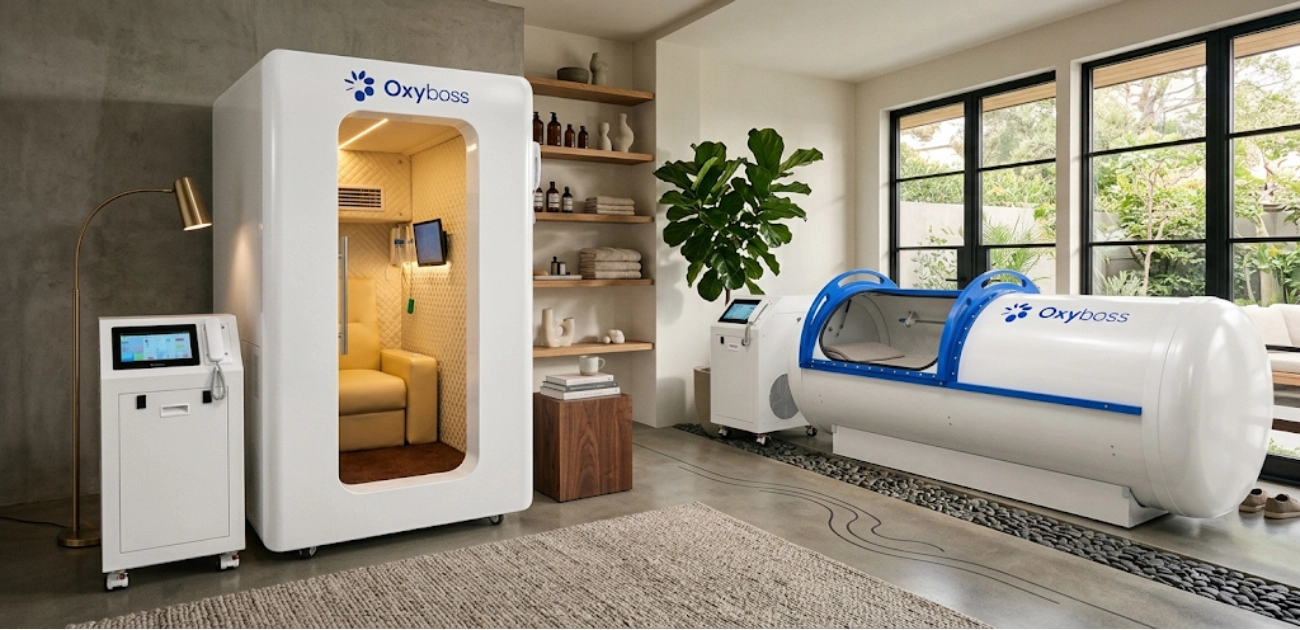
- Shape — seated / lying-down / multi-position (room-style)
- Shell — soft (TPU bladder) / hard (aluminum or carbon steel)
- Pressure — typically 1.3 / 1.5 / 2.0 ATA
- Capacity — solo / companion / multi-user
- Oxygen delivery — ambient air in chamber / mask or nasal cannula / BIBS (Built-In Breathing System)
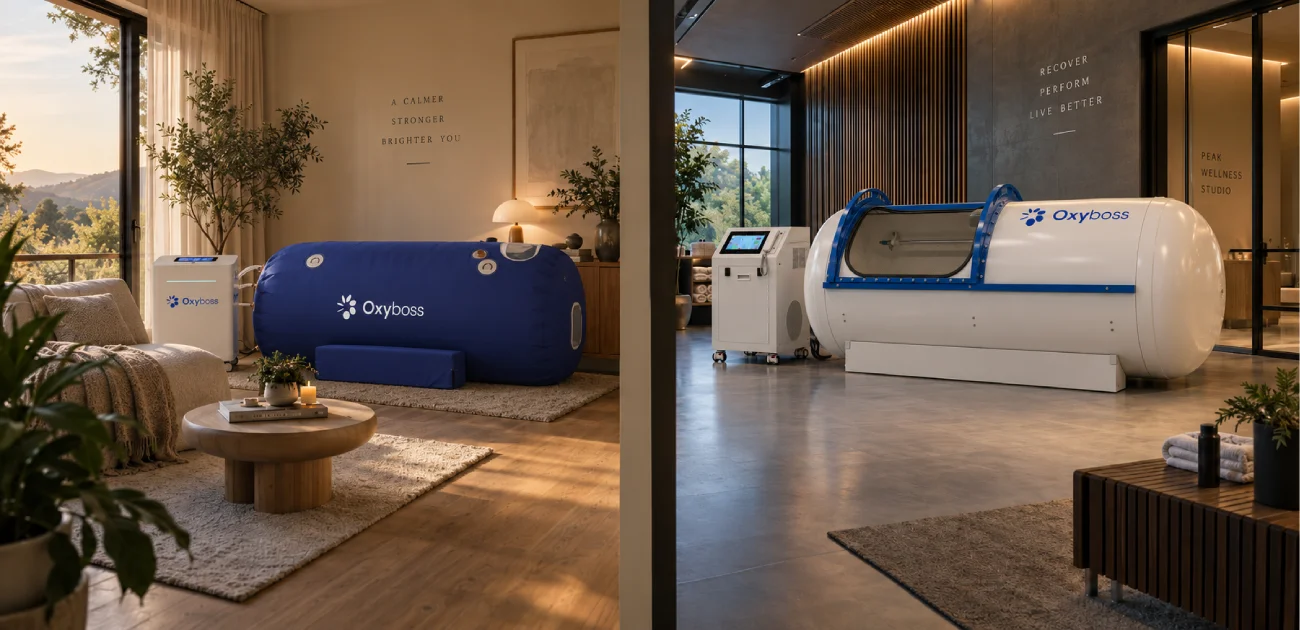
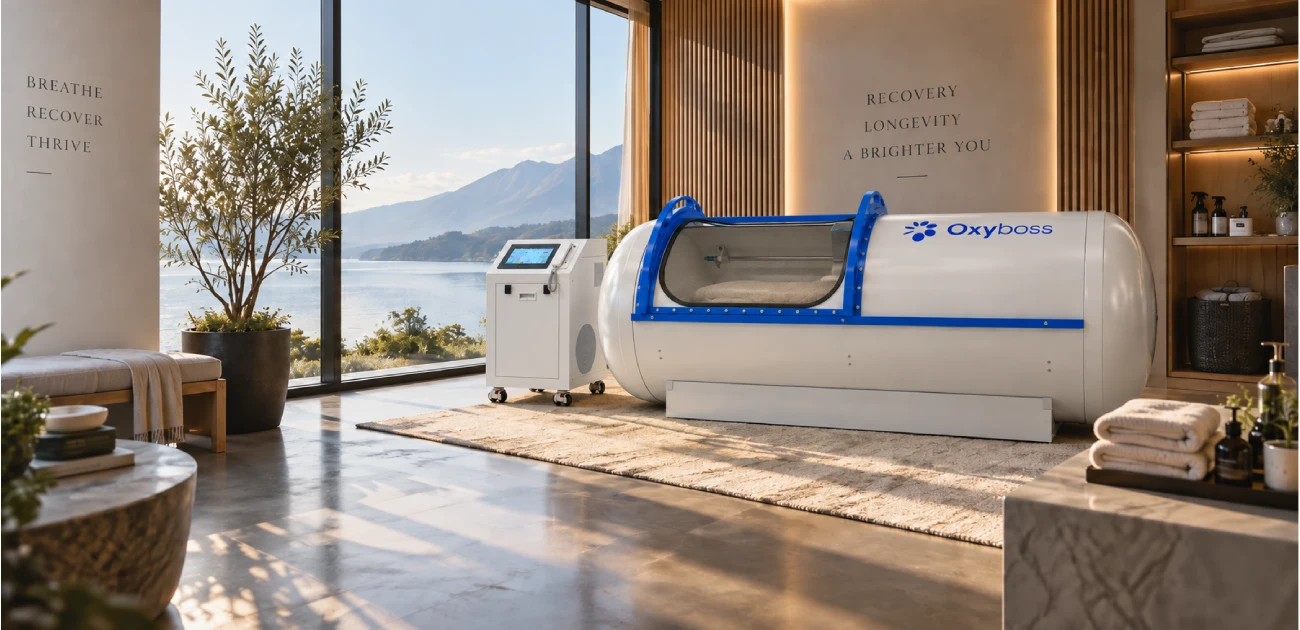
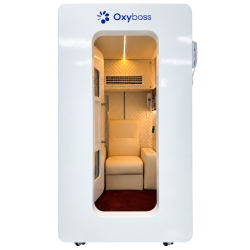
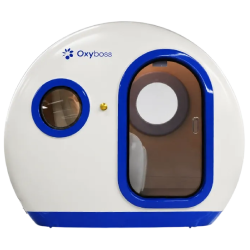
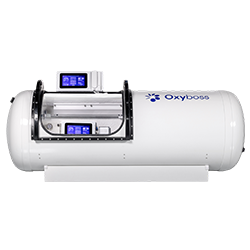
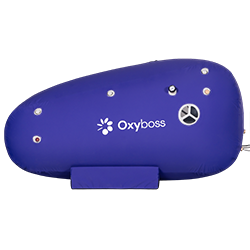
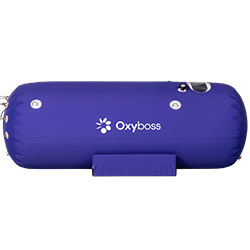
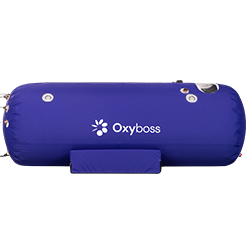
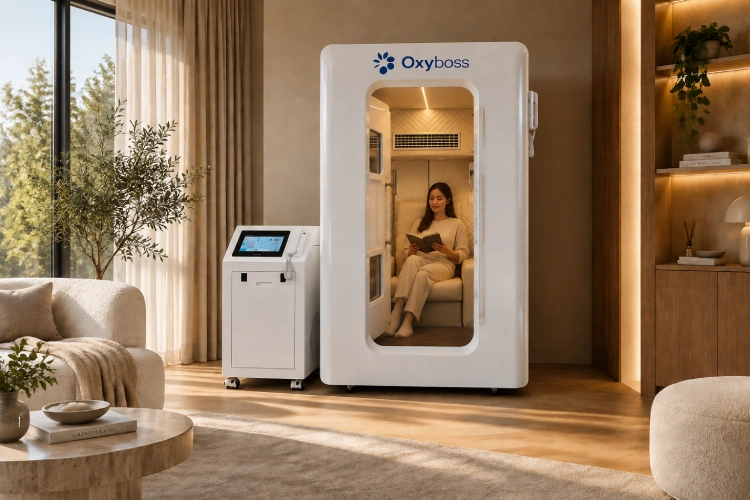
You can pick any combination you want. Our own catalog proves it: we make a 2.0 ATA hard-shell seated chamber (OB-H401) and a 1.5 ATA soft-shell lying-down chamber (OB-S159), and the two serve different buyers. Industry shorthand like "seated = soft = low-pressure" is a sales pattern, not a law of physics.
One sentence you'll see a lot on this page: "the same dose, different experience." That sentence is only true when four conditions all hold (we lay them out in §2.2). Most pages skip the conditions and leave you thinking posture is the variable — it's not.
2. Side by side: the 9-row comparison
Most comparison tables on this topic have two columns and one row (seat vs lie). Below is the version we wish existed when we started. Three columns because we actually make all three configurations. Nine rows because that's how many independent decisions you're actually making.
2.1 The table
Source for rows 1–7: synthesized from the comparison pages at Oxygen8 America, Superhuman Chambers, and Hyperbaric Pro. Rows 8–9 are not covered on any of those pages — see §6.
2.2 The one condition that never gets written down
That "same dose" sentence you'll see on five out of five competitor pages is only true when all four of these match across postures:
- Oxygen concentration at the point of breathing (ambient ~21% vs mask-fed ~90%+ vs BIBS-fed ~99%)
- Breathing interface (ambient chamber air vs mask / nasal cannula vs BIBS hood)
- Session duration at target pressure (60 min vs 90 min vs 120 min)
- Ventilation / air exchange rate (closed vs continuous flow)
Change any one of these and you're no longer comparing posture, you're comparing two different protocols. We don't quote specific clinical dose-response studies here because (a) those exist primarily for medical HBOT, not home wellness, and (b) several competitor pages cite review papers we couldn't independently verify. The Cleveland Clinic lists claustrophobia, ear/sinus barotrauma, and oxygen toxicity as known HBOT side effects, which is the right frame of reference: oxygen at pressure is a real physiological event, and the dose you actually receive depends on the four variables above, not on whether you're sitting or lying.
3. Five things that actually decide your choice
The table above is the map. Below is the territory — the five real-life constraints that determine which row in the table actually works for you.
3.1 Space: floor area vs ceiling height (most people underestimate this)
"Seated saves space" is half true and missing the trade-off.
A seated soft-shell can fit in roughly a 4 × 4 ft floor footprint. A lying-down soft-shell needs about 7–8 ft of floor run for your body length. So far so good for the seated side.
But here's what most pages skip: a seated chamber needs 6.5 to 8 ft of ceiling clearance. Measure that, including any ceiling light fixture or sprinkler head. A basement with 7 ft ceilings won't accept most seated chambers, even though the floor footprint is small. (Hyperbaric Pro is the only page out of five that actually gives ceiling numbers; we think this should be standard.)
For hard-shell chambers (1.5 or 2.0 ATA), plan on a 4 × 8 ft to 5 × 10 ft room, plus clearance for the door swing, plus space for the air compressor / oxygen concentrator unit (ours is about 930 × 450 × 920 mm / 130 kg) and its ventilation.
The measurement checklist — before you order anything:
- Doorway width and height (every door the unit passes through, including to the room it'll live in)
- Hallway turns and any stair or elevator corners
- Floor loading for hard-shell models (heavier units can approach 1,000 lb; check your floor can take it)
- Ceiling height including any light fixture or sprinkler
- Ventilation and cooling clearance around the compressor / concentrator unit
- Power outlet distance and circuit amperage (our 3-in-1 system draws 2,200 W / 10 A)
If ceiling height fails, look for lying-down or room-style, not "a smaller seated model." If floor run fails, look for seated or compact capsule, not "a tighter layout." Trying to force-fit the wrong shape is the single most common source of buyer regret we hear about.
3.2 Body: how you get in and out
"Seated is easier on bad backs" is also half true, but the mechanism matters. There are roughly five entry styles on the market:
- Seat-height door — you step or sit through a side opening at chair height (the easiest on knees and hips)
- Side zippered soft-shell — you slide in horizontally through a side-sealed zipper
- Top entry — you climb down in from above (harder on shoulders, balance, and anyone with limited mobility)
- U-shape / clamshell capsule — the shell opens on a hinge; you sit or lie in like a bassinet
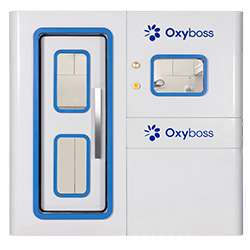
- Hard door walk-in — a real door, swing or slide, on a multiplace or hard cabin
For someone with knee, hip, or back limitations, the seat-height door and the clamshell capsule are usually the easiest. The top entry is the worst on balance and shoulder issues — if anyone in your household has either of those, treat any top-entry model as a non-starter.
Wheelchair use: we get asked about this weekly. Treat any "wheelchair-ready" claim as marketing until you see four things in writing: the door or hatch opening size, the interior turning radius, the rated floor load, and the ramp or transfer aid supplied (or specified). For reference, one industry-standard multiplace chamber lists a 32 × 52 in opening with an optional ramp — that's the order of magnitude to ask about, not a number we promise for our own units. (Source)
3.3 Mind: claustrophobia, anxiety, and the "open feel"
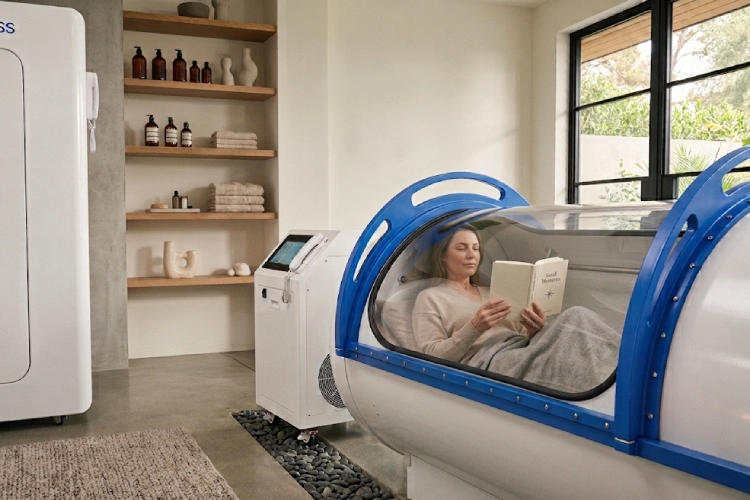
Most users report seated chambers feel less confining because you're upright and can see out (or see a screen, see below). That is real.
But "seated cures claustrophobia" is not a thing. The Cleveland Clinic lists claustrophobia as a known side effect of hyperbaric oxygen therapy — meaning it's a documented reaction to the environment, not something one posture eliminates. Many users find a clear acrylic window, an intercom, or simply the ability to look outward helps. Some don't, regardless of posture.
If you or your household member has any history of claustrophobia, panic disorder, or significant anxiety in enclosed spaces: ask the chamber supplier for a sit-or-lie trial (some showrooms allow short orientation sessions), and ask your clinician whether the chamber environment is appropriate for you.
3.4 Use: what you'll actually do inside
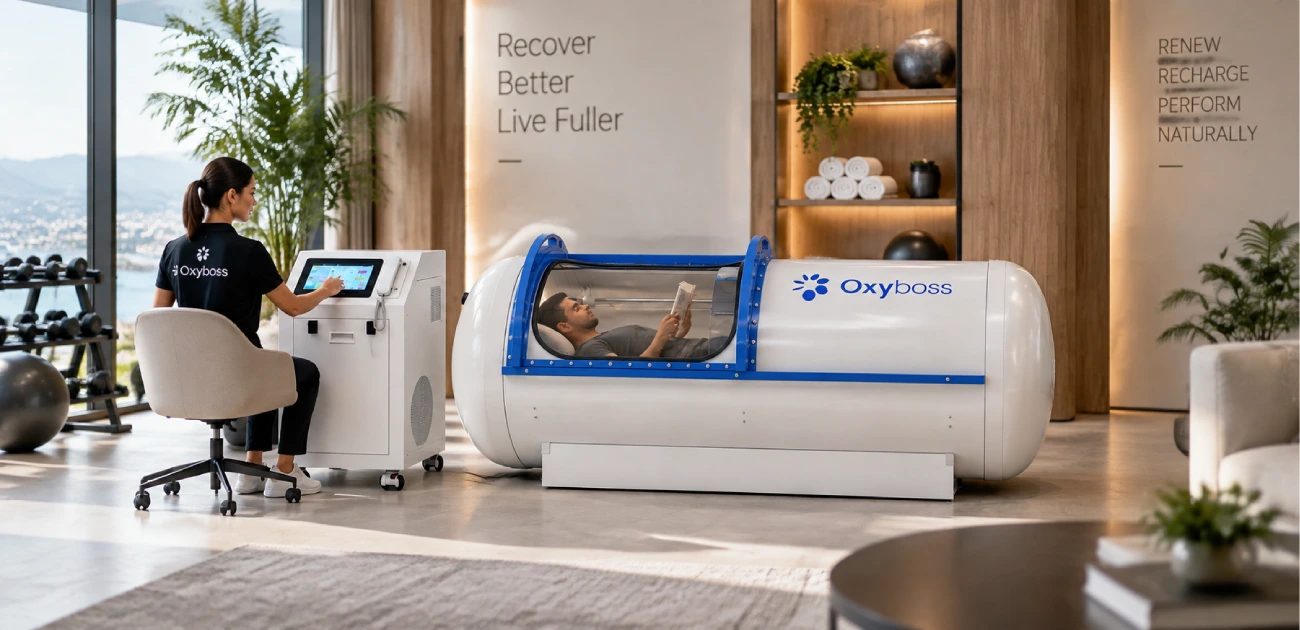
Most competitor pages highlight three "use" features: read a book, watch a screen, work on a laptop. That's accurate as far as it goes. The thing those pages don't say: what you can bring inside the chamber depends on the specific model's Instructions for Use (IFU). Some soft-shell IFUs ban electronics entirely (static and fire risk). Some hard-shell IFUs allow specific 12 V accessories through a bulkhead connector. There is no universal "yes you can use a laptop" answer.
Three things that matter regardless of posture:
- Ear and sinus pressure. Your ears will equalize first, and painfully if they don't. Learn the valsalva maneuver (pinch nose, gentle blow) before your first session. If you can't equalize, stop the session and contact the operator — barotrauma is one of the documented HBOT side effects per Cleveland Clinic.
- Solo vs companion. A two-person chamber isn't a productivity upgrade — it's an attended-session option. For children, elderly users, or anyone who shouldn't be alone during a session, a companion seat or a two-person unit is the difference between "OK" and "unsafe."
- Cleaning and maintenance. This is the unsexy part that decides whether you keep using the chamber six months in. For soft-shell: wipe the interior with a non-abrasive disinfectant, dry completely before zipping (mold is the #1 long-term soft-shell failure mode), inspect the zipper and seams monthly, replace filters on the concentrator per the IFU. For hard-shell: the same plus gasket inspection on the pressure seal and a periodic test of the emergency vent and alarms. We provide cleaning checklists with every unit; if your supplier doesn't, ask why.
3.5 Budget: how to compare quotes when nobody publishes the same number
We don't list prices on this page and we'll explain why: there is no clean apples-to-apples price on the home hyperbaric chamber market, because the price is driven by five independent variables (shell, pressure, capacity, oxygen system, warranty) — and posture is not one of them. A 2.0 ATA hard-shell multiplace chamber and a 1.5 ATA soft-shell seated chamber aren't the same product at different prices; they're different products.
When you compare quotes, ask for the total package, not the sticker:
- Chamber unit
- Oxygen concentrator (10 L vs 20 L — 20 L is required for BIBS)
- Air compressor / cooling / dehumidification
- Seat or mattress (some are included, some aren't)
- Shipping (these are heavy and bulky)
- Installation (some suppliers include, some bill separately)
- Tax and any import / duties for your region
- Training materials (we include these; not all suppliers do)
- Warranty terms (length, what's covered, who pays labor and freight on a claim)
Warranty is its own topic: soft-shell chambers in our catalog carry a 1-year warranty; hard-shell chambers carry 3 years. Ask every supplier the same eight questions — labor included, freight included, zipper covered, compressor covered, oxygen concentrator covered, electronics covered, viewing window covered, on-site service available — and you'll see real differences that the sticker price hides.
4. Who should choose which: a 60-second routing
Below is the routing we use when a buyer calls or messages us with their situation. Pick the row that matches you, then go to §7 to see which of our five model families fits.
Before you read this section — one important filter. A home hyperbaric chamber is not appropriate if you have any of the following without first talking to a licensed clinician: untreated pneumothorax, recent ear or sinus surgery, certain types of implanted electronic devices (some pacemakers, some cochlear implants), pregnancy, uncontrolled heart or lung conditions, history of seizures, or active respiratory infection. This list isn't exhaustive; it's a starting point. Your clinician decides. See §6.1 for the full version.
If two rows could fit you, §3.1 (space) and §3.4 (cleaning & maintenance) are usually the tie-breakers — not the price.
5. Safety & what the labels actually mean
This section is the one most competitor pages skip. We think it matters more than which shape you pick.
5.1 Medical screening: read this before you book a session
A hyperbaric chamber is a pressurized environment. It changes how your body handles gases. That has known side effects and known contraindications — see Cleveland Clinic's hyperbaric oxygen therapy page for the patient-facing overview.
Common contraindications include (this is not an exhaustive list — your clinician decides):
- Untreated pneumothorax (collapsed lung)
- Recent thoracic or ear surgery
- Certain implanted electronic devices
- Pregnancy
- Uncontrolled cardiovascular or pulmonary disease
- History of seizures
- Active upper respiratory infection
- Claustrophobia or panic disorder that hasn't been discussed with a clinician
If any of these apply to you, talk to a licensed clinician before using any hyperbaric chamber, home or otherwise. This page is not medical advice; we're a non-medical wellness brand.
5.2 What happens during a power outage (this varies by shell — pay attention)
This is the difference between a soft-shell and a hard-shell chamber that nobody on the competitor pages will tell you.
Soft-shell chamber during a power outage: pressure equalizes relatively quickly as the chamber is not a rigid pressure vessel. The occupant can usually open the zipper and exit in a normal way. This is not the same as "safe to be in during an outage" — the chamber may still be pressurizing or depressurizing, and the oxygen concentrator will have stopped. Follow your model's emergency procedure.
Hard-shell chamber during a power outage: the chamber remains pressurized until deliberately vented. You cannot open the door against a pressure differential. There must be a manual vent valve and a documented emergency procedure, and the operator must know it.
For both: a UPS / battery backup can keep communications and monitoring alive for a window, but it does not power the compressor indefinitely. Ask every supplier, in writing, what their specific model's emergency procedure is and how long the backup lasts.
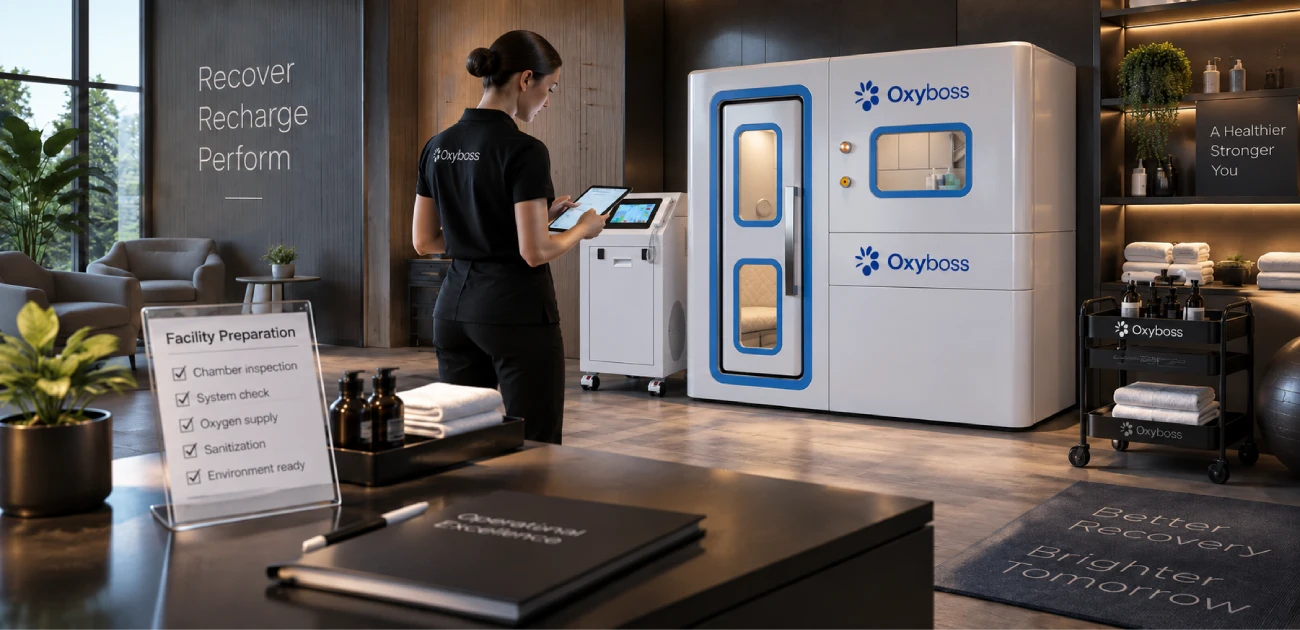
We covered this topic in detail on our staff onboarding page — the principles are the same whether you're the operator or the user.
5.3 What you can bring inside: the IFU is the answer
Whatever you've seen in marketing photos — laptops, tablets, books, phones, heated blankets — the actual rule is the Instructions for Use that came with your specific chamber. Some IFUs prohibit anything electrical. Some IFUs allow specific low-voltage accessories through a bulkhead connector. Some IFUs restrict clothing material (synthetic fibers can build static; the FDA's 2025 safety communication on hyperbaric oxygen systems flagged clothing-related ignition risk as a recurring issue).
There is no universal answer. Treat "you can bring X inside" claims as marketing until you've read the IFU.
5.4 How to read "FDA" claims on hyperbaric chamber pages
You will see three different FDA-related phrases on chamber product pages: "FDA approved," "FDA cleared," and "FDA registered." They mean three different things.
- "FDA cleared" means the device went through the FDA's 510(k) pathway, demonstrating substantial equivalence to a predicate device. Hyperbaric chambers are classified under 21 CFR 868.5470, product code CBF, Class II. (FDA product classification database)
- "FDA approved" means the device went through the PMA (Premarket Approval) pathway, used for high-risk Class III devices. This is not the pathway hyperbaric chambers use.
- "FDA registered" means the manufacturer or facility is registered with the FDA. It does not mean the device is cleared or approved. Many sites use "FDA registered" to imply clearance; it does not.
The same applies to other marks: CE is European conformity, not FDA clearance. ISO 13485 certifies a quality management system, not a specific product. None of these marks, individually or together, mean a chamber is "FDA approved."
We hold ISO 9001:2015 and ISO 13485:2016 certifications at the manufacturing level (Oxyboss), and our chambers carry the CE mark. We do not claim FDA clearance for our home-wellness chambers. If you see a home chamber page claiming "FDA approved," that's a red flag for the rest of the page's claims.
6. Before you order: 12 questions to ask in writing
Print this list. Email it to every supplier you're considering. Compare answers side by side.
- What is the exact model number, and what is the manufacturing date of the unit I'd receive?
- What is the opening size (width × height) of the entry, and the interior usable space (length × shoulder width × headroom)?
- What is the floor loading when the chamber is at operating pressure, including the compressor?
- What is the minimum ceiling height for safe operation, including any clearance for the compressor ventilation?
- What is the emergency procedure during a power outage for this specific model? (Ask for the page number in the IFU.)
- What does the IFU permit inside the chamber — electronics, fabrics, power sources, personal items? (Ask for the relevant section.)
- What is the oxygen delivery system — ambient, mask, nasal cannula, or BIBS — and what flow rate and concentration does it actually deliver at operating pressure?
- What is the warranty, broken down by component (chamber shell, compressor, oxygen concentrator, electronics, zipper, viewing window), and who pays labor and freight on a claim?
- What training materials are included, in what language, and in what format (video, document, in-person)?
- What cleaning and maintenance is required, at what interval, and what consumables does the supplier stock?
- What certifications does the manufacturer hold (ISO 9001, ISO 13485, CE, PVHO-1), and can you provide the certificate documents?
- For soft-shell: what is the expected service life of the bladder and zipper, and what is the replacement cost?
If a supplier won't answer these in writing, that's the answer.
7. FAQ
Ten questions, each one a real search query. Answers are deliberately short — the body of the page above has the full reasoning.
1. Is a seated hyperbaric chamber as effective as a lying-down one? At the same pressure and the same oxygen setup, yes — the dose delivered per unit time is the same. The variables that actually change your dose are oxygen concentration, breathing interface (ambient vs mask vs BIBS), session length, and ventilation — not posture. See §2.2.
2. Does a seated chamber save space? It saves floor area (about 4 × 4 ft vs 7–8 ft of floor run for lying-down) but trades it for ceiling height (6.5–8 ft required). See §3.1.
3. Is a seated chamber easier to get into if I have back, hip, or knee problems? Usually yes, because seat-height entry and clamshell capsules don't require climbing. Top-entry designs are the opposite — avoid those if balance or shoulder mobility is limited. See §3.2.
4. Does sitting upright help with claustrophobia? Many users find it helps because they're not enclosed the same way. It is not a cure, and the Cleveland Clinic lists claustrophobia as a known side effect of hyperbaric therapy regardless of posture. See §3.3.
5. Can I read, work on a laptop, or watch a screen inside? Only if your specific model's IFU permits it. There is no universal answer. The FDA's 2025 safety communication on hyperbaric systems flagged prohibited items and inadequate operator training as recurring fire and injury causes. See §5.3 and §5.6.
6. Can a wheelchair user use a seated chamber without transferring out of the chair? Not in most seated or capsule chambers — the interior geometry requires transfer. A walk-in cabin (like our OT-H202) is the configuration to evaluate for wheelchair transfer; verify opening size, turning radius, floor load, and ramp options in writing before purchase. See §3.2.
7. Do I need a prescription or physician supervision to use a home hyperbaric chamber in the U.S.? It depends on the device's classification and labeling. Hyperbaric chambers are Class II devices under 21 CFR 868.5470 (product code CBF), which typically requires 510(k) clearance — and the labeling on the specific model determines whether it's for prescription use or over-the-counter. Verify the 510(k) status on the FDA database for any specific model you're considering, and talk to your clinician regardless of legal requirement. See §5.4.
8. How much does a seated chamber cost compared to a lying-down one? There is no clean apples-to-apples price in this market, because price is driven by shell + pressure + capacity + oxygen system + warranty — not by posture. The same dollar amount can buy either shape depending on which of those five variables you prioritize. For a fair comparison, ask every supplier for the total package (unit, compressor, oxygen, shipping, install, tax, warranty terms). See §3.5.
9. Are seated chambers always soft-shell and low-pressure? No. That's a sales pattern, not a physical rule. We make a 2.0 ATA hard-shell seated chamber (OT-H401). See §1 and §7.4.
10. What should I check before buying a seated chamber for an elderly parent with limited mobility? Five things, in writing from the supplier: (1) entry style and whether it's seat-height or top-entry; (2) interior usable dimensions (not just the outside dimensions); (3) emergency procedure during a power outage; (4) IFU restrictions on what can go inside; (5) companion-seat or two-person option if they shouldn't be alone. Then a sixth: talk to their clinician. See §3, §5, and §6.
8. Where we got this, and what we didn't include
We cited these sources because they're either government, professional society, or standards-body primary sources, or because they're comparison pages we read while building §2 and §3:
- Cleveland Clinic — Hyperbaric Oxygen Therapy (patient-facing overview; side effects and contraindications)
- FDA — Product Classification Database (21 CFR 868.5470, product code CBF, Class II)
- FDA — Medical Device Safety Communications (2025 hyperbaric systems communication; fire, injury, and death reports; prohibited items and training)
- Oxyboss — oxyboss.com (our own catalog, certifications, support terms)
- Oxygen8 America — Conventional vs Sitting Hyperbaric Chambers (competitor comparison, used to check §2 framing)
- Superhuman Chambers — Seated & Vertical Hyperbaric Chambers (competitor comparison, used for §3.3 framing)
- Hyperbaric Pro — How to Choose the Right Hyperbaric Chamber Size (competitor comparison; one of few pages giving ceiling-height numbers, used in §3.1)
- ASME PVHO-1 (pressure vessel for human occupancy standard; cited conceptually in §5.5)
- NFPA 99 (health care facilities code; current chapter on hyperbaric facilities is Chapter 14; cited conceptually in §5.5)
Disclaimer
This page is for general information about home hyperbaric chamber selection. It is not medical advice. Oxyboss chambers are designed and marketed for general wellness and recovery use, not for the diagnosis, treatment, or cure of any medical condition. Talk to a licensed clinician about whether a hyperbaric chamber is appropriate for you, especially if any of the contraindications listed in §5.1 apply to you or anyone in your household. Specifications, certifications, and product availability change; contact us for the latest information before ordering.