.svg)
.svg)
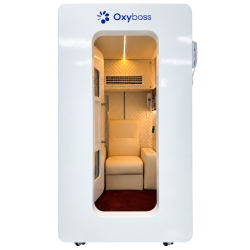
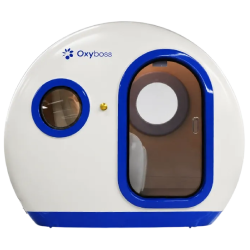
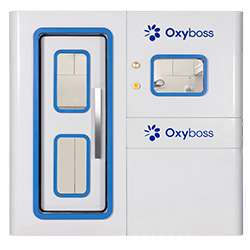
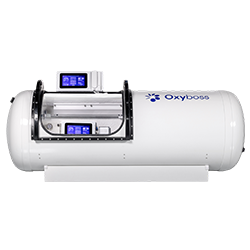
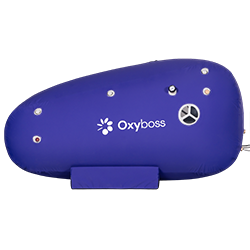
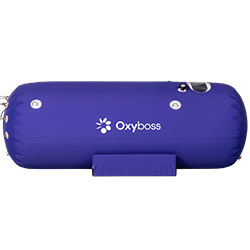
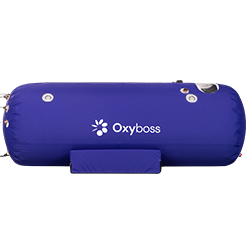
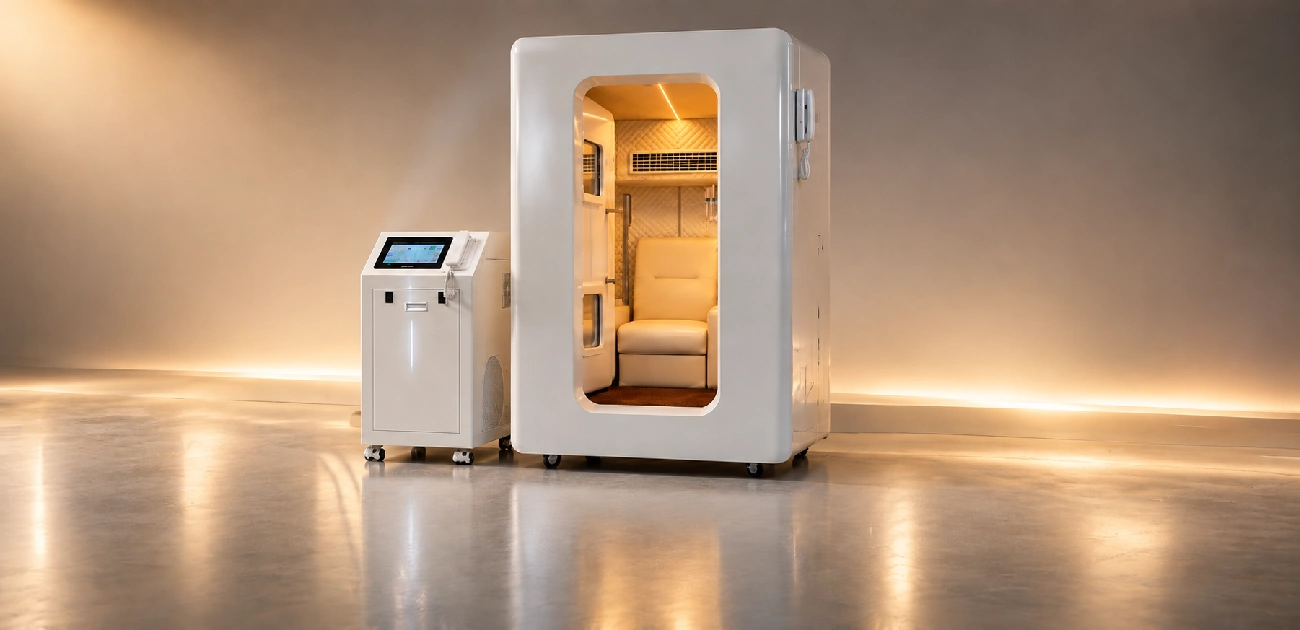
There's no single number. A home hyperbaric chamber pulls anywhere from about 200 watts to roughly 2,000 watts, depending on which pieces of equipment are running and whether you count the air conditioner in the same room. That range isn't measurement noise — it's because people are counting different things.
Before you do any math, decide what you're actually powering. Most home setups include two or more of these:
- the air compressor that pressurizes the chamber
- an oxygen concentrator (10 L medical units draw about 590 watts continuously at 120 V, per the AirSep NewLife Intensity 10 spec sheet — see AirSep / Corner Medical spec)
- a dehumidifier or air cooler
- the chamber controller and lights
- the air conditioner that some hard-shell chambers need
Add those up for the configuration you're considering and you'll land somewhere in that 200–2,000 W range. We'll come back to this with real numbers, but first the thing nobody tells you: every watt listed in marketing copy assumes a different configuration. That's why you'll see "200 watts" on one page and "1,200 watts" on another from the same vendor family — they're not wrong, they're just counting different parts of the system.
Quick answer for skimmers
For a typical home soft-shell chamber running on 110–120 V, here's what you should expect if you're pairing it with a 10 L oxygen concentrator and nothing else exotic:
If you're looking at a hard-shell chamber with integrated cooling and a built-in oxygen system, total draw runs higher — the OneBase AirForm spec sheet lists the main unit at 1,500 W (13 A) at 110–120 V plus an air conditioner at 300 W (3 A), so you're looking at about 16 amps combined. That spec is at OneBase Health — AirForm Chamber.
Sources and assumptions for the table:
- "3–8 amps" figure from Airvida Chambers — best chamber for small apartments
- Soft-shell "200–400 W" compressor range from Peak Primal Wellness — Home Hyperbaric Chamber Electrical Requirements
- AirSep NewLife Intensity 10 wattage from Corner Medical — AirSep NewLife Intensity 10
- Electricity cost calculated using the U.S. residential average of 18.34 ¢/kWh (June 2026) from EIA Table 5.3 — Average Price of Electricity. Your state's rate will be different — most states range from about 10 ¢ to 30 ¢/kWh.
Why the number changes so much between vendors
Open five vendor pages in a row and you'll see power numbers that contradict each other. Here's why:
The "200–300 watts" claim comes from one type of configuration: a small soft-shell chamber with just a compressor, and no oxygen concentrator. It's not a lie, it's just the smallest possible count.
The "1,200 watts" or "1,500 watts" claim comes from a full system count: compressor + oxygen concentrator + cooling. The 1,500 W figure from OneBase's spec sheet above is exactly this — main unit plus the AC listed separately.
The practical takeaway: any wattage figure that doesn't tell you which components are included is unreliable. Always ask the vendor: "Wattage of which configuration? Just the compressor, or compressor plus oxygen plus cooling?"
The math, made honest
Most pages skip the calculation. We'll do it in full so you can plug in your own numbers.
Step 1: Convert watts to kilowatts. Divide by 1,000. A 960 W system is 0.96 kW.
Step 2: Multiply by hours of use. A 1-hour session = 0.96 kWh. A 90-minute session = 1.44 kWh.
Step 3: Multiply by your electricity rate. At the U.S. average of 18.34 ¢/kWh:
If you live in a state with a higher rate (Hawaii, California, Connecticut all run higher than 25 ¢/kWh), multiply these by roughly 1.3–1.6. If you're on a lower-rate plan (Washington State, Idaho, parts of Texas), multiply by about 0.6–0.7. The EIA state-level electricity rates let you check your exact rate.
Source for the wattage categories: Peak Primal Wellness — Home Hyperbaric Chamber Electrical Requirements, which is the only public home-chamber guide that gives both assumptions and a working formula for the 80% rule.
The thing nobody writes: the oxygen concentrator is often the biggest load
This is one of the most useful pieces of info on this page, and it's almost nowhere else on the internet.
A 10 L oxygen concentrator — the kind serious soft-shell users pair with their chamber — pulls 580–640 watts continuously. That's larger than the compressor in most home setups. The AirSep NewLife Intensity 10 spec is 590 W at 120 V (Corner Medical listing); Drive DeVilbiss 10 L units are spec'd around 639 W.
Why this matters:
- The concentrator runs the whole session. Even when the chamber is at pressure, the oxygen unit is still making oxygen. It doesn't cycle off like the compressor.
- It runs on 120 V, 60 Hz, grounded outlet. Same circuit as the chamber in most home setups.
- It cannot share that outlet with another appliance (per most 10 L concentrator manuals — that's a manufacturer requirement, not a suggestion).
So when you see vendor pages claiming "200 watts" for the whole setup, they are either omitting the concentrator or describing the smallest possible soft-shell with no supplemental oxygen. Neither is wrong, but neither tells the whole story either.
Will it heat up your room?
Yes. All of that electricity turns into heat. The rule of thumb: 1 watt = 3.412 Btu per hour. So:
If you're running a hard-shell chamber with the air conditioner inside the chamber (some hard-shell designs do this), almost all of the 2,010 W becomes room heat. If the compressor and AC are in a separate closet, only some of that heat reaches your session room. Plan the room's cooling accordingly — this is why some hard-shell setups include a dedicated mini-split for the equipment closet.
One vendor page (Airvida Chambers — small apartments guide) does note that "the compressor and concentrator [are] typically 3–8 amps" but doesn't convert that to Btu. You almost never see the Btu conversion on vendor pages — it's one of the gaps in the public information.
The 80% rule: the actual electrical safety question
Here's the part that matters for whether your home electrical system can handle the chamber.
A standard North American home circuit is 120 V at 15 A or 20 A. That's nominally 1,800 W or 2,400 W. But you should not actually run a continuous load above 80% of that — that's the standard electrical code practice (your licensed electrician will apply the local NEC edition, but 80% is the universal convention for anything that runs more than 3 hours at a time).
Source: Peak Primal Wellness — Home Hyperbaric Chamber Electrical Requirements is the only public home-chamber guide that publishes this rule with a working formula. Public NEC tables are at WireRef — 20 amp breaker.
What this means for the typical home setup:
- A soft-shell system pulling 3–8 amps fits a 15 A or 20 A circuit comfortably.
- A hard-shell chamber at 13 A (main) + 3 A (AC) = 16 A combined will not fit on a standard 15 A circuit. You need a 20 A dedicated circuit — which most modern homes have at least one of, but not necessarily where you want to put the chamber.
- Anything pulling more than 16 A total needs a dedicated 20 A or 30 A circuit, run by a licensed electrician. Wire size scales with the breaker: 20 A → 12 AWG copper; 30 A → 10 AWG copper (NEC standard; your electrician will verify the run length and local code).
What you should never do (and why)
These are the rules that show up in manufacturer manuals but almost nowhere else.
1. Don't use an extension cord
Every 10 L oxygen concentrator manual we found says: plug into a grounded wall outlet, no extension cord. The reason isn't paranoia — it's physics. An undersized extension cord causes voltage drop, which forces the compressor motor to draw more current to maintain output, which generates heat and shortens the motor's life. In a pressurized oxygen-enriched environment, that heat is a worse idea than usual. Source: Peak Primal Wellness — Home Hyperbaric Chamber Electrical Requirements; Corner Medical — AirSep NewLife Intensity 10.
2. Don't share the outlet with another appliance
This is also a manufacturer requirement, not a suggestion. The 10 L concentrator manual explicitly says no other appliance on the same outlet. The reason: the concentrator is already drawing 5+ amps continuously; adding a refrigerator or microwave to the same circuit will trip the breaker mid-session.
3. Don't bring electronics inside the chamber
No phones, no watches, no laptops, no battery packs. Pressurized oxygen-enriched environments are not friendly to lithium batteries. FDA safety communication, August 2025 reinforces manufacturer instructions on clothing, grounding, and prohibited items.
4. Don't skip the grounding check
Older homes (pre-1960s) may still have two-prong ungrounded outlets in some rooms. Running a chamber compressor from one is not safe. A three-prong to two-prong adapter doesn't actually provide grounding — it just changes the plug shape.
5. Don't assume "no dedicated circuit needed" means "no electrician needed"
Several soft-shell vendor pages say "no dedicated circuit construction" — meaning the product is designed to work on a standard household outlet. That's about the product's design target, not about whether your outlet is in good condition, properly grounded, on a 20 A breaker, and not shared with a refrigerator. The safe move is to ask a licensed electrician to confirm the outlet you're planning to use before the chamber arrives. Peak Primal Wellness — Home Hyperbaric Chamber Electrical Requirements is one of the few public sources that lays this out clearly.
What about generators, solar, and battery power?
Short answer: for a soft-shell home setup, none of these are practical, and the data we need to size them properly isn't public.
Here's the technical reason. Compressors draw a large inrush current at startup — several times their steady-state draw for a fraction of a second. Most generators and inverters are rated for steady-state power, not inrush. A generator that's "big enough" on paper will trip the moment the compressor kicks on.
For a hard-shell or commercial setup, generator sizing is a real engineering exercise that requires the manufacturer's nameplate data for every component. It can't be done with a generic wattage number from a vendor page. If you're planning this, ask the chamber manufacturer for the locked-rotor amp (LRA) rating on the compressor and use that — not the running wattage — to size the generator.
If you want backup power for the chamber itself (so a brief outage doesn't cut your session short), the only practical solution we've seen is a UPS on the control electronics. The compressor itself generally can't run on a small UPS — it needs too much sustained current.
How to read a vendor's wattage claim (so you don't get fooled)
Here's a quick test. Open any product page claiming a wattage or electricity cost, and check whether it answers these questions:
- Which components are included? Just the compressor? Compressor + oxygen? Compressor + oxygen + cooling? "The chamber" without a list is a red flag.
- What's the test condition? A 1-hour session? An 8-hour hospital day? The number changes.
- What's the electricity rate assumption? "$1.50 per session" at 10¢/kWh is 1 kWh. At 30¢/kWh it's 0.5 kWh. If the vendor doesn't say, they're hiding something.
- Is the same exact phrasing on multiple unrelated sites? If yes, it's recycled marketing copy, not measured data.
If a vendor can't answer these four questions, treat the wattage as marketing, not measurement.
A checklist you can actually use
Before your chamber arrives, walk this list:
- [ ] Get the wattage, voltage, and amperage in writing for every component: compressor, oxygen concentrator (if separate), cooling system, any accessories.
- [ ] Identify your intended outlet. Is it 120 V or 240 V? What amp breaker? Grounded? Shared with what?
- [ ] Add up the total amps at the rated voltage. Confirm it's under 80% of the breaker rating.
- [ ] Check the run length from the panel to the outlet. Long runs need heavier wire (your electrician handles this).
- [ ] Verify GFCI protection if the room is damp (bathroom, basement, garage, outdoor-adjacent). GFCI is required by code in those locations.
- [ ] Test the outlet under load before first use: plug in the compressor, let it run up to pressure, check for warmth at the outlet, check that the breaker doesn't feel hot.
- [ ] Plan for heat. If you're putting a hard-shell chamber in a small room, plan how to remove 3,000–7,000 Btu/h of waste heat.
- [ ] Consult a licensed electrician if any of the above is unclear. This is the cheapest insurance against the most expensive mistakes.
All of the practical electrical items above are spelled out in Peak Primal Wellness — Home Hyperbaric Chamber Electrical Requirements. It's the single most useful public guide on this topic.
Frequently asked questions
Can a hyperbaric chamber run on a regular 120 V outlet?
Yes, for soft-shell home systems running a typical configuration (compressor + oxygen concentrator). The combined draw is 3–8 amps, which fits a standard 15 A or 20 A household circuit with room to spare. Hard-shell chambers with integrated cooling and 13+ A draw need a 20 A or 30 A dedicated circuit. Source: Airvida Chambers, OneBase Health.
How many amps does a hyperbaric chamber draw?
Soft-shell with compressor and 10 L concentrator: 3–8 amps at 120 V. Hard-shell main unit: 13 amps at 110–120 V, with an additional 3 amps if you run the integrated AC. Convert to 240 V and the current drops roughly in half (6.5 A + 1.5 A) — same total power, less current on the wire. Source: OneBase Health AirForm spec sheet.
How much does it cost per session in electricity?
At the U.S. average rate of 18.34 ¢/kWh, between 4 cents and 37 cents for a 1-hour session, depending on the system. That's $24–$135 per year if you use it daily. Your actual cost depends on your state's electricity rate and which configuration you're running. Source: EIA Table 5.3.
Do I need a dedicated circuit?
For most soft-shell chambers: no, a standard 15 A or 20 A outlet on a circuit that's not shared with a high-draw appliance (fridge, microwave) is enough. For hard-shell chambers pulling 16+ amps: yes, you need a dedicated 20 A or 30 A circuit. When in doubt, ask a licensed electrician. Source: Peak Primal Wellness.
What size breaker and wire do I need?
For up to 16 A continuous load: a 20 A breaker with 12 AWG copper wire. For up to 24 A: a 30 A breaker with 10 AWG copper wire. Your electrician will verify the run length and local code. Source: Peak Primal Wellness, WireRef — 20 amp breaker.
Can I use an extension cord or power strip?
No. Manufacturer manuals for 10 L oxygen concentrators explicitly prohibit extension cords, and require a grounded wall outlet not shared with other appliances. The reason is voltage drop: an undersized cord forces the motor to draw more current, generating heat and shortening the motor's life. Source: Corner Medical — AirSep NewLife Intensity 10.
Does the chamber heat up the room?
Yes — all of the input power turns into heat. A 1,500 W system adds about 5,100 Btu/h to the room, which is comparable to running a small window AC unit. Plan the room's cooling accordingly; in some hard-shell setups, the equipment closet gets its own dedicated mini-split. The 1 W = 3.412 Btu/h conversion isn't widely published in chamber content, but it's standard engineering math.
Can I run it on a generator or solar?
Soft-shell home setups generally can't. Compressors draw a large inrush current at startup that most generators and inverters aren't rated for. For a real backup power design, ask the manufacturer for the locked-rotor amp rating on the compressor and size the generator from that — not from the running wattage.
How do I check if a vendor's wattage claim is reliable?
Four questions: which components are included? What's the test condition? What's the electricity rate assumption? Is the same exact wording on unrelated sites? If the vendor can't answer, treat the number as marketing.
Methodology and sources
This page was built from publicly available sources, cross-checked for consistency. The principal sources cited above are:
- Wattage ranges for home configurations: Peak Primal Wellness — Home Hyperbaric Chamber Electrical Requirements, Airvida Chambers, OneBase Health — AirForm Chamber.
- Oxygen concentrator specifications (AirSep NewLife Intensity 10, 590 W at 120 V): Corner Medical product page.
- U.S. residential electricity price (18.34 ¢/kWh, June 2026): EIA Table 5.3.
- State-level electricity rates: EIA state electricity profiles.
- NEC wire and breaker tables: WireRef — 20 amp breaker.
- FDA safety guidance: FDA / UHMS safety communication, August 2025.
- General electrical guidance for home chambers: Peak Primal Wellness (the most thorough public guide); Oxygen Health Systems setup guide (for context on vendor-side framing).