.svg)
.svg)
The short answer
Safe when a trained monitor is in the room. Unsafe when nobody else is.
The variable that decides this is not the ATA, not the soft or hard shell, not the price tier. It's who else is in the room when you pressurize.
If you remember one thing from this page, let it be this: every serious home-chamber incident on the public record — the death by asphyxia in North Carolina, the soft-shell rupture in India in 2024 — happened while the chamber was unattended. No pressure setting, no chamber brand, no protocol change turns that fact off.
— Source: UHMS Consumer Warning: The Dangers of Soft-Sided Bag Chambers
What actually goes wrong when you're alone
Three failure families. All three need a person outside the chamber to respond, and none of them gives you time to troubleshoot.
Fire
The FDA issued a formal safety communication on August 25, 2025 about fires in HBOT devices:
"There have been recent reports of fires that occurred with HBOT devices that resulted in serious injuries and deaths."
— FDA — Follow Instructions for Safe Use of HBOT Devices (Aug 25, 2025)
Fire in an oxygen-enriched chamber behaves differently than fire in open air. A static-electricity spark that wouldn't light a sheet of paper at room atmosphere can flash-burn a person inside an enriched chamber in under a second. UHMS's chamber-fire analysis covers 77 fatalities across 35 incidents between 1923 and 1996 (UHMS Safety Articles). The pattern is consistent: ignition source, oxygen-enriched atmosphere, and an occupant who cannot exit on their own.
The fire triangle is always half-satisfied inside the chamber — fuel (clothing, paper, bedding) and oxygen are present by design. The only variable the user controls is the third side: ignition. And ignition is not something you, alone and on your back, can react to.
Chamber rupture
Soft-shell chambers can fail at the seam or zipper under pressure. The failure is sudden:
"A blowout can expel the occupant with significant force, cause the chamber walls to collapse inward suddenly…"
— peakprimalwellness.com — zipper safety
The September 2024 incident in India — recorded in the UHMS consumer warning — was exactly this pattern: a soft-sided bag chamber ruptured, the occupant was inside, the chamber was not attended. (UHMS Consumer Warning)
Pressure and oxygen-related physiological events
Less catastrophic, but they happen and they happen fast enough to need a second person:
- Middle-ear barotrauma. The single most common complaint. Roughly 50% of all chamber adverse events in the monoplace literature (StatPearls / NCBI). Most cases resolve, but a ruptured eardrum disables the occupant's ability to equalize for the rest of the session — which is when the monitor's job matters.
- Oxygen-toxicity seizures. Estimated at roughly 1 per 2,000–3,000 treatments, risk rising above 2.0 ATA and with longer courses (Atlanta Hyperbaric Center). A seizure in a pressurized chamber, alone, is not something you can self-manage.
- Anxiety and claustrophobic reactions. Common enough that clinic protocols routinely plan for them (Mayo Clinic). Inside a sealed, pressurized space, these reactions can escalate to panic.
The clinical baseline for all of these is the same: a second person in the room who can decompress, communicate, and escalate.
.webp)
If you need out, it takes minutes — here's why
Most home-chamber marketing suggests that opening the door is just a handle turn away. It's not. The chamber is pressurized, and pressure has to come off before the seal will release.
"Due to the enclosed and pressurized nature of the chamber, it is impossible to quickly open the door when the chamber is pressurized, so rapid evacuation is not always possible."
— University of Iowa Health Care — Fire safety in HBOT
At a typical home setting of 1.3 ATA, a full depressurization runs about two to three minutes (peakprimalwellness.com). That sounds slow when you're anxious. It's also the safe way to come down. A rapid pressure drop is a different kind of injury (decompression sickness, lung over-expansion) and isn't a route out.
The point isn't that the chamber is unsafe. The point is that the chamber's safety design assumes a person outside is running the clock. Remove that person and the "two to three minutes" stops being a measured procedure and starts being an uncontrolled wait.
The first 60 seconds: a monitor's script
This section is written for the person outside the chamber. If you're the one buying the chamber, print this for whoever is going to be in the room with you.
A pre-printed copy on the wall next to the chamber is a good idea. Reading it for the first time during an actual incident is too late.
Before the session
- Read the chamber's pressure gauge and confirm it's at zero before the occupant goes in.
- Confirm the relief valve is closed and you know where it is without looking for it.
- Confirm a phone is in the room, charged, and that you know how to use it one-handed.
- Confirm nothing flammable is on or near the chamber: no phones inside, no lighters, no hand sanitizer, no loose paper, no synthetic-fiber blankets.
- Ask the occupant how they feel. If they have a cold, sinus pressure, ear pain, or a recent upper-respiratory infection, reschedule. Equalization is the most common source of middle-ear injury.
During pressurization (the first 5–10 minutes)
- Watch the occupant's face every 30 seconds. Look for wincing, hands on ears, throat-clearing, unusual silence.
- Listen. The occupant should be talking to you, swallowing, yawning. If they go quiet, ask them how their ears feel.
- Do not leave the room. Not for a minute. Not for a phone call. Not for the bathroom.
At steady pressure
- Stay in the room. Stay where you can see the occupant and the pressure gauge at the same time.
- Don't drink alcohol. Don't take anything that affects your own alertness.
- If the occupant says anything is wrong, take them at their word. Begin controlled depressurization. Don't wait for confirmation.
If something goes wrong
This is the script. Don't improvise it. Run it in this order:
- Call the occupant's name. Loudly. No response in 5 seconds — move to step 2.
- Begin controlled depressurization. Turn the relief valve per the manufacturer's procedure. Not faster than that.
- Place the call to 911 while the chamber is depressurizing. Use the phrase "hyperbaric chamber with enriched oxygen" — not "oxygen tank" or "sauna." Dispatchers route on those words and so do fire crews.
- When the gauge reads zero and the door releases, open the chamber and clear the occupant's airway.
- Do not try to open the chamber under pressure. Don't cut the bladder. Don't force the zipper. Don't pry the door. The chamber is built to hold the pressure it's holding; you are not stronger than it, and you will hurt the occupant.
Tell your local fire department, in advance, that you have a hyperbaric chamber at home. Not in an emergency — in a non-emergency visit, by phone, or via your fire department's community-risk-reduction program. Tell them the address, the chamber type, and where the relief valve is. The first responders who show up should not be learning any of this at your front door.
What your chamber needs so a monitor can actually help
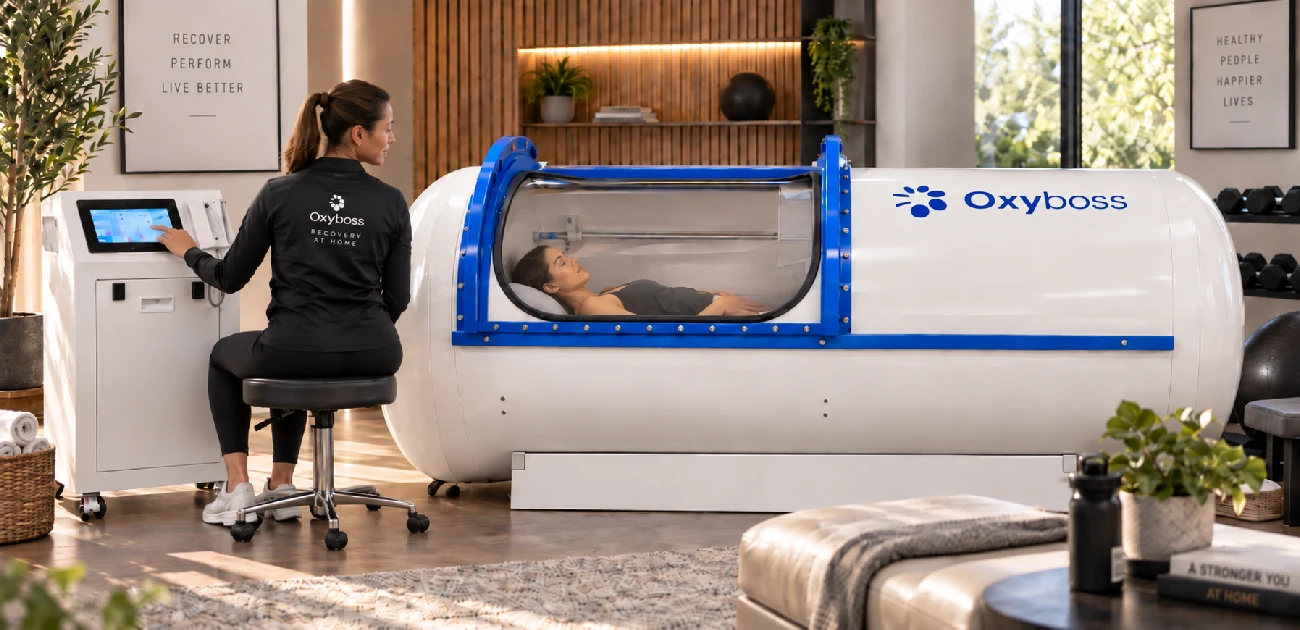
The monitoring requirement is half people, half equipment. A monitor in the room with a chamber they can't operate is a witness, not a responder.
Here's the equipment-side checklist. This list is brand-neutral — apply it to anything you're considering buying, including ours.
- External, readable pressure gauge. The monitor should be able to read the chamber pressure from where they sit, without putting their face to a port.
- External depressurization control. Able to bring the chamber down without opening it or reaching into it.
- Relief valve positioned for a standing adult to operate. Not behind the chamber, not under the frame, not at floor level.
- Observation window or viewport covering head and chest. The monitor needs to see the occupant's face and hands, not just a foot.
- Two-way communication. Either an intercom, or a chamber wall thin enough that conversation at speaking voice carries. A sealed, mute chamber is a witness chamber, not a monitored chamber.
- Door that opens from outside at zero pressure, and from inside at zero pressure. Both directions. If the occupant loses consciousness at zero pressure and the door can only be opened from outside, that is a design defect — full stop.
- A low-pressure or oxygen-supply alarm the monitor can hear. A silent failure is a state nobody can respond to.
The right way to think about this list: it converts the chamber from a thing you sit inside to a thing someone outside can run. That's the configuration the safety record is built around.
Side effects and who shouldn't use one at all
We're not going to walk you through every contraindication — your physician should. What follows is the screen, in plain words, that you should run on yourself and your family members before scheduling a session.
Common and mostly mild
- Ear discomfort during pressure change. The most common complaint — about half of all adverse events in the monoplace literature (StatPearls / NCBI).
- Sinus pressure and temporary runny nose.
- Temporary nearsightedness that usually clears in the weeks after the last session (Mayo Clinic).
- Claustrophobic reaction. Plan for it. Don't push through it.
Less common, more serious
- Ruptured eardrum or middle-ear fluid.
- Lung-function changes.
- Low blood sugar in insulin-treated diabetes.
- Pulmonary barotrauma / lung collapse.
- Seizure from CNS oxygen toxicity (see section 2.3 for rates).
Overall adverse-event incidence in monoplace chambers is about 0.4% — that number is from a peer-reviewed summary, not a manufacturer (StatPearls / NCBI). Low doesn't mean zero. It means the second person in the room is the difference between an event and an emergency.
Who should not use one at all
A non-exhaustive list, in plain language. If any of these apply, talk to your physician before scheduling a session — and reconsider solo operation entirely, regardless of chamber type.
- Untreated pneumothorax (collapsed lung). This is the absolute contraindication. A pressure change can be life-threatening.
- Air-trapping lung disease. Advanced COPD, emphysema, cystic fibrosis, pulmonary blebs. Trapped gas expands on decompression.
- Uncontrolled seizure disorder. Higher-pressure oxygen outside a monitored clinical setting is not appropriate.
- Active cold, sinus or ear infection. Equalization becomes much harder; barotrauma risk rises. Reschedule.
- Recent ear surgery or ear injury.
- Pregnancy.
- Children and elderly users should always be supervised — guidance is explicit on this (Des Moines Hyperbarics, Johns Hopkins Medicine).
Home vs. clinic — what changes and what doesn't
You can frame the difference as six rows:
If an incident does happen
Two things, briefly:
- Report it to the manufacturer's regulatory contact and to your physician. Keep the chamber in the state it was in. Don't dismantle it.
- Report it to the industry. The UHMS maintains a global hyperbaric incident reporting system (UHMS GHIRS — incident reporting portal). Most consumers don't know this exists. We think more of them should.
Sources
Every claim on this page that needed a source got one. We restricted ourselves to regulator and medical sources; manufacturer and clinic marketing pages are not cited as authority.
Regulators
- UHMS — Consumer Warning: The Dangers of Soft-Sided Bag Chambers
- UHMS — Side Effects of HBOT
- UHMS — Hyperbaric chamber fires: safety articles and 73-year analysis
- UHMS — GHIRS incident reporting
- FDA — Follow Instructions for Safe Use of HBOT Devices (Aug 25, 2025)
Medical and academic
- Mayo Clinic — Hyperbaric oxygen therapy
- Cleveland Clinic — Hyperbaric Oxygen Therapy
- Johns Hopkins Medicine — Complications of Hyperbaric Oxygen Treatment
- StatPearls (NCBI) — Hyperbaric Complications
- University of Iowa Health Care — Fire safety in HBOT
- University of Iowa Health Care — Medical risks of HBOT
- Frontiers in Medicine — Adverse effects of HBOT: systematic review (2023)
- UM Shock Trauma Center — Inside the Chamber (patient guide)
Industry guidance and press (used to characterize the field, not to support safety claims)
- BARA Medical HBOT patient FAQ
- The Guardian — Oxygen therapy chambers deaths (Dec 2025)
- hbotblog.com — prescription and hidden costs
- hyperbaricpro.com — legal ownership/use
- oxygenhealthsystems.com — legality by pressure class
- peakprimalwellness.com — zipper safety and depressurization time
- justhealthy.com — home hyperbaric chamber overview
- healingthehyperbaricway.com — accessory stack and concentrator
- atlantahyperbariccenter.com — oxygen-toxicity seizure rate
- desmoineshyperbarics.com — children and elderly supervision
- recovathlete.com — never-use-alone industry guidance