.svg)
.svg)
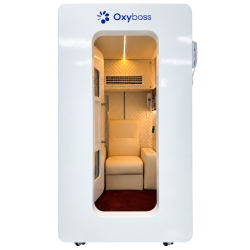
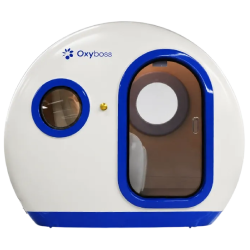
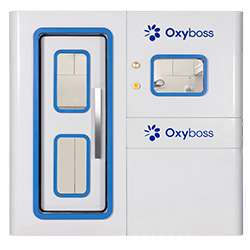
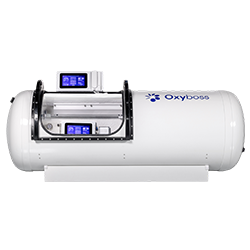
A practical guide to answering the only question that actually matters: how many chambers does this facility need, and when do we add the next one?
Quick answer (don't skip this)
There is no "right" number. The number depends on the shape of your demand, not on the chamber's specs.
- Solo or irregular demand (drop-ins, members coming whenever) → a small fleet of monoplace (single-occupant) chambers scales gracefully. Add another box when the waitlist grows. One trained operator can supervise several running in parallel.
- Group, cohort, or scheduled demand (teams, corporate wellness blocks, family groups) → one multi-occupant chamber fills the cohort at lower per-session variable cost—provided you can actually fill the seats.
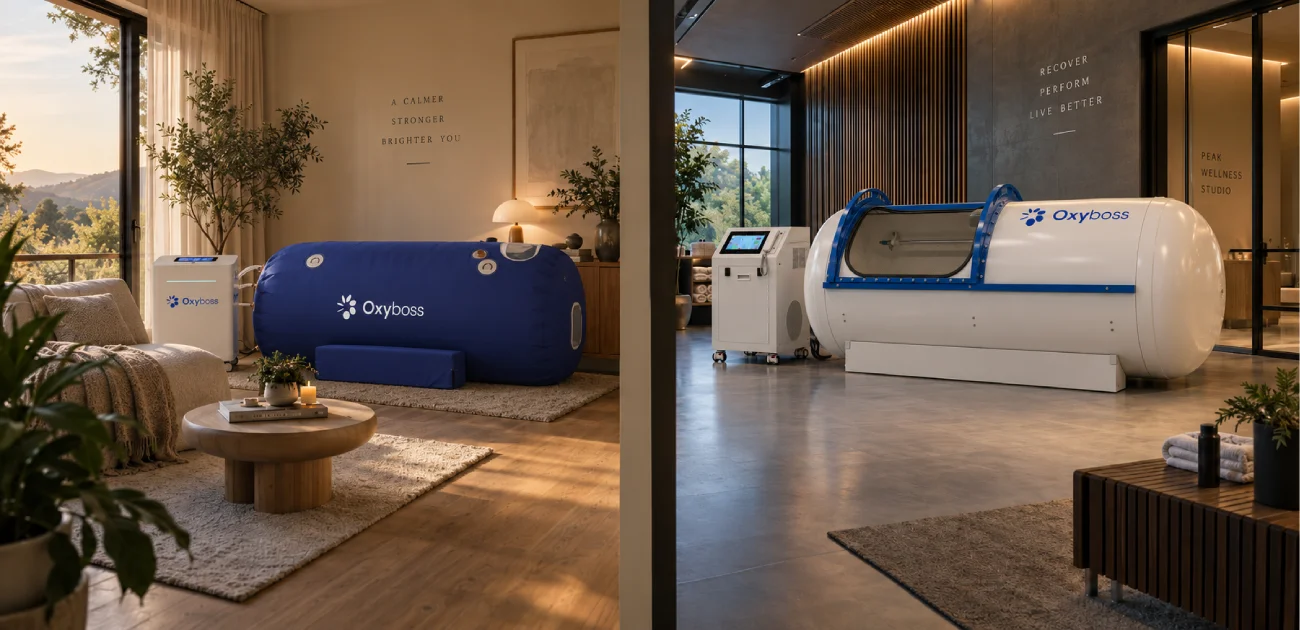
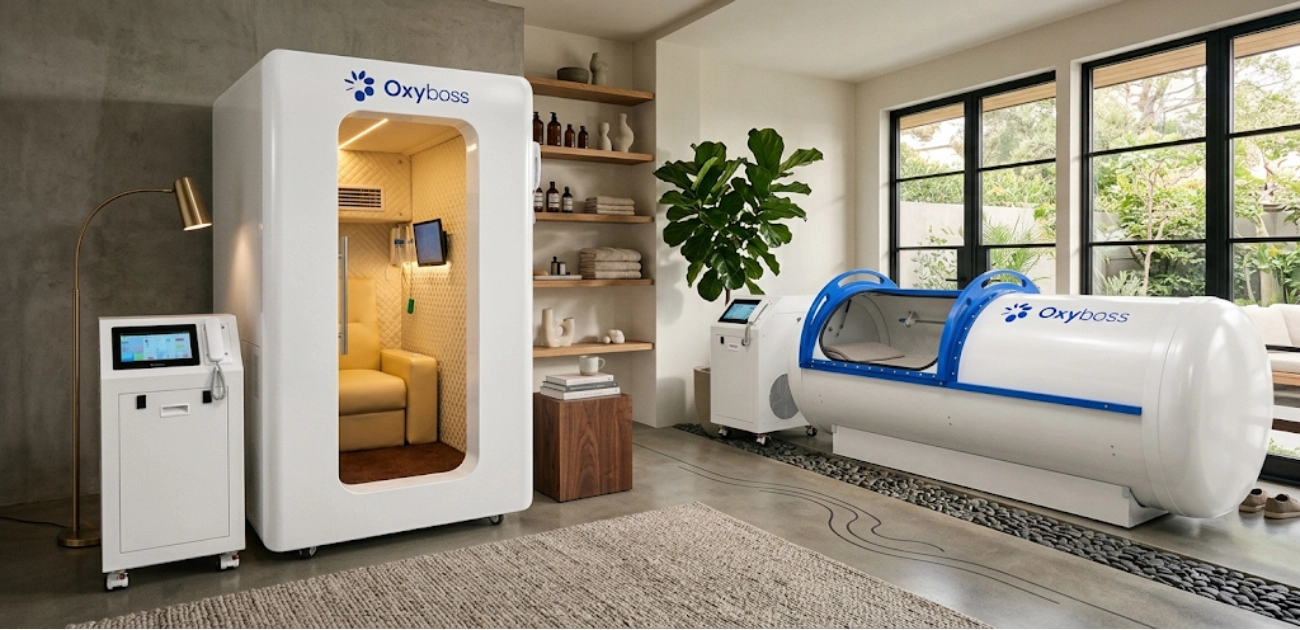
- Mixed demand → a hybrid fleet (one multi + several monos) is often the right answer. Coverage on this option across the industry is around 9.6%—almost nobody writes about it, which is part of why so many facilities get it wrong.
The rest of this page is how to figure out which one you are.
The decision everyone gets wrong: "one" vs "many" isn't about chamber type
Most pages written on this topic quietly reframe the question as monoplace vs multiplace—which chamber type to pick. That's a different question, and it's mostly relevant for clinical programs that need to handle critical-care patients.
For a commercial facility, "one vs many" literally means: how many chambers, and when do I add the next one? Chamber type is one variable inside that question, not the question itself. Across the five competitor pages we reviewed for this guide, "monoplace vs multiplace differences" appears roughly 250 times in body copy, while "capacity bottleneck / queueing" appears 0 times. That gap is the whole story.
So: the framework below is built around demand shape, throughput, and the cost of being wrong, not around a clinical classification.
The core idea: fill-rate vs turnover
Two configurations that look very different on paper actually compete on two metrics only.
Capacity is shaped by demand, not by equipment specs. Two facilities with identical chambers can have wildly different real throughput, because one has solo visitors and the other has corporate groups.
A clean rule of thumb:
- Grouped / cohort / scheduled demand → one multiplace chamber beats several monos on per-session cost.
- Solo / irregular / member-driven demand → a small fleet of monos beats one multiplace on flexibility and operator economics.
- Both → hybrid fleet.
The point: there is no "bigger is better" answer. There is "what does Tuesday at 2pm look like, and what does Saturday at 10am look like?"
The 6-dimension comparison table (what to actually compare)
Most of the comparison pages on the web don't give you a clean table—they give you a wall of paragraphs. Here is one. Numbers are ranges reported by hyperbaric industry sources for 2026, for clinical-grade equipment used in commercial contexts; non-medical soft-sided chambers run lower and are addressed separately below.
Notice the last row. Adding chambers to a monoplace fleet is incremental and reversible. Expanding a multiplace facility means tearing out a bigger chamber and replacing it. That's a one-way door.
Realistic capacity: the three production lines
This is the bit that the entire industry almost never writes about, and it's the most important thing on this page.
Your real daily capacity is the minimum of three numbers:
- Chamber-time available. How many bookable hours do you have per day, multiplied by how many chambers you have, multiplied by what fraction of those hours are actually usable after you subtract compression, decompression, cleaning between sessions, and operator handoff.
- Operator coverage. How many trained operators do you have on shift, and how many chambers (or seats) each can safely supervise. Note that "supervise several monoplace chambers in parallel" and "supervise a multiplace chamber" are very different labor models.
- Gas / utility supply. Oxygen supply, electrical capacity, HVAC, and the room's ability to handle the heat and humidity load. Bottled or concentrator oxygen is its own bottleneck that often gets discovered only after install.
Real capacity = min(line 1, line 2, line 3).
Your job is to figure out which line is shortest, because that's the only one you can profitably fix by adding equipment. If line 2 is shortest, adding chambers makes things worse (you're paying for idle inventory and angry operators). If line 1 is shortest, you need more chambers. If line 3 is shortest, no amount of buying more boxes helps until utility capacity is upgraded.
A useful diagnostic: if your waitlist is consistently more than a week long, you're on line 1. If operators are running between bays, you're on line 2. If your sessions are getting cut short because the compressor can't keep up, you're on line 3.
Industry coverage on this framework is around 0.7% across the hyperbaric content we reviewed. This is the gap we built the page to fill.
Demand shape: the question you actually need to answer first
Before you size anything, be honest about your demand shape.
A simple exercise:
- List your top five expected customer sources (members, walk-ins, team bookings, corporate wellness contracts, referrals).
- For each source, note: are customers solo or in groups? Do they book in advance or drop in? Is demand seasonal or steady?
- Estimate sessions per week per source. Use the conservative number.
- Apply a 50–65% realization rate (industry rule of thumb from Financial Models Lab—real demand is meaningfully lower than expressed interest).
- That is your monthly session demand.
Then:
Chambers needed ≈ Monthly session demand ÷ (sessions per chamber per month × target utilization)
A typical planning benchmark from commercial clinic models is ~160 sessions per line per month at single-shift operation, with a typical per-session gross in the $300–$400 range (Financial Models Lab). Your local numbers will differ, but the shape of the calculation doesn't.
If the answer is "less than one chamber's worth," the right move is one chamber, not two. That's not a sales pitch—it's the math. We talk to operators all the time who over-bought, and the bigger fleet just means more idle inventory and a longer payback.
Real total cost: the 5 cost blocks that hit you before the chamber ever does
The price of the chamber is roughly half of what you'll spend to get to first session. Most comparison pages ignore this. Industry sources break it out as follows (commercial clinic reference figures, 2026):
Reference monthly fixed overhead at this scale: ~$65,633/month (model baseline).
Source: industry hyperbaric clinic startup cost models (e.g., 2026 published operator startup kits) place the all-in buildout in the $380K–$600K range for a single hard-shell monoplace line including site work, equipment, first-year operating reserve, and working capital. Your local numbers will differ, but the shape (≈ 60% equipment, ≈ 25% site build, ≈ 15% first-year reserve) is consistent across operator-side estimates we've reviewed.
The implication for capacity planning: if your demand can only fill one chamber's worth of sessions, adding a second chamber doesn't double your revenue—it doubles your fixed cost, and your payback just stretched. Stay honest.
Site, footprint, and what install actually involves
For a commercial facility, site constraints often decide the configuration before you do.
- Monoplace hard-shell: 2–4 m² per unit, install $3,000–$10,000. Fast install, small footprint, fits a back room. (Per published equipment configuration guides.)
- Multiplace hard-shell: 10–60 m² depending on capacity, install $30,000–$100,000. Floor load rating (per NFPA 99 §14.2.1.1.9), door openings, electrical service, oxygen piping, HVAC—each is a project on its own.
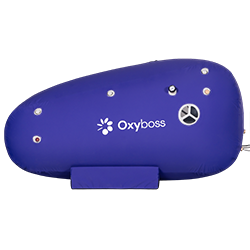
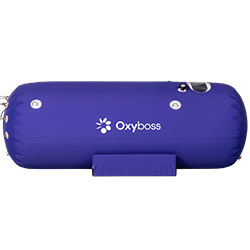
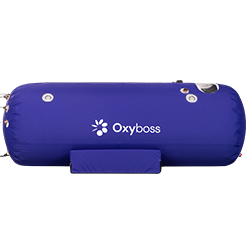
- Soft-sided (low-pressure): ~1–2 m² per unit, minimal install, but placement matters a lot (see "Soft vs hard: which scenario fits" below).
The hidden cost in multiplace build-outs is rarely the chamber itself. It's the door opening you have to widen, the slab you have to reinforce, and the oxygen line you have to run. Survey your site before you pick the configuration, not after.
Safety: the fire risk nobody wants to talk about
Hard-shell, soft-sided, monoplace, multiplace—all hyperbaric chambers carry fire risk when misused. UHMS documented a catastrophic chamber fire in Troy, Michigan: 2.0 ATA, 100% oxygen, ignition from static electricity, less than three seconds from ignition to chamber breach, temperatures high enough to melt stainless steel mesh. The official report concludes that compliance with NFPA 99 requirements would likely have prevented the event. (UHMS Catastrophic Chamber Fire Report)
The takeaway for any commercial operator, regardless of chamber type:
- Grounding matters. Per NFPA 99, any environment with oxygen content above 23.5% requires the user to be grounded; chamber grounding resistance must be ≤1 Ω.
- Verify grounding every session. Don't assume the previous operator did it.
- No electronics in the chamber. Phones, tablets, watches, heated blankets—none of it.
- Static control. Appropriate clothing, no synthetic fabrics, humidification as specified.
- Have a depressurization plan and train everyone on it.
This is not a hard-shell vs soft-sided question. It applies across the board.
Staffing: one operator can do more than you think—with the right chamber
A common mistake: assuming one chamber = one operator. It's more nuanced than that.
- Monoplace hard-shell: A single trained operator can supervise multiple monoplace chambers running in parallel, because the operator's role is monitoring, not in-chamber attendance. This is the labor advantage of the monoplace fleet.
- Multiplace hard-shell: UHMS minimum staffing ratios apply. For routine outpatient cases, the minimum is 6:1 patient-to-attendant ratio (with documented justification for relaxing to 8:1); for complex cases, 4:1; for critical patients, 1:1 or even 2:1 with ventilated patients (UHMS Multiplace Staffing Position Statement). Plus a minimum 3-person team: one chamber operator, one inside attendant, one outside operator on standby.
- Soft-sided (low-pressure, non-medical): Generally one trained operator on site can supervise a small fleet, but this depends on local regulation and your own operating procedures.
For a commercial facility, the labor model is often the deciding factor. If your area has tight labor supply, a multiplace chamber that requires a 3-person minimum team is a very different investment than a monoplace fleet that one operator can run.
Important: UHMS staffing ratios above apply to clinical multiplace operations. For commercial, non-medical multiplace use, your local code and insurer will dictate the actual minimum. Get this in writing before you buy.
Staged build-out: start with one, scale when the math says so
This is where capacity planning becomes strategy. The "start with one and add later" question has a clear answer, but only if you're honest about triggers.
Recommended approach:
- Start with one chamber that matches your dominant demand shape (use the table above). Don't pre-buy capacity for a demand you haven't proven.
- Define your expansion triggers in advance. Two metrics that work:
- Waitlist length. When your waitlist is consistently more than 5–7 days for the same time slot, you're capacity-bound on chamber-time.
- Utilization. When your existing chamber is booked >70–80% of available prime hours, you've exhausted the easy gains.
- Reserve infrastructure in the first build-out. Oxygen line sizing, electrical service, room layout—do these at "what the full facility will need" spec the first time. Retrofitting later is the expensive mistake.
- Add chambers that match the existing one. Operator familiarity, parts, training—all of it gets easier with a homogeneous fleet.
- Don't add a different type of chamber mid-stream unless you've thought hard about it. Mixed fleets work, but they double your training and SOP complexity.
The one irreversible decision: a monoplace chamber cannot be converted into a multiplace chamber. If you think you might need multiplace capability in 24 months, plan the multiplace path now. If you're sure you're staying solo / small-fleet, monoplace is the more flexible path.
Hybrid fleet: when one of each is the right answer
When hybrid makes sense:
- You serve both solo members (regular sessions) and group bookings (corporate wellness, sports teams, family groups).
- You want to differentiate your offering (e.g., higher-pressure sessions for a premium tier, lower-pressure for a basic tier).
- You have the operational maturity to run two chamber types with two SOPs.
The catch:
- Operator training doubles (or close to it).
- Scheduling across two chamber types requires more discipline.
- Spare parts, service contracts, and consumables inventory grow.
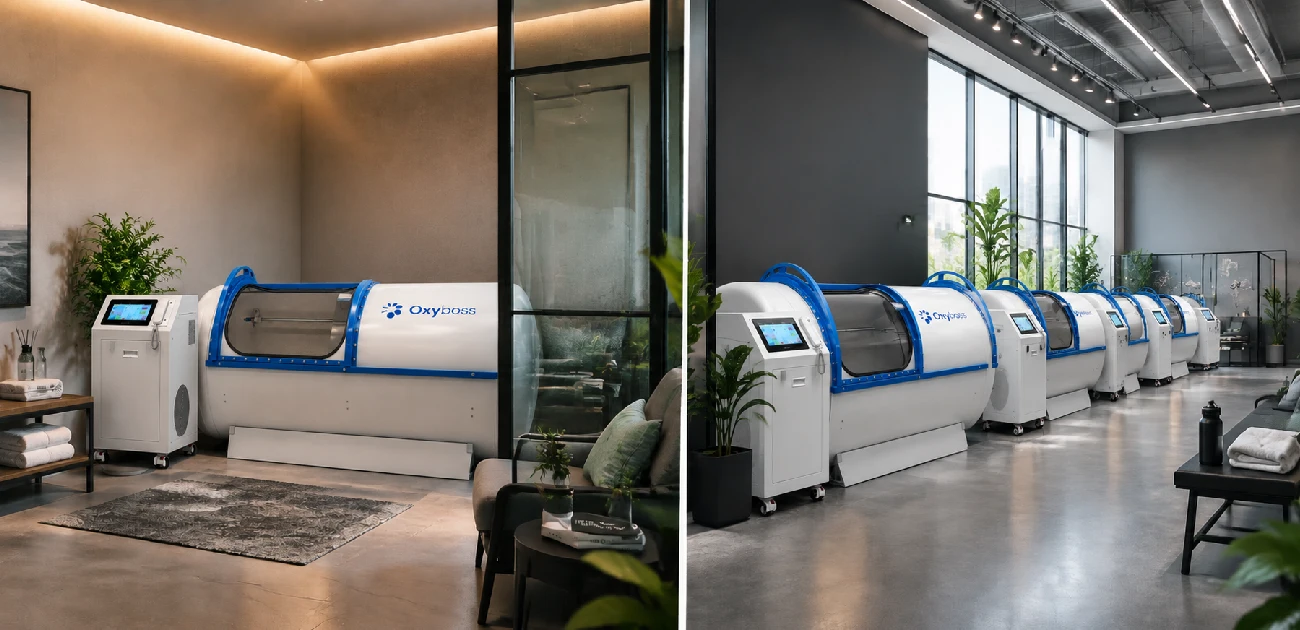
A typical hybrid setup: one multiplace chamber (e.g., 4–6 seat) for cohort/group bookings + 2–3 monoplace chambers for solo sessions and overflow. Real-world deployments of this shape exist; we can share anonymized examples if you're evaluating.
ROI and payback: the calculation nobody can do for you
We won't quote you a payback period, because the answer is yours to compute. Industry consensus among operator-side business analysts is that anyone quoting you a fixed payback period is selling, not analyzing.
The honest framework:
- Revenue = completed sessions × per-session net revenue. Net, not gross. Subtract payment processing, consumables, and per-session variable costs.
- Per-session variable cost typically runs $40–$80 for a monoplace (oxygen, electricity, consumables), per industry operating data. For a multiplace, this is higher due to oxygen and attendant labor.
- Fixed monthly cost (rent, payroll, insurance, software, loan service) at the reference scale is ~$65,633/month (Financial Models Lab). At smaller scale, proportionally lower but with less absorption.
- Contribution margin per session = per-session net revenue − per-session variable cost.
- Monthly contribution = contribution margin × sessions per month.
- Payback = total invested capital ÷ monthly contribution above fixed cost.
Run this for three scenarios (conservative, base, optimistic), and you'll have a defensible answer for your lender, your partner, and yourself. Don't skip the conservative case. That's the one you'll be living in if growth is slower than you hope.
Financing and lease: do the math on the whole package, not the monthly payment
Leasing lowers the cash barrier, but it also obscures total cost. Things to compare across lease and purchase:
- Monthly payment vs total of payments (often 1.3–1.6× equipment price over a typical lease term).
- What's included: freight, rigging, install, commissioning, warranty, spare parts, service contract.
- Downtime risk. A leased unit with a slow service response can cost more than the lease savings. Ask about guaranteed response times in writing.
- End-of-term options. Buyout price, return conditions, upgrade path.
Useful principle from operator-side procurement literature: "Use lease terms only if they lower cash strain without raising downtime or service risk." In other words, lease for cash flow reasons, not because it's cheaper—it usually isn't.
Demand forecasting: where your capacity number actually comes from
Most operators size their facility to what they hope demand will be. Plan to what you can defend.
Three sources to triangulate:
- Local demographics and competitor mapping. How many similar facilities exist within a 30-minute drive? What does their published pricing look like? What capacity are they running at?
- Pre-launch validation. A deposit-backed waitlist, a soft-launch membership drive, or partnerships with 1–2 corporate wellness buyers. Anything that converts expressed interest into a number you can multiply.
- Comparable benchmarks. Industry models (Financial Models Lab, Financial Models Lab profitability model) use ~160 sessions/line/month as a planning benchmark for a single-line, single-shift operation. Adjust for your hours, your demand shape, and your pricing.
Then apply the formula from earlier:
Chambers needed ≈ Monthly session demand ÷ (sessions per chamber per month × target utilization)
Run it three ways: solo demand only, cohort demand only, and a weighted mix. The answer that's largest is the one you size to.
When the right answer is "one chamber"
We'll close with this, because nobody else does, and it's the most useful thing we can say:
There are many commercial facilities for which the right answer is one chamber. Specifically:
- Solo / irregular demand with low predictability.
- Tight labor supply (one operator, no team).
- Small footprint or shared space.
- Pre-launch validation phase.
- Adjacent offering to a primary business (e.g., a recovery studio adding hyperbaric as one of several modalities).
If that describes you, start with one chamber, sized to your dominant demand shape, and run it for 6–12 months before you commit to a second. That 6–12 months of real data is worth more than any forecast model. You'll know your actual utilization, your actual session duration, your actual customer mix. Then the second-chamber decision is informed, not aspirational.
We make chambers, so obviously we'd rather sell you two. But we'd rather you buy the right configuration and add the second unit a year later as a satisfied customer, than over-buy now and never buy again. That's the long game, and it's the only one worth playing.
Quick decision checklist
What to ask us (or any chamber vendor) before you buy
- Real installations. Can you share anonymized data from facilities of similar size and demand shape? What was their month-6 utilization?
- Site survey. Will you do a site survey before quoting, including oxygen supply, electrical, HVAC, and floor load?
- Operator training. What's included? How long? Is it recurring?
- Service and response time. What's the guaranteed response time for a chamber-down situation, in writing?
- Compliance documentation. What certifications and standards does the chamber meet (ASME PVHO-1, NFPA 99, FDA 510(k) if relevant, CE/MDR for EU)?
- References. 2–3 customers in commercial (non-medical) operation, ideally with similar demand shape. Talk to them.
- Capacity planning help. Will you help us model demand against the chamber's realistic session capacity, not its theoretical max?
Sources and references
- NFPA 99:2024 Health Care Facilities Code — classification, fire safety, grounding requirements
- UHMS Facility Accreditation Manual, 4th Edition — facility standards, equipment requirements
- UHMS Position Statement on Multiplace Staffing Ratios — staffing requirements and operator-to-occupant ratios
- UHMS Consumer Warning on Soft-Sided Hyperbaric Chambers — scope and limitations of soft-sided chambers
- UHMS Catastrophic Hyperbaric Chamber Fire Report (Troy, MI, March 2026) — fire risk documentation
- UHMS Fire Safety Position Statement
- FDA 21 CFR §868.5470 — Hyperbaric chamber — regulatory classification for clinical hyperbaric devices
- FDA — Hyperbaric Oxygen Therapy: Get the Facts — FDA consumer guidance