.svg)
.svg)

If you've been Googling "local market analysis for a new hyperbaric wellness center" for the last week, you've probably noticed something. Every guide you've opened says the same three things: "do your research", "study the demographics", "know your competition." Then it stops.
That's the gap. We're going to close it.
What follows is the analysis you should be doing before you sign a lease — and what almost no one in this industry actually writes down. It's the working method, the numbers, and the "wait, I didn't think of that" parts. We'll cover trade area, demand sizing, site physical limits, compliance boundaries, and the cost math. We'll also tell you which sources to read yourself, because in this category there are statements from federal agencies and professional societies that you need to weigh directly.
Skip to whatever step you're stuck on:
- Step 1 — Draw your trade area
- Step 2 — Pull the right census fields
- Step 3 — Size demand: population × frequency × ticket
- Step 4 — Count competitor capacity, not competitor logos
- Step 5 — The two numbers your plan must clear before you sign
- Step 6 — Why two credible sources disagree on the U.S. market size
- Step 7 — Will the room actually fit the chamber?
- Step 8 — Two objections worth hearing first
- FAQ + sources
Step 1 — Draw your trade area by drive time, not by a circle
Here's the most common mistake in this whole process. People draw a 3-mile circle around a candidate site, count the population, and call that "the market."
Don't.
A 3-mile circle in a dense urban grid covers far fewer people than a 3-mile drive in a suburb, and the people you catch inside that circle aren't the same people who'd actually drive to you on a Tuesday evening. The retail site-selection world figured this out decades ago: define your trade area by drive-time isochrone, not radius .
The difference is huge. Same address, two methods:
- 3-mile radius: ~55,555 people
- 5-minute drive-time: ~21,343 people
- 10-minute drive-time: bigger — and a different demographic mix (median household income $112K inside the 3-mile ring vs $94K inside the 10-minute drive, in one worked example from geod.app)
Use 5-, 10-, and 15-minute drive times. The 10-minute ring is where most of your regulars will live; the 15-minute ring is where your occasional customers live. The 5-minute ring is your walk-in catchment, which matters less for a chamber business than for, say, a coffee shop.
The 75% rule is a useful sanity check: in most service businesses, around 75% of your revenue comes from inside your primary trade area. If your drive-time 10-minute ring can't plausibly generate 75% of the sessions you need to break even, the site is wrong.
Don't draw the trade area once and call it done. Re-draw it at 7am and 6pm. Daytime population in a downtown or suburban office corridor is wildly different from nighttime population — and a hyperbaric wellness center, unlike a bar, has most of its sessions in working hours. If you only see the residential count, you'll undercount the daytime market or vice versa, depending on where you are (Growth Factor). This is the single most-forgotten field in a wellness-center analysis, and it's also the easiest one to fix.
Step 2 — Pull the right census fields (most people pull the wrong ones)
Total population is the field you find first, and it is also the field you care about least for this kind of business.
The standard data source for U.S. trade-area work is the American Community Survey (ACS) on data.census.gov, with TIGER/Line shapefiles for boundaries (census.gov). ACS gives you 1-year and 5-year estimates; for trade areas under 50K people, use the 5-year so you don't get noisy single-year swings.
Here's what to actually pull:
Two notes.
First, if your candidate site is in a suburban office park, swap the population and daytime-population fields — and watch your daytime count collapse if your ring is mostly residential. The catchment math changes shape.
Second, don't trust ZIP-code-level ACS for trade areas smaller than a few thousand people. ACS' margin of error is meaningful at small geographies. If your 5-minute drive-time ring is under 10K people, the census data alone won't tell you much; you'll need a customer-origin survey once you're operational, or a competitor's POS data if you can get it.
Step 3 — Size demand: population × frequency × ticket
The demand formula is dead simple, which is why everyone repeats it and almost no one defends the inputs.
Annual demand ≈ trade-area population × annual visit frequency × average ticket
The art is in the second and third terms.
Visit frequency for a wellness-center chamber typically runs 8–40 sessions per customer per year, depending on whether your model is a "10-session recovery package" (low end) or a "monthly membership, 2x/week" (high end). Don't pull one of these numbers out of the air — pull it from the model you actually plan to run. If you don't have a model yet, this is the place to pause and write one. The two extreme answers differ by 5x.
Average ticket is where the temptation to round up lives. Don't. Use a defensible band: in the U.S. cash-pay hyperbaric wellness segment, published per-session prices run from roughly $75 to $250, with package pricing 400–1,500 and memberships 300–800/month depending on the market (airvida chambers, oxycheny). Your pricing will sit somewhere in those bands, weighted by your market's income mix and your competition. Don't double-count: if you're running a membership model, the monthly ticket is what enters the formula, not the per-session price.
A worked example, on purpose rough:
- Trade area (10-min drive-time): 30,000 people
- Target buyer slice (age 25–64, household income $75K+): ~9,000 people
- Realistic reach (1.5% of addressable buyers per year): ~135 customers/year
- Sessions per customer per year (membership model, 2x/month average): 24
- Total sessions/year: ~3,240
- Average ticket per session (blended membership + drop-in): ~$95
That gives you a rough annual demand of **~310K in revenue** for one site in one trade area. The same inputs, with a 1% reach assumption instead of 1.5%, drop you to ~207K. Sensitivity matters more than precision here. Run the same math with pessimistic, base, and optimistic reach assumptions, and look at the spread, not the central estimate.

Step 4 — Count competitor capacity, not competitor logos
Now the part almost everyone skips, because it's harder than googling.
You know how many competitors are in your 15-minute drive-time ring. But knowing there are three studios in your area doesn't tell you whether the market is full. You need their service capacity, not their sign count.
For each competitor, estimate:
- Number of chambers they run (or single-chair equivalents)
- Hours of operation per week
- Average session length
- Estimated utilization (you won't know the real number — guess 50% as base case, 70% as optimistic, 35% as pessimistic)
Total competitor capacity = sum across all competitors of (chambers × hours ÷ session length × utilization). If your estimated demand from Step 3 is below that capacity, your market is competitive but might still fit a new entrant. If your estimated demand is roughly equal to the capacity, you're entering a saturated market where the only way to win is by taking customers away from incumbents — which is a different (and more expensive) business plan.
The supply-demand ratio that the retail site-selection world uses is straightforward: competitor capacity ÷ your estimated demand. A ratio near or above 1.0 is "saturated." A ratio below 0.5 is "still has room" (Growth Factor). You'll see this exact framework used in fitness, self-storage, and medical-tenant retail site selection; it works just as well here.
One more thing. Online reviews and Google Maps listings will tell you a lot. A competitor with 50 reviews and 4.2 stars and a full booking calendar is at a different utilization level than one with 12 reviews and 4.7 stars and "call for availability" on every slot. This is qualitative, but it sharpens the utilization guess meaningfully.
Step 5 — The two numbers your plan must clear before you sign
Now we get to the part where most "do your research" advice dissolves into vagueness.
Your plan needs two numbers, and it needs them before you sign anything:
Number 1: break-even sessions per day. Take your monthly fixed costs (rent, payroll, utilities, marketing baseline, insurance, loan service) and divide by the contribution margin per session. That's it. A useful sanity check is to invert the formula: monthly fixed costs ÷ break-even sessions per month ÷ 30 days = contribution margin per session. If the result doesn't cover the per-session variable cost (oxygen, power, chamber depreciation, consumables), your break-even number is wrong or your fixed costs are wrong.
Number 2: payback period in months. Total startup capital ÷ monthly net profit. If you can't honestly project under 24 months, you need a different capital structure or a different model — not a more optimistic spreadsheet.
What most plan analyses leave out — and this is the second place the industry half-writes the problem:
Empty-seat cost. A membership-based model sells capacity that may not get used. If your customers buy a 10-session package and only use 6, you have booked revenue but unbooked chair-time, and you have an obligation to deliver those 4 sessions when they do show up. Across all your members, this is a real liability on your books, not just an accounting item. Most analysis guides skip this. Wellness and aesthetics operations have published benchmarks showing unused-session rates that range from 20% to 35% of prepaid credits. If you model 0% empty-seat cost, your break-even is wrong by a factor you can't recover from later.
No-show and cancellation rate. Industry references for kept-appointment rates in wellness settings put the figure in the 75–85% range; below 85% and your session revenue starts running behind your bookings. This isn't a small adjustment — a 10-point drop in kept-appointment rate is roughly a 10% hit to revenue.
So: estimate break-even, then re-estimate it with a 25% empty-seat factor and a kept-appointment rate of 80%. If the second number still works, you have a real business. If it doesn't, the first number was the lie.
Step 6 — Why two credible sources disagree on the U.S. market size
This is the kind of thing you should notice before you put any market-size number on a slide.
If you've looked at industry reports for the U.S. hyperbaric oxygen therapy market, you've seen two different shapes of answer, and they don't agree. One cluster puts the U.S. market in the 100M–200M range, focused on session services revenue. Another puts it in the 600M–900M range, sometimes higher, usually counting equipment sales or expanding the category to "oxygen therapy" broadly. The difference is roughly 9x, depending on who's counting.
Both can be defensible. That's the problem.
- The smaller number is usually a service-revenue figure: what U.S. clinics actually billed for hyperbaric sessions over a year. It's a tight definition.
- The larger number is usually a category figure: equipment sales plus adjacent services plus broader "oxygen therapy" definitions. It's a wide definition.
Neither is wrong. They're measuring different things.
When you see an industry CAGR of 5–6% or a "21% growth" headline, check the denominator. A 21% growth rate on a $100M base is a $21M addition. The same growth rate on a $900M base is $189M. Same percentage, vastly different operational reality.
For your local analysis, what this means is: don't anchor on a market-size number at all. The number that matters for your business is the one you can compute from your own trade area (Step 3), not the one a market research firm computed for the whole country. If you must cite a market-size number in your plan, cite the methodology, not the headline, and tell your reader which definition you're using. The credibility cost of getting this wrong is much higher than the credibility cost of saying "we did our own bottom-up."

Step 7 — Will the room actually fit the chamber?
Here's the second half of what nobody writes down.
Almost every "site selection" guide for a wellness center talks about foot traffic, parking, visibility, neighborhood vibe. Almost none of them tells you whether the room you picked can physically hold a hyperbaric chamber with a passenger inside it. This is not a corner case. It's a deal-breaker that you find out about on move-in day if you don't check it in advance.
The questions you need answered before you sign:
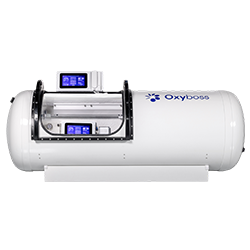
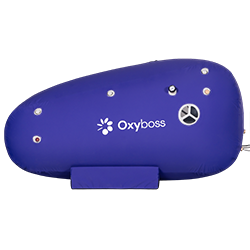
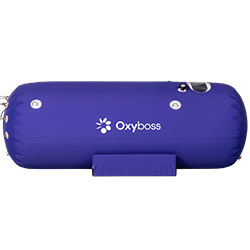
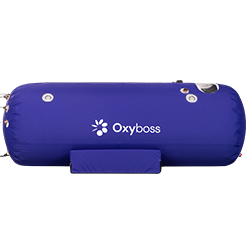
Footprint. A chamber is not a chair. Soft-shell chambers for non-medical use typically run 90–220 cm long and 70–110 cm across, depending on whether you're sitting or lying. Hard-shell 2.0 ATA chambers are larger — single-person hard-shell units commonly run around 200–220 cm long by 75–90 cm wide, multi-person units 200–230 cm by 150–180 cm or larger. Plus the oxygen unit, which itself takes a 50–130 kg box and roughly half a square meter of floor space. Plus clearance for the user to enter and exit, plus operator workspace. A reasonable working rule: a single-chamber site needs a minimum room footprint of roughly 12–18 m² (130–195 sq ft) once you account for the chamber, the oxygen source, the entry path, and operator working space.
Floor load. This is the one nobody talks about. Chambers vary hugely in weight:
- A 1.5 ATA soft-shell chamber for non-medical use typically weighs around 18–24 kg for the chamber itself, plus an integrated oxygen unit around 50 kg. Total around 70–75 kg. Standard office or retail floor load (around 4.8 kPa / 100 psf) handles this with margin. Soft-shell units don't put you in structural-engineer territory.
- A 2.0 ATA hard-shell single-person chamber is a different conversation. The chamber body alone commonly runs 200–300 kg depending on size and material; the integrated oxygen unit adds another ~130 kg. Realistic floor load on the chamber pad runs 300–450 kg concentrated on a small footprint, which translates to roughly 50–90 psf in the worst case — within residential or office floor-load limits, but pushing it. Multi-person or larger-format units running 500–1,000 kg are a real structural conversation, especially if you're considering anything above ground floor.
Always quote the weight with the oxygen unit included. A chamber's published "net weight" sometimes excludes the concentrator, compressor, and air cooler that come with it. If you plan a floor-load calculation from the net weight alone, you will under-count by 50–130 kg and your structural assumption will be wrong.
Ceiling height. You need vertical clearance not just for the chamber but for the entry. Most hard-shell units are 170–190 cm tall. Allow a working ceiling of 230–250 cm to give the operator and entry space headroom.
Door and access route. A chamber arrives once. If it can't fit through the door, the freight elevator, the hallway, or around the corner, you have a serious problem. Measure your door width and the path the chamber will travel on delivery day. Don't trust the spec sheet to give you "minimum access width" — they rarely do.
Power. A non-medical soft-shell chamber at 1.5 ATA typically draws around 1,200 W on a standard 110V/220V circuit. A 2.0 ATA hard-shell chamber with integrated oxygen and air cooling typically draws around 2,200 W and needs a dedicated 10A–20A circuit at 220V, depending on configuration. In a U.S. site running 110V service, that translates to roughly 20A on the chamber circuit — close to the limit of a standard 20A outlet. Plan your electrical layout before you sign the lease; panel upgrades after the fact are expensive.
Compliance boundaries for the site itself. The standards your landlord (and the fire marshal) may eventually ask about are real. The U.S. authority here is NFPA 99 (Health Care Facilities Code), which carries language on hyperbaric facilities, and which itself points to NFPA 101 (Life Safety Code) for occupancy classification. For chamber design and manufacture, the relevant American standard is ASME PVHO-1, which applies to human-occupied pressure vessels operating above a defined pressure differential. The FDA classifies hyperbaric chambers as Class II medical devices (product code CBF, 21 CFR 868.5470) (FDA classification database).
You should read those references yourself. The UHMS has published a consumer-facing statement that any prospective operator should see before they decide what kind of chamber they will run (UHMS consumer warning). The FDA has also published both a safety letter to healthcare providers and a consumer update on hyperbaric oxygen therapy. What we will say here, and what we will only say once: the classification, the standard, and the agency's public statements all exist, and they should be in your decision-making — not as marketing language, as inputs to a real one.
For a non-medical cash-pay center specifically, the practical implication is: the room you're choosing has to meet a physical and electrical standard for the chamber you intend to install, and your operation has to meet the fire and safety standard that the local authority having jurisdiction applies. The local authority having jurisdiction is your local fire marshal, not us. Call them before you sign.
Step 8 — Two objections worth hearing first
Every analysis guide skips these. Here's why you shouldn't.
"The market is already saturated."
Maybe. But the test isn't whether competitors exist; it's whether their capacity is full (Step 4). If your 15-minute drive-time ring has two competitors running four chambers between them and they are typically 60% utilized, the market has room. If they are typically 90% utilized, the market is genuinely full and the only way in is to take share from them, which is a different business plan with a different cost.
The second thing the saturated-market argument hides is that "saturated" usually means "saturated for one specific buyer persona." A center optimized for athletic-recovery pricing at $75/session is a different market from one optimized for executive-wellness memberships at $600/mo. Same geography, different catchment.
"Where's the clinical evidence?"
Two answers.
First: for the non-medical wellness positioning that most cash-pay centers operate under, the regulatory framework is not "show evidence of efficacy." It's "operate within the standards and disclosure obligations that apply to non-medical facilities." Those standards are real (Step 7), and they're the bar. The clinical evidence question belongs to clinical operations, which is a different business with different regulation and different unit economics.
Second: the professional societies in this space have taken public positions on consumer-grade soft-shell chambers that you should read before you decide what to install. The UHMS position statement is at uhms.org. Read it. The FDA consumer update on hyperbaric oxygen therapy is at cacmap.fda.gov. Read that too. The two documents, plus the ASME and NFPA references in Step 7, are the four things you should be able to summarize in your own words before you sign anything. If you can't, you aren't ready to sign anything yet.
FAQ and sources
Where can I get the data for trade-area demographics? Start at data.census.gov for ACS five-year estimates. For drive-time isochrones instead of radius circles, you can use the free tier of any commercial site-selection tool. The retail site-selection literature explains the drive-time method in plain language at geod.app and blueprintcommercial.com. Growth Factor has a clean walkthrough of the demand-sizing formula.
Do I need to bill insurance or Medicare? A cash-pay wellness center can operate without billing insurance, and most do. Insurance and Medicare reimbursement for hyperbaric oxygen therapy is gated by clinical coverage policies that are written for clinical facilities operating under specific protocols; if you're a non-medical cash-pay center, you are not in that lane. Coverage policies from individual payers are publicly available — see, for example, Fallon Health's HBOT clinical coverage policy — and they make the boundaries explicit.
What about the FDA position on hyperbaric chambers? The FDA classifies hyperbaric chambers as Class II medical devices (product code CBF, 21 CFR 868.5470), and has published both a safety letter to healthcare providers and a consumer update on hyperbaric oxygen therapy. Read both documents yourself; the agency's published positions are the relevant input, not a vendor's marketing claim. Whether any specific chamber model on the market is or is not within the FDA's cleared scope is a question for the manufacturer of that specific chamber, asked of the FDA directly.
What is UHMS, and why does its name keep coming up? The Undersea and Hyperbaric Medical Society is the relevant U.S. professional society. They publish position statements, an accreditation manual for clinical hyperbaric facilities (UHMS Accreditation Manual, 4th Edition), and a safety bulletin. They have also published a public statement regarding consumer-grade soft-shell chambers that any prospective operator should read (UHMS consumer warning). They are the relevant professional society, not a competitor, and their public positions are part of the standard reference set for this category.
What chamber should I buy? The honest answer is: we can't tell you, and you shouldn't trust anyone who can. The right chamber depends on your service model (recovery packages vs. membership vs. drop-in), your room's physical and electrical limits, your local regulatory situation, and your customer target. The product specifications — pressure class, dimensions, weight, electrical load, and the chamber's relationship to the standards discussed above — should be the inputs to your decision, not a brand name. If a salesperson can't walk you through how their chamber fits into NFPA 99, ASME PVHO-1, and your local fire marshal's expectations, they are not the right salesperson.
Need the raw dataset behind these estimates? Email us and we'll send the spreadsheet with the worked example, the formulas, and the sensitivity analysis.
Sources: U.S. Census Bureau ACS / TIGER (census.gov) · trade-area method (geod.app, blueprintcommercial.com, growthfactor.ai) · cost band (airvida chambers, oxycheny) · FDA classification and statements (accessdata.fda.gov, fda.gov letter, cacmap.fda.gov) · NFPA / ASME framework (UHMS consumer warning, UHMS accreditation manual, UHMS safety bulletin) · insurance coverage example (fallonhealth.org).