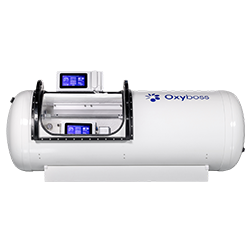
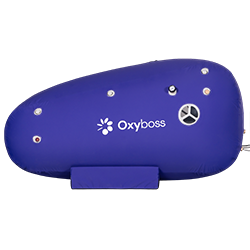
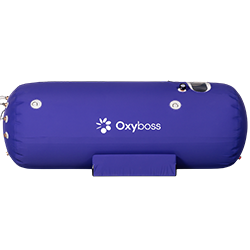
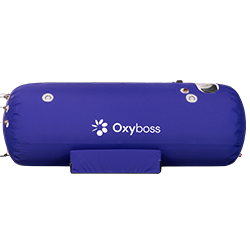
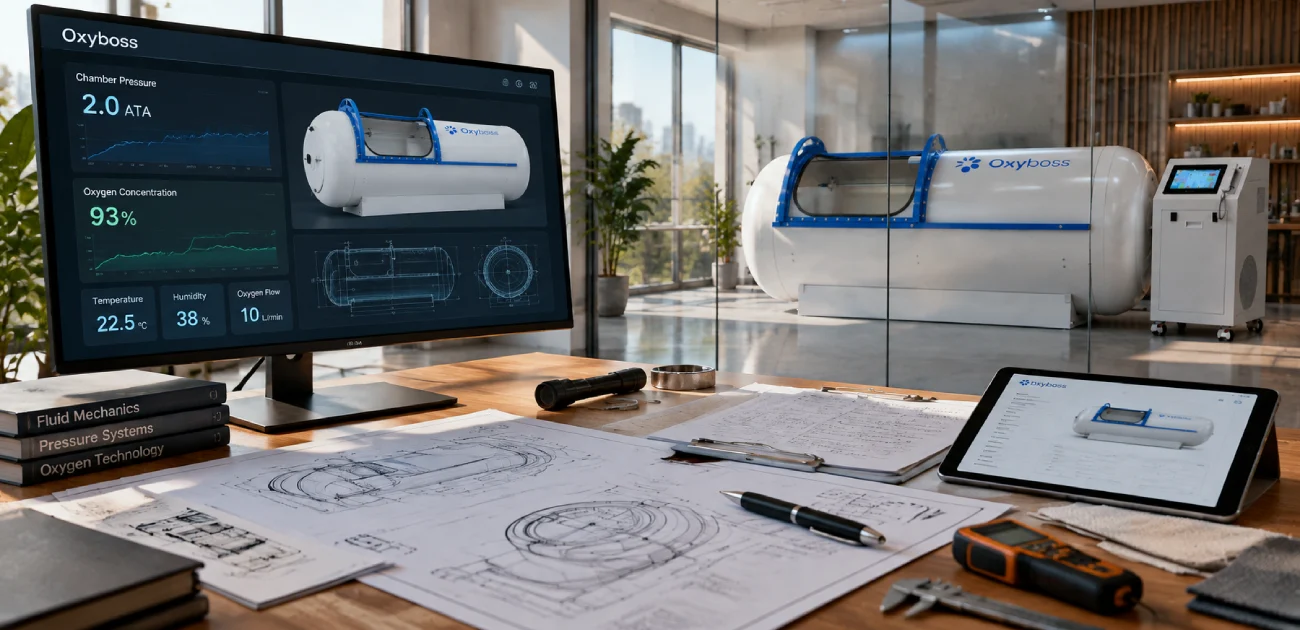
Short answer: your red blood cells are already full of oxygen. Pressure doesn't add room there. What pressure does is force extra oxygen to dissolve directly into blood plasma, the liquid part of your blood — and plasma can carry that oxygen to tissue your normal circulation serves poorly. The mechanism behind it is Henry's Law: at a constant temperature, the amount of a gas that dissolves in a liquid rises in proportion to that gas's partial pressure.
Why your red blood cells are already maxed out
Oxygen moves through your blood along two routes.
Route 1 — bound to hemoglobin. Hemoglobin is the protein inside red blood cells that picks up oxygen in your lungs and drops it off in tissue. At normal air pressure, it runs at roughly 97–99% saturation. That number barely moves, no matter what you do.
Route 2 — dissolved directly in plasma. Plasma is the liquid part of blood, and it can hold oxygen on its own, with no hemoglobin involved.
Here's the part most pages skip: because hemoglobin is already near its ceiling, Route 1 is closed. Breathe pure oxygen through a mask at normal pressure and hemoglobin still sits at 97–99%. There's nowhere left for the extra to bind.
That leaves plasma. And plasma oxygen is the only lane pressure can widen — which is why "breathe more oxygen" and "raise the pressure" are not two versions of the same idea. The first runs into a saturated carrier. The second opens a new route.
Henry's Law, stated plainly
Henry's Law says: at a constant temperature, the amount of a gas that dissolves in a liquid is directly proportional to the partial pressure of that gas above the liquid.
Inside a chamber, the chain runs like this:
- You raise the ambient pressure.
- The partial pressure of the oxygen you're breathing rises with it.
- More oxygen dissolves into your plasma.
- That creates a steeper diffusion gradient between blood and tissue.
- Oxygen reaches tissue that normal blood flow serves poorly.
That's it. No mystery, no magic — just a gas doing what gases do when you squeeze them. [1][2]
A naming trap worth clearing up. Two gas laws show up in nearly every article on this topic, and they do two completely different jobs:
This article is about Henry's. When you see the two woven together as if they were one principle, you're reading two separate stories at once.
Pressure vs oxygen concentration: you need both
Most articles frame this as a contest. "Pressure matters more than oxygen." Or the reverse. It's neither. It's a product:
Oxygen partial pressure = oxygen fraction × absolute pressure (ATA)
Two ways to raise the left side: turn up the oxygen fraction, or turn up the pressure. Both work. They are not interchangeable, for one reason — the fraction you can breathe tops out around 100%, while pressure has no comparable practical ceiling.
To make this concrete, take the comparison you'll find everywhere online. A physician-authored explanation (Dr. Caroline Fife) makes the point that breathing compressed air at 1.3 ATA is roughly equivalent to breathing about 27% oxygen at sea level — and that you could get further than that with pure oxygen by mask, no chamber required. [11]
That comparison is correct. Check the arithmetic:
- 20.9% oxygen × 1.3 ATA = 0.272 ATA of oxygen partial pressure
- Sea-level air: 20.9% × 1.0 ATA = 0.209 ATA
- 0.272 ÷ 0.209 = 1.30 → about 27%
So yes: at 1.3 ATA on plain air, the extra oxygen exposure is real but small. Anyone implying otherwise is selling you something.
But here's what that comparison leaves out. It's a single point on a curve, and the curve is straight. Same arithmetic, four more settings:
Now read the last two rows against each other. Identical pressure. Wildly different oxygen exposure. That's the entire reason the oxygen configuration — not just the pressure rating — belongs in this conversation.
And notice where the big jump lands. It's the last row, where near-pure oxygen meets 2.0 ATA. That's the clinical configuration. It is not the same thing as a home chamber running on air, or on lightly enriched air.
So it's three variables, not two. If you want to describe oxygen exposure honestly:
Exposure scales with pressure × oxygen fraction × time
Drop any one of the three and the comparison falls apart. That, rather than "pressure wins," is the real answer — the question assumes you can only pick one.
How much extra oxygen actually dissolves?
Here's a formula you can run yourself. The amount of oxygen that dissolves in plasma, in mL per deciliter of blood, is approximately:
Dissolved O₂ ≈ 0.0031 × oxygen partial pressure (in mmHg)
Test it against a published number. At 2.0 ATA on near-pure oxygen, partial pressure is roughly 1,513 mmHg. Multiply: 0.0031 × 1,513 ≈ 4.69 mL/dL. That matches the figure a physician-authoritative source publishes for the same conditions (4.71 mL/dL). [11] The formula reproduces someone else's number — it isn't ours to bend.
Now run it down the ladder:
Plasma values are estimates from the formula above; total-blood share assumes hemoglobin 15 g/dL at 1.34 mL O₂ per gram, plus dissolved oxygen. Real values move with the individual and the setting. Read this as order-of-magnitude, not a lab result.
Read the last two columns. Under normal conditions, plasma carries a small fraction of your total blood oxygen — the rest rides on hemoglobin. Under the clinical configuration, plasma's share jumps several-fold. That jump is real, and it's why the mechanism matters.
But we're not going to hand you a multiplier, and here's why. You'll see claims like "plasma oxygen increases 20-fold." Those numbers come from three different sources using three different baselines and three different pressures — comparing sea-level air to high-pressure pure oxygen, in the most extreme pairing available. Quote the top of that range without the conditions attached and you've misled your reader. So we give you the formula and the assumptions instead. Run it for your own setting, and check our work. [4]
ATA vs PSI: reading pressure without getting fooled
These two units describe different things, and mixing them up is how people end up comparing equipment that isn't comparable.
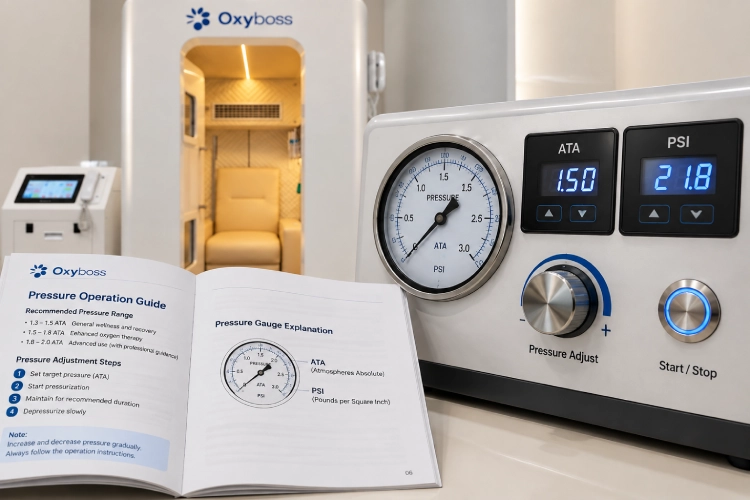
- ATA (atmospheres absolute) counts the whole pressure inside the chamber, sea-level atmosphere included. 1.0 ATA is normal air at sea level.
- PSI in this context usually means gauge pressure — the pressure above ambient. It starts at zero.
You'll find slightly different figures quoted around the web — 4.4, 7.35, 14.7 — because sources round differently and don't always say whether they mean absolute or gauge. That's exactly why the next paragraph matters.
Two questions to ask any supplier, including us:
- What is the maximum ATA rating, and what is the maximum gauge pressure?
- Is that the equipment's maximum rated value, or the pressure actually used under the intended operating conditions?
Two different numbers, and the gap between them is where confusion lives. [12]
Where home chambers sit next to clinical hyperbaric oxygen therapy
This is the comparison that matters most, and it's the one most marketing pages blur. So let's be precise, starting with the definition.
Clinical hyperbaric oxygen therapy (HBOT) is defined by two conditions, and both have to be met at once. The Undersea and Hyperbaric Medical Society (UHMS) defines it as breathing near 100% oxygen inside a chamber pressurized to at least 1.4 ATA. The UHMS indications guidance describes clinical protocols at 2.0 ATA or higher, using physician-prescribed medical oxygen. [3][4]
Two conditions. Not one. A chamber that meets the pressure number while running on something other than near-pure oxygen does not meet that definition — and reaching a given working pressure is not the same as receiving a clinical protocol.
Ranges reflect common commercial listings and published clinical guidance; specific equipment varies.
Two ways a chamber raises your oxygen exposure
Same physics, two delivery paths — and this is the part most pages collapse into one.
Path 1 — raise the ambient pressure on air. The chamber compresses air. Oxygen fraction stays around 21%, pressure does all the work. This is what most consumer soft chambers are designed to do.
Path 2 — change what's in the chamber or what you breathe. Now the oxygen fraction becomes a variable too. Four configurations exist in the market:
Two of these — (c) and (d) — are where the fire-safety picture changes materially, and where regulatory documentation matters most.
A regulatory fact worth stating plainly. UHMS notes that low-pressure fabric chambers cleared in the U.S. are designed to be compressed with air and are not cleared for attachment to oxygen tanks or concentrators. [3] The FDA's most recent safety communication to health care providers is blunt about what shifts when oxygen concentration rises: it flags a heightened risk of fire with use of oxygen at a high concentration, names electrical and static devices as potentially prohibited inside a chamber, and refers to fires that caused serious injuries and deaths. [5]
What that means if you're buying. "It works with a concentrator" is not the same statement as "this configuration is covered by the product's documentation." Ask which of the four configurations a specific model is documented for, and ask for the paper. If a configuration isn't covered, a reseller's assurance doesn't change that.
What this physics does not claim
We just spent several sections explaining a mechanism. Now we're going to put a fence around it, because that fence is the most useful thing on this page.
The mechanism explains how oxygen gets where it goes. It does not show that a particular chamber or pressure produces a particular outcome. Those are two different claims, and the second one needs research on that specific use, not a gas law. Any page that slides from the first to the second has changed the subject without telling you.
Four terms that are not interchangeable:
When a page says "FDA-certified," stop and ask which of these four it means. The word "certified" isn't one of them.
Clearance is tied to an intended use, not to everything a device might be used for. The FDA's own framing: clearance for a specific use means the agency reviewed valid scientific evidence supporting that use. [14] As an example of how narrow this can be: FDA records show a portable chamber cleared to relieve mild symptoms associated with acute mountain sickness, under physician direction. [9] That is a specific use. It isn't a general endorsement.
And the FDA has said plainly what it does not cover. The agency states that HBOT devices are not proven to cure cancer, Lyme disease, autism or Alzheimer's disease, and that it has not cleared or authorized any HBOT device for COVID-19 or for anything beyond its published cleared list. [14] The cleared uses themselves are searchable in the FDA's own device records under Product Code CBF — a short list, mostly acute conditions handled in clinical settings. [15] That cuts in only one direction, and we're fine with it. If you see a chamber marketed for something outside that list, you're looking at a claim the FDA hasn't cleared — and a reason to read the rest of the page differently.
Safety: what pressure and oxygen actually change
Raising pressure and changing oxygen both change the risk picture. Here's the honest list, most-frequent first.
Fire is the one that deserves its own paragraph. Oxygen enrichment makes everything in the chamber burn hotter and faster. The FDA has said so directly — a heightened fire risk with high-concentration oxygen — and maintains a public database of adverse-event reports for these devices, with incidents that include fires involving electronic devices. [5][8] This is not a theoretical risk, and it's the reason "don't bring your phone in" is a rule rather than a preference.
Four rules we'd put on the wall:
- No electronics, no flammable anything, inside the chamber. Not a phone, not a smartwatch, not a vape.
- Follow the pressure rhythm. Pressurize, hold, depressurize — don't skip or rush a stage.
- Let a professional clear you before you start. The next paragraph explains why.
- Never run a session as self-directed medical care. If you're managing a health condition, that conversation belongs with a clinician.
Who needs a professional evaluation first. There is one absolute contraindication — an untreated pneumothorax (collapsed lung) — and a long list of relative ones that require assessment rather than automatic exclusion: severe lung disease, recent chest surgery, certain heart conditions, active seizure disorders, inability to equalize ear pressure, active sinus or upper-respiratory infection, pregnancy, severe anemia, and specific medication interactions, among others. [10]
Read that structure carefully: one absolute, many relative. Which means for most people the question isn't "am I barred," it's "has a professional looked at my situation." We're giving you the categories so you know what to raise with your clinician — not so you can clear yourself. This list is not a self-screening tool.
On session length and frequency. You'll see specific numbers circulating — a set number of minutes, a set number of sessions. Those reflect clinical protocols and market convention, not a general recommendation, and they depend on the individual and the setting. We're not publishing a schedule for you to follow. What we will say: the rhythm matters, the equipment's instructions and your professional's guidance govern, and anything that reads like a prescription you can self-administer deserves suspicion.
Before you buy: what to verify
This is the section most pages skip, and it's the one that decides whether you get what you think you're paying for. Five groups. Each one gets a question and an action.
1. Pressure rating — two numbers, not one. Ask for maximum ATA and maximum gauge pressure, and ask whether each is the equipment's rated maximum or the value used under intended operating conditions. A single pressure figure is not enough to compare two chambers.
2. Oxygen configuration — in writing. Ask which of the four configurations on this page your model is documented for: ambient air, concentrator to a mask, concentrator to the chamber atmosphere, or compressed medical oxygen. Then ask for the document. A verbal assurance from a reseller is not documentation.
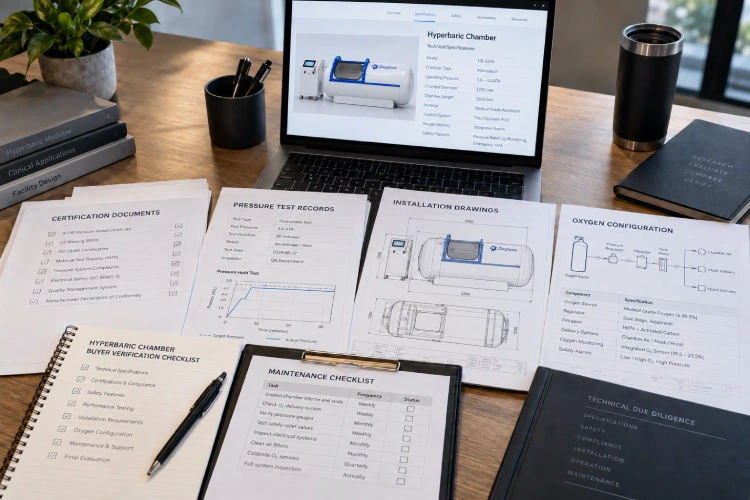
3. Certification and test records — a specific list. Request these by name:
- Clearance number and the letter or document that goes with it
- The stated intended use, in the manufacturer's own words
- Pressure and relief-valve test records
- Oxygen purity and flow test results, if an oxygen source is included
- Electrical safety certification
- Cleaning, maintenance, and emergency procedures
If a supplier can't produce these, that tells you something. [12]
4. Engineering and facility documentation. Two standard families come up here: ASME PVHO-1 and NFPA 99. Both are engineering and facility safety documents. Neither is proof that a device produces a clinical result — they answer a different question, and a page that presents them as effectiveness evidence is confusing two things. [7][12]
Buyers should also be aware of an unresolved market-level conflict: some sellers describe soft chambers as exempt from pressure-vessel requirements, while NFPA committee materials and UHMS warnings indicate that hyperbaric installations — including some soft-sided ones — remain subject to applicable requirements. We won't take a side on your local situation, because we can't. Get a written determination from your local authority having jurisdiction (AHJ) rather than relying on a seller's interpretation. [7][12]
5. Installation reality — before it arrives, not after. Check these five items early: electrical circuit capacity, ventilation, room dimensions and floor loading, doorway and stairway clearance, and compressor footprint. A rigid chamber can weigh several hundred kilograms, and a doorway it can't fit through is a problem no delivery crew can solve. Specific electrical requirements vary by model — get them from the manufacturer's own documentation rather than inferring them from another model's spec sheet.
Also worth asking, because nobody publishes it:
- Warranty structure. Ask what covers the pressure vessel or fabric bladder, and separately what covers the compressor, oxygen unit, valves, zipper, and electronics — and whether labour and return freight are included. Published warranty terms for this category typically run from one to three years depending on the component, but that's market convention, not a requirement; your contract governs.
- Size and fit. Internal diameter, lying or seated, maximum user height and weight, entry opening width. These decide whether you'll actually use the thing.
- Device classification. In the U.S., hyperbaric chambers are regulated as Class II devices under 21 CFR 868.5470 — but classification and clearance both follow the intended use. A given classification does not automatically extend to every low-pressure or wellness product on the market. [9][13]
What it costs to own — by category, without numbers. Rather than quote figures that go stale and vary by market, here's the list of things that carry cost: the chamber itself, the oxygen source, professional installation, any electrical work, consumables and filters, scheduled maintenance, and out-of-warranty parts. Ask a supplier to itemize those seven lines. The itemization tells you more than any single number.
Two things we've put together to make this easier: a pre-purchase document request checklist you can send to any supplier — including us — and a short guide to getting an AHJ determination in writing. Both are linked below.
Frequently asked questions
Does pressure matter more than oxygen concentration? Neither wins. Oxygen exposure is pressure × oxygen fraction × time. Raising pressure opens the plasma route that a mask can't reach — but at the same pressure, changing the oxygen fraction changes exposure substantially. Compare settings, not slogans.
Is a 1.3 ATA home chamber the same as clinical HBOT? No. Clinical HBOT is defined as near-100% oxygen at 1.4 ATA or above, with clinical protocols running at 2.0 ATA or higher. A home chamber on ambient air is a different setup with a different oxygen exposure.
What's the difference between ATA and PSI? ATA counts total pressure including sea-level atmosphere. PSI in this context usually means gauge pressure — the amount above ambient. 1.5 ATA is about 7.35 psig. Ask a supplier for both figures, and ask whether they're rated maxima or operating values.
How much more oxygen does plasma carry under pressure? More, and the increase depends entirely on the setting. Use the formula — dissolved O₂ ≈ 0.0031 × oxygen partial pressure in mmHg — and the assumptions listed with our table. We deliberately don't publish a single multiplier, because every published one depends on a baseline it doesn't show you.
Do I need an oxygen concentrator, or is compressed air enough? A chamber runs on compressed air. Whether an oxygen source is part of a documented configuration is a separate question, and it's one only the manufacturer's documentation can answer. Some low-pressure fabric chambers are not cleared for attachment to oxygen tanks or concentrators, and the FDA has warned that improvised combinations create fire and suffocation hazards.
What is Henry's Law, in one sentence? At a constant temperature, the amount of gas that dissolves in a liquid is proportional to that gas's partial pressure above the liquid. It's why higher pressure means more oxygen in plasma — and it's the core of everything above.
Is it safe to use a hyperbaric chamber at home? Risk depends on the equipment, the pressure, the oxygen configuration, and your own health. With properly engineered equipment, correct use, and a professional's sign-off, it can be managed. Note that "managed" is not "zero" — the risks in the table above are real, and electronics inside the chamber are a genuine hazard.
Does FDA clearance mean a chamber is approved for a medical condition? No. Clearance means the agency reviewed evidence for a specific intended use and found the device substantially equivalent to an already-marketed one. It is not approval, and it doesn't extend to other uses. The FDA has stated that hyperbaric oxygen therapy is not cleared or approved for several widely marketed uses, including cancer, autism, Alzheimer's disease, and COVID-19.
The takeaway
Pressure raises oxygen delivery because hemoglobin has no room left and plasma does. Three things worth keeping:
- Pressure and oxygen fraction multiply. Never compare two chambers on pressure alone.
- The big jump belongs to a clinical configuration — near-pure oxygen at 2.0 ATA. Home and wellness equipment sits well below that line.
- What you can verify beats what you're told. Ask for the pressure numbers, the oxygen configuration in writing, and the test records.
Sources
- Hyperbaric Physics — StatPearls, NCBI. https://www.ncbi.nlm.nih.gov/books/NBK448104/
- Hyperbaric Physiological and Pharmacological Effects of Gases — StatPearls, NCBI. https://www.ncbi.nlm.nih.gov/books/NBK470481/
- UHMS Position Statement: Low-Pressure Fabric Hyperbaric Chambers — Undersea and Hyperbaric Medical Society. https://www.uhms.org/images/Position-Statements/UHMS_Position_Statement_LP_chambers_revised.pdf
- HBO Indications (UHMS). https://uhms.org/resources/featured-resources/hbo-indications.html
- Follow Instructions for Safe Use of Hyperbaric Oxygen Therapy Devices — Letter to Health Care Providers, U.S. Food and Drug Administration (August 25, 2025). https://www.fda.gov/medical-devices/letters-health-care-providers/follow-instructions-safe-use-hyperbaric-oxygen-therapy-devices-letter-health-care-providers
- UHMS Consumer Warning: The Dangers of Soft-Sided Bag Chambers — Undersea and Hyperbaric Medical Society. https://uhms.org/pressure-other-articles/1542-consumer-warning.html
- NFPA 99 Technical Committee on Hyperbaric and Hypobaric Facilities — NFPA technical committee documents. https://docinfofiles.nfpa.org/files/AboutTheCodes/99/99_2024_HEA_HYP_Log1735_tiaballot_pubcommcirc.pdf
- MAUDE Adverse Event Report — U.S. Food and Drug Administration. https://www.accessdata.fda.gov/scripts/cdrh/cfdocs/cfmaude/detail.cfm?mdrfoi__id=22796994&pc=CBF
- 510(k) Premarket Notification — Flexi-Lite Chamber — U.S. Food and Drug Administration. https://www.accessdata.fda.gov/cdrh_docs/pdf10/K101262.pdf
- Hyperbaric Oxygen Therapy Contraindications — StatPearls, NCBI. https://www.ncbi.nlm.nih.gov/books/NBK557661/
- Explaining the Math for Hyperbaric Oxygen — Caroline Fife, M.D. https://carolinefifemd.com/2018/02/06/explaining-the-math-for-hyperbaric-oxygen/
- Use of Pressure Vessels for Human Occupancy in Clinical Settings — The National Board of Boiler and Pressure Vessel Inspectors. https://www.nationalboard.org/index.aspx?pageID=164&ID=202
- 21 CFR 868.5470 — Hyperbaric Chamber — U.S. Code of Federal Regulations. https://www.ecfr.gov/current/title-21/section-868.5470
- Hyperbaric Oxygen Therapy: Get the Facts — U.S. Food and Drug Administration, consumer update (archived January 2, 2025; the FDA page has since been retired). https://web.archive.org/web/20250102110859/https://www.fda.gov/consumers/consumer-updates/hyperbaric-oxygen-therapy-get-facts
- Product Code CBF — Hyperbaric Chamber, device classification — U.S. Food and Drug Administration. https://www.accessdata.fda.gov/scripts/cdrh/cfdocs/cfpcd/classification.cfm?id=95
This article describes equipment physics and general safety considerations. It is not medical advice, and it is not a substitute for evaluation by a qualified professional. Chamber specifications describe equipment performance only — reaching a given working pressure is not the same as receiving a clinical protocol. Regulatory and safety matters vary by location; where they apply to you, the determination of your local authority having jurisdiction governs. Specifications and standards referenced are current as of the date above and are subject to change.