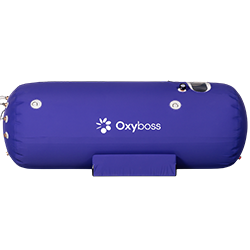
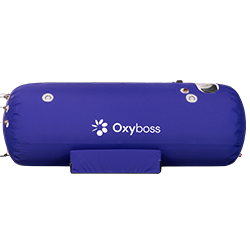

When you look at a hyperbaric chamber system, two pieces of equipment show up in almost every setup: an air compressor and an oxygen concentrator. If you're researching chambers for home or clinical use, you've probably noticed that most pages answering this question actually answer something else—either "oxygen concentrator vs oxygen tank" or "chamber vs concentrator." Those are valid comparisons, but they're not what we're talking about here.
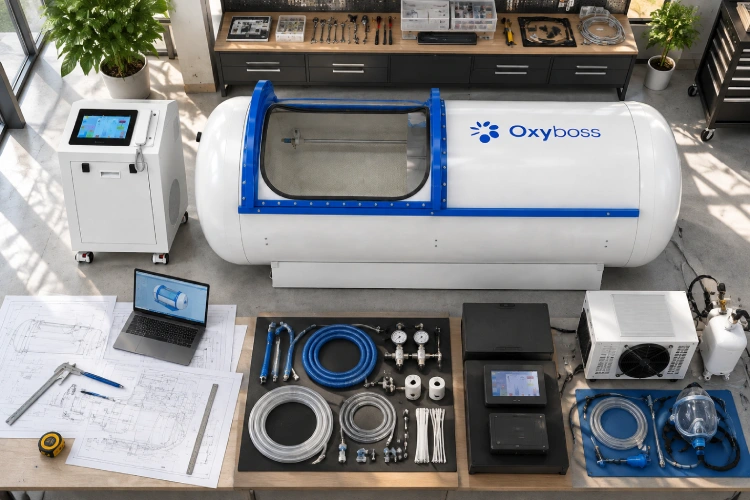
This page compares the two components inside a chamber system—the air compressor and the oxygen concentrator. They do two completely different jobs. One changes the total pressure in the chamber. The other changes what percentage of the gas is oxygen. Neither can replace the other, and understanding why matters if you're trying to make sense of equipment specs, installation requirements, or what "pressurized air with supplemental oxygen" actually means.
What each component actually does — and what it does not
Let's start with the terms themselves, because they get mixed up more often than you'd think.
The air compressor raises total pressure — it does not raise oxygen percentage
The air compressor takes room air—about 21% oxygen, 78% nitrogen, 1% other gases—and pushes it into the chamber. That raises the atmospheric pressure inside. When a chamber runs at 1.3 ATA or 1.5 ATA, the compressor is what built that pressure. The gas composition stays the same; it's just denser.
What it does: Increases total atmospheric pressure (measured in ATA or psig). What it does not do: Change the oxygen fraction. Room air at 1.5 ATA is still about 21% oxygen—just compressed.
If you see a chamber rated for "1.3 ATA working pressure," the compressor is the component that gets you there.
The oxygen concentrator changes gas composition — it does not pressurize
The oxygen concentrator pulls in room air, runs it through a molecular sieve (usually zeolite), and filters out most of the nitrogen. What comes out is 90–95% oxygen. That enriched oxygen is delivered to the user through a mask, nasal cannula, or hood.
What it does: Raises the oxygen fraction from 21% to 90–95%. What it does not do: Pressurize the chamber. A concentrator sitting on a table, running at full flow, produces oxygen-rich air at essentially atmospheric pressure (some models add a few PSI of outlet pressure to push against tubing resistance, but that's not chamber pressurization).
The concentrator doesn't "fill the chamber with oxygen." It fills a mask with oxygen-enriched air while the chamber itself stays filled with compressed room air from the compressor.
Terms that get mixed up
Here's a quick reference table for the terms you'll see on spec sheets and in product pages:
Why this matters: If a spec sheet says "requires 10 LPM oxygen supply," that's the concentrator spec, not the compressor. If it says "1.5 ATA maximum working pressure," that's the compressor spec. Mixing them up leads to mismatched equipment—buying a concentrator when you needed a higher-flow compressor, or vice versa.
Why one cannot replace the other
The reason these two components both exist in the same system is that they change different physical quantities.
The physical quantity each one changes
Put another way: if you unplug the compressor, the chamber won't pressurize—even if the concentrator is running. If you unplug the concentrator, the chamber will still pressurize, but the user is breathing compressed room air with no supplemental oxygen.
For a home or clinical mild hyperbaric chamber (1.3–1.5 ATA), some protocols use only compressed air with no added oxygen. That's a design choice, not an equipment failure. But if the design calls for supplemental oxygen and you run it without the concentrator, you're not following the protocol.
Can a generic substitute work?
This is where a lot of buyers get tripped up. "I already have an air compressor in my garage—can I use that?" or "My concentrator says 10 LPM—is that enough?"
Here's the quick version: most off-the-shelf compressors and concentrators are not designed for chamber use. The difference is in the specs.
For the air compressor side
A chamber-rated compressor has to:
- Deliver consistent pressure in the 4–7 psig range (for 1.3–1.5 ATA hyperbaric chambers) without cycling on and off constantly
- Provide continuous airflow while maintaining that pressure—not just fill the chamber and shut off
- Run oil-free (oil mist inside a chamber is a contamination and fire risk)
- Match the chamber's free-air volume and target pressure
A typical garage compressor is designed to hit 90–150 psi, then shut off. It's made for pneumatic tools that draw air in bursts. A chamber draws air continuously at much lower pressure, which is a totally different load profile.
For the oxygen concentrator side
A chamber-rated concentrator has to:
- Overcome the chamber's internal pressure—if the hyperbaric oxygen chamber is at 1.3 ATA (~4.4 psig), the concentrator's outlet pressure has to be higher than that or the oxygen won't flow into the mask
- Deliver the specified LPM at that pressure, not just at free-air conditions
- Maintain purity (90–95%) under continuous use
Most home medical concentrators are rated for free-air delivery—meaning their 10 LPM flow spec assumes they're pushing against zero backpressure. Inside a pressurized chamber, effective flow drops. Some concentrators lose 20–30% of their rated flow when working against even a few PSI.
The answer: matching is not optional
You can't just grab any compressor or concentrator and expect it to work. The equipment has to be matched—compressor to chamber volume and target pressure; concentrator to chamber pressure and user oxygen demand.
Most chamber manufacturers either bundle the right equipment or give you a compatibility list. Ignoring that list is the single most common reason for "my chamber won't hold pressure" or "I'm not getting enough oxygen" complaints.
Three layers, not two components
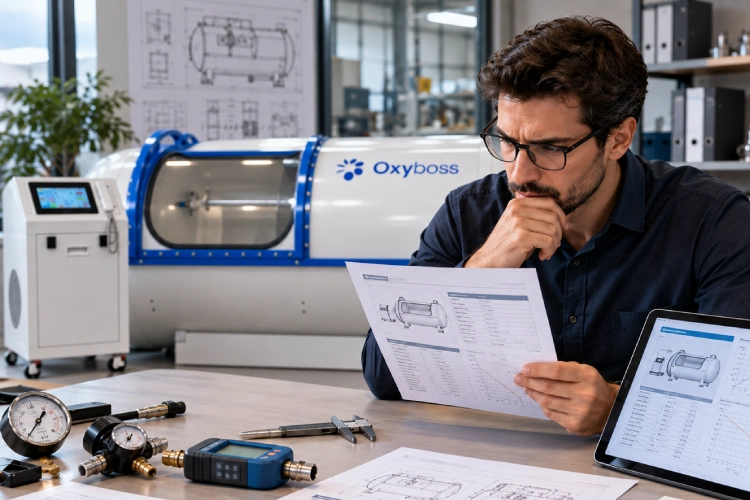
Here's a better way to think about the system: it's not just "compressor + concentrator." It's three functional layers stacked on top of each other.
Pressure layer (air compressor)
Function: Raises the total atmospheric pressure inside the chamber. Component: Air compressor What changes: ATA (atmospheres absolute) and psig (pressure differential) What does not change: Gas composition—still about 21% oxygen
Example: A chamber running at 1.5 ATA has a pressure differential of about 7.3 psig. The compressor built that differential. The air inside is denser, but it's still the same mix of gases you'd breathe at sea level.
Gas composition layer (oxygen concentrator)
Function: Raises the oxygen fraction in the breathing gas from 21% to 90–95%. Component: Oxygen concentrator (with PSA molecular sieve + zeolite) What changes: Oxygen percentage in the output stream What does not change: Chamber pressure—the concentrator adds almost no pressurization
The concentrator pulls in room air, strips out most of the nitrogen, and outputs oxygen-enriched gas. That gas goes into a mask or hood, not directly into the chamber's bulk volume.
Delivery layer (mask, nasal cannula, or hood)
Function: Gets the enriched oxygen from the concentrator's outlet to the user's nose and mouth. Component: Tubing + mask/cannula What it does not do: Change pressure or gas composition—just delivers what the concentrator produced
Why this is the correct model: Because it explains what "pressurized air with supplemental oxygen" actually means. The chamber is filled with compressed air (pressure layer). The user breathes enriched oxygen through a mask (composition + delivery layers). Two different gas streams. The chamber stays at 21% oxygen in its bulk volume; the user's breathing zone gets 90–95% oxygen from the mask feed.
This also explains why "can I just flood the chamber with pure oxygen?" is a bad idea. You'd need an absurd amount of oxygen to fill a 200–300 liter chamber volume, it's a fire risk, and it's not how the system is designed to work. The mask-delivery model uses a fraction of the oxygen and is far safer.
Inside the air compressor
Oil-free vs oil-lubricated: why it matters for chambers
Compressors fall into two broad camps: oil-lubricated (where oil circulates through the compression chamber to seal and cool the moving parts) and oil-free (where the moving parts are sealed with low-friction coatings or run on bearing surfaces only).
For hyperbaric chamber use, oil-free is the rule, not a nice-to-have. Here's why:
- Oil-lubricated compressors introduce trace oil mist into the air stream. In a sealed chamber at elevated pressure, that oil mist becomes more concentrated with each breath.
- Oil residue on the chamber interior is hard to clean and can damage TPU or fabric seals.
- Oil mist is a fire accelerant in oxygen-enriched environments (more on this in the safety section).
The compressor's oil-free status also affects what flows through the rest of the system. If the compressor is the only thing pushing air through a molecular sieve concentrator downstream, any oil contamination shortens the sieve's life significantly.
What specs to look at on a chamber compressor
The four numbers that decide whether a compressor works for your chamber:
Important: "Air flow rate" and "total air flow" are not the same thing. Total air flow is the maximum free-air output when the compressor isn't pushing against any backpressure. Once the chamber pressurizes, the compressor's effective flow at the working pressure matters more. Spec sheets that only quote total air flow are leaving out the harder-to-find but more relevant number.
What kind of compressor you need (the engineering version)
Instead of listing four compressor types and letting you guess, here's the actual decision logic:
- For a soft chamber at 1.3–1.5 ATA (volumes 200–400 L): You need an oil-free compressor rated for at least 60–100 LPM at 5–8 psig working pressure. Small rocking-piston or oil-free scroll compressors are common.
- For a hard chamber at 2.0 ATA (volumes 400–1,500+ L): You need higher flow—often 120–200+ LPM at 10–15 psig working pressure. Industrial-grade oil-free compressors, often two-stage.
- For a 2+ person hard chamber: Plan for 1.5× to 2× the single-person flow requirement.
The chamber's free-air volume and target pressure together determine the compressor size. A bigger chamber at the same pressure needs a bigger compressor. A higher pressure at the same chamber size also needs a bigger compressor. Both factors multiply.
Inside the oxygen concentrator
How a concentrator works: the three-step version
Most oxygen concentrators use a process called PSA (Pressure Swing Adsorption). Here's the simplified version:
- Pull in room air. The concentrator draws in ambient air through an inlet filter. (This is the same room air that the compressor pushes into the chamber—about 21% oxygen, 78% nitrogen, 1% argon and other gases.)
- Push it through a zeolite sieve. The air is forced through a chamber filled with zeolite, a mineral that traps nitrogen molecules under pressure. Oxygen passes through.
- Release the pressure. When the pressure drops, the zeolite releases the trapped nitrogen and the cycle repeats. Two sieve beds alternate so the output is continuous.
That's the whole system. Pull, push, release. No chemicals, no refills—just air in, oxygen-enriched air out.
What "90–95% oxygen" actually means
When a concentrator is rated at "90% ± 3% oxygen concentration," that's the output purity under free-air conditions—meaning the concentrator is pushing against no backpressure. The moment you connect it to a mask inside a pressurized chamber, several things change:
- Backpressure inside the chamber (e.g., 4.4 psig at 1.3 ATA) opposes the concentrator's outlet flow.
- Effective LPM falls proportionally. A 10 LPM free-air rating might deliver 7–8 LPM at 4 psig backpressure, depending on the model.
- Purity can shift. Pure drop-off under load is design-dependent; some models maintain 90%+ even at high flow, others drop to 85% or lower when working against backpressure.
The takeaway: "90% oxygen" is a free-air spec. The actual concentration and flow inside a pressurized chamber are typically lower. If you need precise purity for your protocol, ask the manufacturer for chamber-pressure performance data, not free-air ratings.
Flow rate: free-air vs under-pressure
You'll see flow specs written two ways on chamber-system spec sheets:
- Free-air flow rate: Maximum liters per minute when pushing against zero pressure. Usually the bigger number.
- Working-pressure flow rate: Liters per minute at the working pressure the compressor creates. Usually the smaller number, and the one that affects what the user actually breathes.
A spec sheet that lists only the free-air number is making the system look more powerful than it is under real conditions. A spec sheet that lists both numbers, with the conditions called out, is being honest about the engineering.
Why a chamber concentrator isn't a home medical concentrator
A standard home medical concentrator (the kind prescribed for supplemental oxygen at home) is designed to deliver oxygen at low flow—often 1–5 LPM—against essentially zero chamber pressure. It works fine for someone sitting in a chair breathing through a nasal cannula at room pressure.
Inside a hyperbaric chamber, that same concentrator runs into problems:
- Outlet pressure of a typical home unit is 5–8 psi. A chamber at 1.3 ATA already has ~4.4 psi backpressure. The concentrator might not be able to push its rated flow past that resistance.
- Continuous run time at higher flow is limited—home units are often rated for intermittent use, not multi-hour chamber sessions.
- Sieve bed life can shorten dramatically under continuous high-demand use.
That's why chamber-rated concentrators exist as a separate category. They cost more, run louder, and handle backpressure continuously.
Oxygen sources: concentrator, tank, or liquid oxygen?
Three options for getting high-purity oxygen to the user:
For most home and clinical chamber users, the concentrator is the practical default—lower ongoing cost, no refills. Tanks are used in backup roles or when a concentrator can't deliver enough flow. Liquid oxygen is mostly relevant for high-flow clinical setups.
Breathing air quality: what grade are you breathing?
Some spec sheets reference "medical-grade air" or "breathing air quality" without naming a standard. That phrasing is doing more work than it should. Useful references to ask about:
- CGA Grade D (US standard for breathing air): CGA scales for breathing air purity.
- EN 12021 (European standard for breathing air): Sets limits on oxygen content, carbon dioxide, carbon monoxide, oil mist, and particulates.
If a manufacturer says "breathing air quality" without specifying a standard, that's a question worth asking directly.
Pressure units, and where the numbers come from
ATA, psi, psig, psia—what's the difference?
Three pressure units show up on chamber spec sheets. They mean different things:
- ATA (Atmospheres Absolute): total pressure including the ambient atmosphere. 1 ATA = normal sea-level pressure. 1.3 ATA = 1.3× sea-level pressure.
- psia (pounds per square inch, absolute): same idea as ATA but in imperial units. 14.7 psia = normal sea-level pressure.
- psig (pounds per square inch, gauge): pressure above ambient. 0 psig = normal room pressure. Positive numbers mean overpressure.
Conversion:
- 1.3 ATA ≈ 4.4 psig (this is the pressure differential the compressor creates)
- 1.5 ATA ≈ 7.3 psig
- 2.0 ATA ≈ 14.7 psig
Use ATA for total pressure, psig for the pressure differential the compressor has to overcome. Mixing them in the same sentence is one of the most common spec-sheet errors.
"Working pressure" vs marketing-driven pressure labels
You'll see several pressure-related terms in product literature. They are not interchangeable:
- Working pressure = the maximum pressure the device is designed to operate at continuously. A spec, not a claim.
- "Clinical pressure" or "wellness pressure" = marketing-language phrasings used by some brands. These terms carry no engineering standard and should not be confused with technical specifications.
For product literature, "working pressure" is the clearer, spec-driven term. Specs should always be in ATA or psig, not in a vague "pressure" label.
How to calculate what outlet pressure the concentrator needs
If you want to figure out whether a given concentrator can deliver oxygen against your chamber's backpressure, here's the formula:
Required outlet pressure (psig) = Chamber pressure differential (psig) + Tubing and fitting pressure loss
Worked example for a 1.3 ATA chamber:
- Chamber pressure differential: ~4.4 psig
- Tubing/fitting loss (typical): ~1–3 psig depending on length, diameter, and fittings
- Total required outlet pressure: ~5.5–7.5 psig
If your concentrator's rated outlet pressure is below that range, effective delivery will drop. If it's above, you have margin.
Note on these numbers: The tubing-loss estimate of 1–3 psig is a working assumption, not a measured value for your specific installation. Actual pressure loss depends on tubing length, internal diameter, number of fittings, and flow rate. For precise numbers, measure with a pressure gauge at the mask end under operating conditions.
For a complete system specification, refer to the chamber and concentrator manufacturer's documentation—the values above are starting points, not substitutes for manufacturer specs.
Why the "1.3 ATA" vs "1.5 ATA" vs "2.0 ATA" choice matters for both components
Higher chamber pressure means:
- More compressor work to reach and maintain that pressure (higher psig differential).
- More concentrator work to push oxygen against the higher backpressure.
- Harder installation (more robust chamber, possibly heavier framing, more electrical draw).
- Potentially different compliance status depending on your jurisdiction (this is covered in the safety section).
There's no "best" ATA—it's a design choice. But the compressor and concentrator specs have to be matched to the ATA you choose.
Maintenance, heat, CO₂, and running cost
Service intervals (by component)
Routine maintenance falls into two buckets—compressor side and concentrator side. Don't mix them up.
Compressor side:
Concentrator side:
Note: These intervals are typical ranges from manufacturer IFU (Instructions for Use) documents. Your specific equipment may have different schedules. The actual service life of a zeolite sieve bed depends on humidity, contaminants, and how hard it's worked. Two users running the same model for the same hours can see wildly different sieve bed life depending on their room air quality.
Heat: both components produce it
Both the compressor and the concentrator are doing mechanical or thermodynamic work. Work generates heat. In a home or small clinical room, that heat becomes relevant.
Compressor: A typical chamber compressor running at 1.3–1.5 ATA outputs 1,000–2,000 watts of power. Most of that eventually becomes heat. If you're running hour-long sessions in a small room, the room will warm up.
Concentrator: Same story—1,200–2,200 watts for a chamber-rated concentrator, most of which turns into heat over time.
How to manage it:
- Place both units in a well-ventilated space. If they're in a closet or tight corner, the heat builds up and forces the units to throttle or shut down on thermal overload.
- Some integrated oxygen units (discussed in the next section) include a cooling module—air compressor, oxygen concentrator, and a small air conditioner in one box. If you're in a warm climate or running long sessions, this feature offsets the heat problem.
Why noise matters here: A compressor running at 55 dB is quiet enough for a living room. A compressor running at 65+ dB is loud enough that you'll want it in a separate room or garage. That decision affects ventilation—if the unit is far from the chamber, you need longer tubing runs and potentially higher outlet pressure to compensate for line loss.
CO₂ buildup and ventilation
Inside a sealed chamber, the user exhales CO₂. If that CO₂ isn't vented, it accumulates. At 1–2% concentration, most people start to feel short of breath. At 3–4%, headaches and nausea are common.
Why the compressor matters here: If the compressor is delivering a continuous fresh-air supply (as it should be), that inflow pushes old air out through the pressure relief valve or a dedicated exhaust port. The continuous flow keeps CO₂ from building up.
If the compressor runs in "fill-and-hold" mode—meaning it pressurizes the chamber and then shuts off—you don't get continuous fresh air. CO₂ can accumulate. That's one reason continuous-run compressors are standard for chamber use.
Running cost: the session-based version
Instead of giving a single dollar-per-month figure (which varies by electricity rate, session frequency, and equipment model), here's the formula so you can calculate it for your setup:
Cost per session = (Power draw in kW) × (Session length in hours) × (Electricity rate per kWh)
Worked example:
- Compressor: 1,200 W = 1.2 kW
- Concentrator: 2,200 W = 2.2 kW
- Total system power: 3.4 kW
- Session length: 1 hour
- Electricity rate: $0.12/kWh (adjust for your area)
Cost per session = 3.4 × 1 × 0.12 = $0.41
If you run three sessions per week, that's ~1.23/week or ~64/year in electricity.
The actual cost for your setup may be higher or lower depending on power draw and local rates. The formula lets you plug in your numbers.
For long-term cost, the biggest variable is whether you're using tanks or a concentrator. Tanks cost $10–30 per refill (depending on size and supplier), and a typical chamber session uses 1–2 refills depending on flow rate. A concentrator has no refill cost—just electricity and periodic filter/sieve replacement.
Safety: what changes when you add oxygen to a pressurized space
Fire risk in oxygen-enriched environments
Oxygen is not flammable by itself. But it's an accelerant—it makes other things burn faster and hotter.
In a room with normal 21% oxygen, a small spark might cause a brief flash. In a 90% oxygen environment, that same spark can ignite materials that are normally hard to burn—cotton, synthetic fabrics, plastics, even aluminum under the right conditions.
Why air-only chambers aren't fully exempt: Some chamber pages describe "air pressurization" as if it avoids the oxygen fire risk entirely. That's partially true and partially misleading. If you're running a chamber at 1.3–1.5 ATA with no supplemental oxygen—just compressed room air—the bulk oxygen percentage in the chamber is still about 21%. Fire risk is only slightly elevated compared to room conditions.
But: as soon as you add a mask delivering 90% oxygen, the local oxygen concentration around the user's face goes way up. A spark near the mask or tubing is the same fire risk as in any oxygen-enriched space. So the rule applies regardless of whether the chamber itself is filled with room air or oxygen-enriched air.
If you're using supplemental oxygen (which most home setups do), treat the system as oxygen-enriched. That means:
- No petroleum-based lubricants or lotions on skin or materials going into the chamber (petroleum ignites easily in high oxygen).
- No electronics inside the chamber unless they're rated for oxygen use.
- No lighters, matches, or open flames anywhere near the system.
What not to bring into the chamber
A short list of items that should never be inside a pressurized chamber with supplemental oxygen:
- Cell phones, tablets, or other battery-powered electronics (battery shorts can spark)
- Petroleum-based creams, lotions, or lip balm (fire risk)
- Wool or synthetic clothing that generates static (static discharge = spark)
- Jewelry with sharp edges (can puncture chamber material, and metal can spark)
- Any ignition source
Most chamber IFU documents include a complete list. Follow it.
What happens if the power goes out
If the compressor loses power, it stops delivering air. Pressure in the chamber starts to drop as the relief valve vents or the user breathes down the volume. How fast it drops depends on the chamber's leak rate and the relief valve setting.
For a typical soft chamber, depressurization takes 3–10 minutes. For a hard chamber with a tighter seal, it can take longer.
Critical question: Does the chamber have a manual pressure-release mechanism (a large pull valve or emergency vent)? If it does, the user can depressurize on demand. If it doesn't, they're relying on the passive relief valve or waiting for the leak rate to bring them back to ambient pressure.
What about the concentrator? If the concentrator loses power, oxygen flow stops. The user is still breathing—just compressed room air instead of oxygen-enriched air. Not a medical emergency unless the protocol specifically requires continuous high-purity oxygen.
For safety-critical setups, some facilities add a battery backup (UPS) to the compressor and concentrator, so a brief power interruption doesn't interrupt the session.
Pressure relief, pressure gauges, and manual release
Three overlapping mechanisms for controlling chamber pressure:
All three are standard on chamber systems. The relief valve is the fail-safe. The manual release is the user-controlled depressurization. The gauge is the feedback so you know what's happening.
If your chamber doesn't have all three, that's a design gap.
Oxygen concentration monitoring inside the chamber
When you're using supplemental oxygen through a mask, the oxygen concentration at the mask is close to the concentrator's output—90–95%. But what's the oxygen concentration in the chamber's bulk volume?
With mask delivery: Still about 21% in the bulk air, assuming the compressor is delivering room air and the mask isn't leaking. The enriched oxygen stays in the mask flow; it doesn't flood the chamber.
Without a mask (or with a poorly sealed mask): Oxygen leaks into the bulk volume. Over time, the chamber's overall oxygen percentage can creep up. That's why some chamber protocols call for oxygen concentration monitoring inside the chamber—not just at the concentrator outlet.
If the chamber's bulk oxygen concentration goes above 23–25%, fire risk increases significantly. Continuous monitoring with an O₂ sensor is the way to catch this before it becomes a problem.
How to tell which component failed
If something goes wrong mid-session, here's how to narrow down the cause:
Most issues trace back to something simple—loose connection, clogged filter, or a seal that needs reseating. Start with the easy checks before assuming a component failure.
Local fire code and Authority Having Jurisdiction (AHJ)
When chamber pages talk about "fire safety," they usually mean material flammability and ignition sources. That's correct, but incomplete.
In many jurisdictions, installing a hyperbaric chamber (especially a hard chamber or one that uses bulk oxygen) triggers a review by the local fire marshal or building inspector—the "Authority Having Jurisdiction" (AHJ). They want to see:
- Adequate ventilation for the room where the compressor and concentrator sit
- Fire-rated construction if the chamber is in a commercial building
- Proper clearances around oxygen storage (if you're using tanks)
- Emergency signage and procedures
The catch: what the AHJ requires varies by location. There's no single national checklist. Check with your local fire department or building department before you install.
This is one of those areas where "everyone else is doing it, so it must be fine" is not a safe assumption. Codes change, enforcement varies, and what's allowed in one city may not be allowed in the next.
Compliance and documentation: what to actually check
ASME PVHO-1 and the "2 psi threshold"
ASME PVHO-1 is a safety standard for pressure vessels for human occupancy. It sets design, fabrication, and testing requirements for chambers and related pressure equipment.
The standard applies to chambers with a pressure differential greater than 2 psig. Below that threshold, ASME PVHO-1 may not apply (depending on chamber design and construction).
Where this gets confusing: Some soft-chamber pages state that "we're below the 2 psi threshold, so ASME doesn't apply." That's partially correct—but only if the chamber design and materials fall outside the standard's structural definition of a pressure vessel. Being below 2 psi does not automatically mean exemption; it means the chamber may not fall within the standard's scope.
The accurate framing:
- "Not within the standard's scope" ≠ "compliant" ≠ "exempt." These are three different legal positions.
- A chamber can be below 2 psi and still subject to other standards or local codes.
- A chamber above 2 psi is almost certainly covered by ASME PVHO-1 if it meets the structural definition of a pressure vessel.
For buyers: Don't assume "below 2 psi" means "no compliance burden." Ask the manufacturer which standards they designed to and whether the chamber has been reviewed by a third party (e.g., pressure vessel inspector, notified body).
FDA cleared, registered, or approved—what's the difference?
The U.S. Food and Drug Administration has three different regulatory pathways for medical devices, and they're not interchangeable:
Why this matters: A chamber or concentrator described as "FDA registered" has only met the minimum reporting requirement—it does not mean the device passed a safety or efficacy review. "FDA cleared" means it went through 510(k) and was found substantially equivalent to something already on the market. "FDA approved" is the highest bar and is uncommon for chambers.
When verifying claims: Ask for the 510(k) number (if cleared) or the registration number (if registered). Both are publicly searchable in FDA's device databases:
- 510(k) database: https://www.accessdata.fda.gov/scripts/cdrh/cfdocs/cfpmn/pmn.cfm
- Registration database: https://www.accessdata.fda.gov/scripts/cdrh/cfdocs/cfRL/rl.cfm
Component-level vs system-level: Sometimes "FDA" refers to a single component (e.g., the concentrator is cleared, but the complete chamber system is not). Always ask: is the entire system cleared, or just part of it?
Wellness vs non-wellness positioning
Some chambers are marketed as "wellness" devices—meaning they're positioned for general health and recovery, not for diagnosing or treating specific medical conditions. Others are marketed as devices for specific indications.
The difference affects regulatory status. A wellness-positioned chamber with no medical claims may fall into a different risk class (or may not be classified as a medical device at all, depending on jurisdiction). A chamber marketed for wound healing or decompression sickness is almost certainly a regulated medical device.
For buyers: If you're in the U.S., a chamber marketed for wellness or general health should not be making claims about treating diseases. If the website says "treats X condition," that's a medical claim and the device should have FDA clearance. If it doesn't, that's a red flag.
If the device does have clearance, the 510(k) summary will list the "indications for use"—the specific conditions the device is cleared for. Anything outside that list is off-label.
How to verify documentation
Three practical checks before you buy:
- Ask for the equipment's serial number and manufacturing date. Cross-reference that with the manufacturer's IFU (Instructions for Use) document for that model year. Make sure the specs match.
- Ask for the third-party test reports (if the manufacturer claims any). Pressure vessel testing, oxygen compatibility testing, and fire-safety testing should have dated reports with lab letterhead. If they say "tested to standard X" but can't provide a report, it's unverified.
- Search the FDA databases if the device claims FDA status. If you can't find it, either the claim is wrong or the registration is under a different name/number. Ask for clarification.
Integrated oxygen units: when two (or three) functions live in one box
So far we've talked about the compressor and concentrator as separate pieces of equipment. But there's a newer design pattern you'll see in modern chamber systems: the integrated oxygen unit.
What "integrated" means
An integrated oxygen unit combines the air compressor and oxygen concentrator into a single housing. Instead of two separate machines sitting side by side, you get one box with two functional modules inside.
Some units take this a step further and add a third module: air cooling. These are called 3-in-1 units (air compressor + oxygen concentrator + cooling unit). The cooling module offsets the heat both the compressor and concentrator produce, which is especially useful in warm climates or long-session use.
Common configurations:
- 2-in-1: Air compressor + oxygen concentrator. Typical power draw: 1,000–1,500 W. Footprint: smaller than two separate units. Used with soft chambers or lower-pressure hard chambers.
- 3-in-1: Air compressor + oxygen concentrator + cooling. Typical power draw: 2,000–2,500 W. Footprint: still smaller than three separate units. Used with higher-pressure hard chambers or extended-session setups.
These aren't fundamentally different technologies—they're the same compressor and concentrator types we discussed earlier, just packaged together.
Why integrated vs separate matters
Space and setup: An integrated unit takes up less floor space and has fewer interconnecting hoses. If you're in a small room or trying to keep the setup tidy, that's a real advantage.
Connection and wiring: With a 2-in-1 or 3-in-1, you're running power to one unit instead of two or three. Fewer extension cords, fewer outlets needed. Some units use modular plug-and-play cabling internally, which simplifies troubleshooting.
Heat management: A 3-in-1 with integrated cooling solves the "both units heat up the room" problem we mentioned earlier. The cooling module is sized for the compressor and concentrator's heat output, so the net temperature rise in the room is much lower.
Service and redundancy: Here's the tradeoff. If the compressor fails in a 2-in-1 unit, you lose both pressurization and oxygen delivery (because the concentrator is in the same box and may share power or control circuits). With separate units, if the compressor fails, you can still run the concentrator as a standalone unit for other uses, or vice versa.
On the other hand, modular internal design (where each function is a separate plug-in module inside the housing) can make repairs faster—pull the failed module, plug in a replacement, done. Whether your specific unit supports that depends on the manufacturer's design.
Redundancy and what happens when one component fails
In a separated system (compressor and concentrator as distinct units):
- If the compressor fails → chamber won't pressurize, but you still have oxygen output (not useful for chamber sessions, but the concentrator itself is functional)
- If the concentrator fails → chamber still pressurizes, user breathes compressed air with no supplemental oxygen (depending on your protocol, this may or may not be acceptable)
In an integrated system:
- If the compressor fails → depends on the unit's internal wiring. Some designs isolate the compressor and concentrator power, so one can fail without taking down the other. Other designs link them, so a failure in one module powers down the entire unit.
- If the concentrator fails → same caveat—depends on whether the unit is modular or monolithic.
What to ask before you buy an integrated unit: "Are the compressor and concentrator modules independently replaceable, or is it a sealed assembly?" If they're independently replaceable, you have redundancy at the module level. If it's sealed, a single-point failure means sending the whole unit back for service.
Before you buy
Site and installation requirements
Two factors that catch buyers off guard: electrical and space/ventilation.
Electrical requirements
The compressor and concentrator combined can pull 1,200–3,400 watts depending on configuration. In the U.S., that's:
- 1,200 W (2-in-1): ~10 A at 120 V → fits on a standard 15 A household circuit, but don't plug anything else heavy on the same circuit
- 2,200 W (3-in-1): ~18 A at 120 V → exceeds a standard 15 A or 20 A circuit. You need either a dedicated 30 A circuit (which requires running new wiring) or 240 V service.
If you're installing a 3-in-1 integrated unit, verify your electrical service before you order. Running a new 30 A circuit isn't expensive in most areas (~$200–500 for a licensed electrician), but it's not same-day work. Plan ahead.
For 220/240 V countries, this is less of an issue—the current draw at higher voltage is proportionally lower, so the same 2,200 W unit pulls ~10 A at 220 V, well within standard outlet capacity.
Space and ventilation
Both the compressor and concentrator produce heat. If they're in a closet or unventilated corner, they'll overheat and throttle or shut down.
Minimum clearances (typical):
- 12–18 inches on all sides for airflow
- Room temperature below 85°F (30°C) for continuous operation
- If using a 3-in-1 with cooling, the cooling module vents warm air out the back—make sure that air has somewhere to go (not blowing directly into a wall)
Chamber placement: Soft chambers are collapsible and can fit through standard doorways when deflated. Hard chambers are rigid. The smallest dimension of a hard chamber (usually width) has to fit through your doorway. For a typical residential doorway (32 inches / 81 cm clear width), only the narrowest hard chambers (single-person capsule designs, ~75 cm width) will fit. Larger chambers may require a wider door, removing a doorframe, or assembling the chamber inside the room.
Warranty, parts availability, and service response
Warranty terms for chambers and oxygen units vary widely—1 year on soft chambers, 3 years on hard chambers, 1–3 years on compressors and concentrators depending on the brand.
What to check:
- What's covered: Labor and parts? Or just parts (meaning you pay for service calls)?
- Response time: Is there an SLA (service level agreement) for repair response? Or is it "we'll get to it when we can"?
- Parts availability: Can you get replacement filters, sieve beds, and seals within a few days? Or are they special-order from overseas?
For more detail on warranty response times, SLAs, and what to ask suppliers, see our separate guide on hyperbaric chamber warranty and service expectations (internal link placeholder).
Equipment matching checklist (downloadable)
Here's a quick-reference checklist you can download and take to suppliers:
Compressor specs to verify:
- Working pressure (psig or ATA) matches chamber target pressure
- Air flow rate (LPM) at working pressure (not just free-air flow) meets chamber volume and target pressurization time
- Oil-free design
- Duty cycle: 100% continuous
- Inlet filter serviceable
- Pressure relief valve accessible for testing
Concentrator specs to verify:
- Outlet pressure (psig) exceeds chamber backpressure + tubing loss by at least 2 psi
- Oxygen flow rate (LPM) at chamber pressure meets user demand (typically 8–15 LPM depending on mask type)
- Purity rating: 90% ± 3% minimum
- Molecular sieve bed service hours documented
- Rated for continuous operation (not intermittent-duty home medical units)
System integration:
- Chamber manufacturer provides compatibility list or bundled equipment
- All electrical specs match site power (voltage, amperage, circuit breaker rating)
- Tubing lengths, diameters, and fittings specified
- Oxygen concentration monitoring inside chamber (if using supplemental oxygen)
Documentation:
- IFU (Instructions for Use) provided for each component
- Pressure testing reports (if applicable)
- FDA registration or clearance number (if in U.S. and device makes medical claims)
- Local fire marshal or AHJ approval (if required in your jurisdiction)
Download this checklist as a printable PDF (download link placeholder)
Chamber systems and integrated oxygen units
Now that you understand how the compressor and concentrator work—and why neither can replace the other—here's how those components pair with actual chamber designs.
We offer two equipment lines, organized by the oxygen supply architecture:
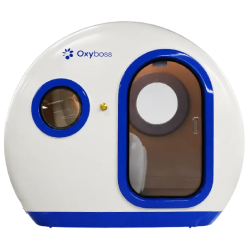
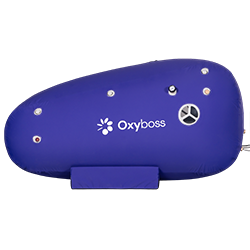
Soft chamber line (configured with 2-in-1 integrated oxygen units)
Oxygen unit: 2-in-1 integrated (air compressor + oxygen concentrator) Power: 1,200 W Electrical: 120 V ~10 A (fits standard 15 A circuit) Footprint: 520 × 450 × 708 mm / 50 kg Output: 10 LPM oxygen at 90% ± 3%; 205 LPM total air flow; adjustable working pressure 1.1–1.5 ATA
Why this configuration works: Soft chambers are collapsible, so they're easy to transport and set up in rooms with standard doorways. The 2-in-1 unit provides enough flow and pressure for the chamber's volume without requiring specialized electrical service. Total system power stays under 1,500 W, which means you can plug it into a normal household outlet.
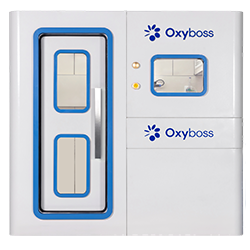
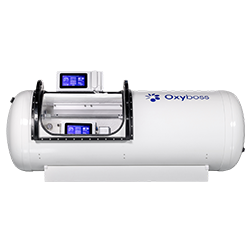
Hard chamber line (configured with 3-in-1 integrated oxygen units)
Oxygen unit: 3-in-1 integrated (air compressor + oxygen concentrator + air cooling) Power: 2,200 W Electrical: 120 V ~18 A (requires 30 A dedicated circuit or 240 V service at ~9 A) Footprint: 930 × 450 × 920 mm / 130 kg Output: 10 LPM oxygen at 90% ± 3%; adjustable working pressure 1.1–2.0 ATA; integrated cooling offsets compressor and concentrator heat
Why this configuration works: Hard chambers operate at higher pressure (2.0 ATA) and have larger internal volumes. The 3-in-1 unit provides the flow, pressure, and cooling needed for extended sessions without overheating the room. The integrated cooling module is a practical feature if you're running hour-long sessions daily—without it, a 2,200 W unit would warm a typical room by several degrees per session.
Doorway fit: Only the H201S (75 cm width) will fit through a standard residential doorway (81 cm clear width). All other hard chambers require either a wider door, temporary doorframe removal, or in-room assembly.
Why we organize by oxygen unit type
Most chamber suppliers organize product pages by chamber size or pressure. We organize by oxygen supply architecture because that's what determines your electrical and space requirements.
If you know you're limited to standard household electrical (15 A / 120 V), the soft chamber line with 2-in-1 units is your range. If you have or can install 30 A service or 240 V, the hard chamber line with 3-in-1 units opens up.
Pressure and size matter, but the electrical infrastructure is the first gate. Figure that out before you get attached to a specific chamber model.
References
- ASME PVHO-1 (Pressure Vessels for Human Occupancy): ASME International, latest edition. Available at https://www.asme.org/codes-standards/find-codes-standards/pvho-1-safety-standard-pressure-vessels-human-occupancy
- FDA 510(k) Premarket Notification Database: U.S. Food and Drug Administration. Search device clearances at https://www.accessdata.fda.gov/scripts/cdrh/cfdocs/cfpmn/pmn.cfm
- FDA Device Registration and Listing: U.S. Food and Drug Administration. Verify manufacturer registration at https://www.accessdata.fda.gov/scripts/cdrh/cfdocs/cfRL/rl.cfm
- CGA Grade D Breathing Air (CGA G-7.1): Compressed Gas Association. Standard for compressed breathing air purity.
- EN 12021 (Respiratory protective devices – Compressed air for breathing apparatus): European standard for breathing air quality.
- NFPA 99 (Health Care Facilities Code): National Fire Protection Association. Chapter 14 covers hyperbaric facilities. Available at https://www.nfpa.org/codes-and-standards/all-codes-and-standards/list-of-codes-and-standards/detail?code=99
Disclaimer: This page provides general information about air compressor and oxygen concentrator components used in hyperbaric chamber systems. It does not provide medical advice, and it is not a substitute for manufacturer documentation, professional installation guidance, or regulatory review specific to your jurisdiction. Equipment specifications, safety requirements, and compliance obligations vary by location and device classification. Always consult the manufacturer's Instructions for Use (IFU), local authorities having jurisdiction (AHJ), and relevant regulatory bodies (FDA, TGA, notified bodies, etc.) before purchasing or operating hyperbaric equipment. The pressure, electrical, and safety information provided here is for educational purposes and reflects typical industry practice as of 2026; your specific equipment may have different requirements.