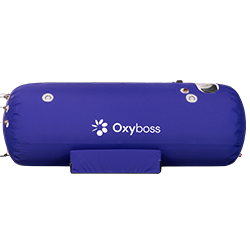
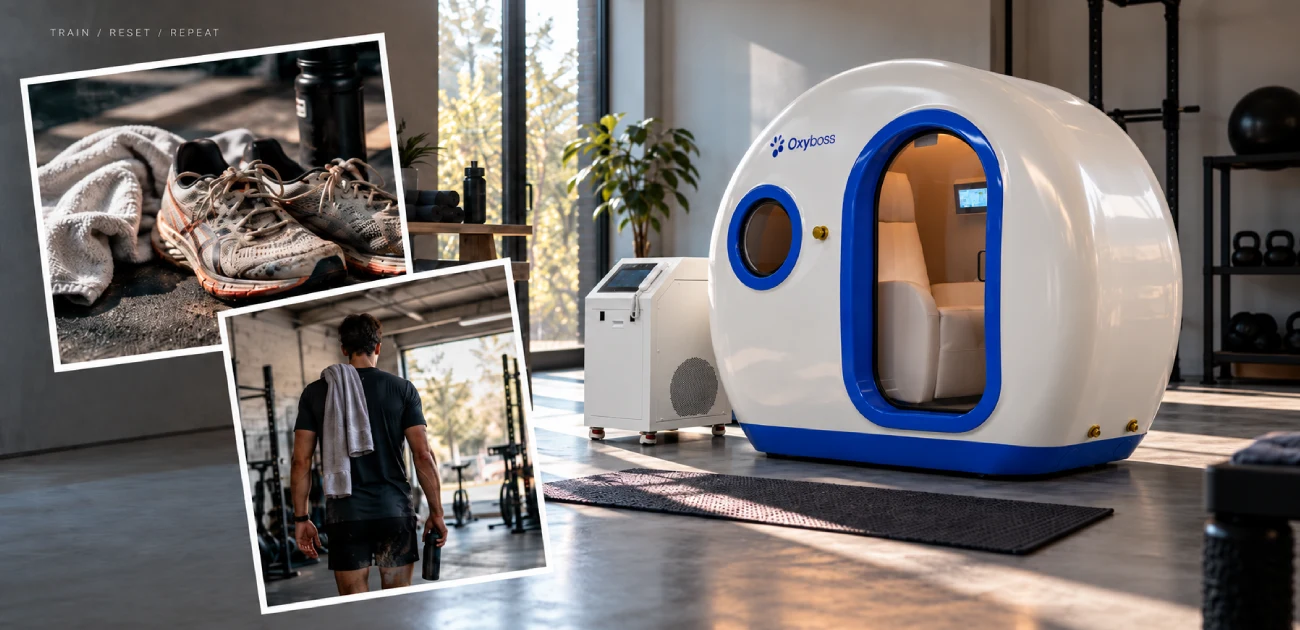
Before you read: Hyperbaric chambers used by athletes are personal wellness devices, not medical devices. If you have any health condition — including recent surgery, ear or sinus problems, lung issues, pregnancy, or implanted devices — talk to your physician before using one. The FDA has not cleared hyperbaric chambers for sports injuries or athletic recovery. [More on FDA status]
What "sports recovery" means
When athletes talk about using a hyperbaric chamber for recovery, they usually mean one or more of these:
- Feeling less sore after hard training or a game
- Getting back to training sooner between sessions
- Sleeping better on nights after hard efforts
- Subjective edge — clearer head, less heavy legs
That last one is the hardest to measure. The published research focuses on blood markers (CK, IL-6, lactate) and subjective soreness scales, not performance outcomes.
How the chamber works
A hyperbaric chamber is a pressure vessel. You sit or lie inside, the door seals, and air pressure rises above normal atmospheric pressure. While you breathe near-pure oxygen through a mask, the higher pressure pushes more oxygen to dissolve into your blood plasma — beyond what red blood cells carry at normal pressure.
That is the physical mechanism. What happens after that — whether soreness drops, sleep improves, or recovery speeds up — varies by person and depends on dose, timing, and baseline condition.
The two variables that matter
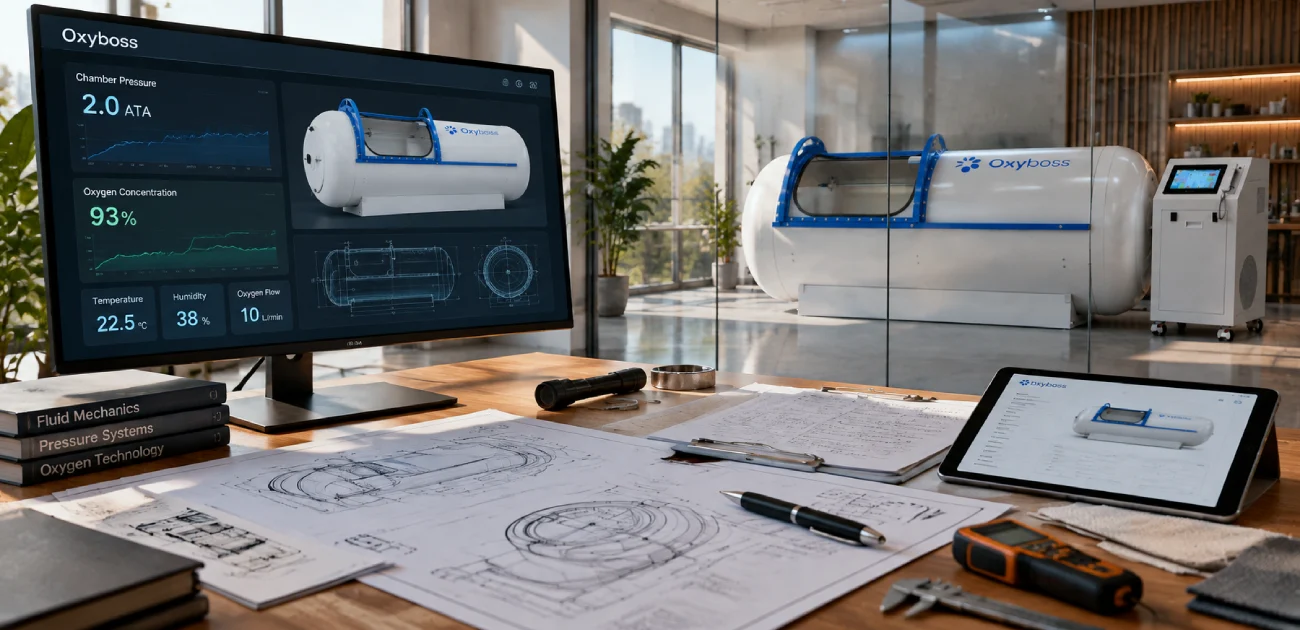
- Pressure — measured in ATA (atmospheres absolute). Sea level is 1.0 ATA. Sports-recovery chambers typically run 1.3–2.0 ATA.
- Oxygen fraction (FiO2) — the percentage of oxygen you breathe. Normal air is 21%. Chambers used for wellness deliver around 90% oxygen through a mask.
Time, temperature, and humidity are also settings, but they affect comfort more than outcome.
Pressure, oxygen, time — the numbers
The table below lines up what published studies used with what home chambers typically deliver. Your physician sets your actual dose.
One caveat. Most published studies used pressures above 1.5 ATA and multiple sessions per day. Many home chambers top out at 1.5 ATA. The match between research protocols and home use is imperfect.
How many sessions
Individual responses vary. Nobody can promise you a specific number.
What published protocols show:
- After one hard effort: a single 60–90 minute session within 24 hours. One football-match trial reported better subjective soreness scores at 24 and 48 hours compared to control.
- Across a training block: 5–14 sessions over 1–2 weeks. Blood markers (CK, IL-6) moved in some studies, not in others.
- For subjective feel: buyers who contact us typically describe noticing a difference somewhere between session 3 and session 10. Some describe no clear difference after 20. Both happen.
A practical trial plan. If you are buying for yourself: 3 sessions per week for 4 weeks = 12 sessions total. After that, decide whether to continue. Do not commit to more than that up front.
What published studies show
The published literature on hyperbaric chambers for sports recovery is still evolving. Here is where it stands.
Study sizes and what they measure
Most studies are small (10–30 participants) and measure surrogate markers — CK, IL-6, LDH, oxidative stress — rather than time-loss from sport or performance outcomes. A 2025 systematic review pooled 9 trials (219 participants total) and found mixed results: some studies showed improvement in subjective soreness, others showed no difference or slightly worse mid-term pain.
Subjective vs objective outcomes
A consistent pattern: participants often report feeling better even when blood markers do not move significantly. This does not mean the effect is not real — subjective recovery matters for training compliance and mental state — but it does mean the mechanism is not fully understood yet.
Pressure and protocol differences
Studies range from 1.3 ATA soft chambers to 2.5 ATA hospital protocols. Higher-pressure, multi-session-per-day protocols have more published support than lower-pressure, less-frequent home use.

When in the training cycle
Timing matters more than people expect. Most published protocols and most buyer-reported results cluster around three windows:
Post-training / post-game
The most common window. A 60–90 minute session within 24 hours of a hard effort is what most research and buyer coaching reports describe. The football-match trial used exactly this timing: a single session within 24 hours, with follow-up the next day.
Pre-training priming
Some athletes use a shorter, lower-ATA session (60–75 min at 1.3–1.4 ATA) 30–90 minutes before hard training or competition, on the theory that raising tissue oxygen saturation beforehand may support output during the effort. Published evidence for priming is thinner than for post-training recovery. Try one session before a moderate workout before you build it into a pre-game taper.
Between-event recovery
For tournaments, multi-day races, or back-to-back fixtures. The pattern that works here is the same 60–90 minute dose, applied 2–4 hours after the prior event and again 12–24 hours later if the next event is the next day. Keep session length under 90 minutes and leave at least one to two hours between sessions.
Use cases by sport
Where the chamber fits, by sport:
Endurance: running, cycling, triathlon, rowing
High training volume and repeat hard sessions. Buyers in this group tend to use the chamber between key sessions — for example, after a Sunday long run, then again Wednesday after a tempo session. Reported feedback centers on leg freshness and the next-day session feeling more aerobic.
Strength and power: powerlifting, Olympic lifting, CrossFit
High eccentric load creates more delayed muscle soreness. Buyers in heavy training cycles tend toward three to five sessions per week during blocks. A small number report noticeable recovery between training days.
Combat sports: MMA, BJJ, boxing, wrestling
Sessions often run three to five per week during camp. Reported feedback centers on head clarity after hard sparring days. Between-camp taper is the most common use.
Team sports: football, rugby, hockey, soccer, basketball
The "between-match" case is the most studied — football-match trials, rugby protocols, basketball back-to-back fixture taper. Three to five sessions per week during a multi-game week is the typical pattern.
Altitude sports: ski mountaineering, trail running, ultrarunning
At 3,000 m and above, atmospheric pressure drops enough that tissue oxygen saturation falls even at rest. A hyperbaric session at 1.3–2.0 ATA at sea level recreates the equivalent of lower altitude — buyers who return to town from high camps describe this as the most useful single use case.
Travel, altitude, and between-event recovery
Three situations where buyers describe the chamber paying for itself:
Long-haul travel to competition
Flights, time-zone shifts, and the drive from the airport create a recovery stack of their own. A 60–90 minute session the evening of arrival or the next morning is the most common pattern. It is not a substitute for sleep, hydration, and nutrition — it stacks on top of them.
Returning from altitude
High-camp training leaves athletes with measurable drops in plasma oxygen for 24–72 hours after descent. A 60–90 minute session at 1.5–2.0 ATA within 24 hours of returning to sea level recreates some of the load absorbed at altitude. The mechanism here is the most direct: you are simulating higher ambient pressure.
Back-to-back fixtures and multi-day events
Multi-day tournaments, heat formats, or a week of fixtures with one rest day between each. The pattern that works: 60–90 minute session 2–4 hours after the first event, repeat 12–24 hours later. Keep session length under 90 minutes and leave at least one to two hours between sessions.
Buying vs booking sessions
Both options are real. Here is the math.
A single hyperbaric session at a wellness studio or recovery lounge in the US typically runs 80–250 per session. Three sessions per week over a year, at the mid-range, adds up to around 12,000–39,000 in session fees.
A home chamber is a one-time capital outlay. Running costs are electricity (around 1.2–2.2 kWh per 60-minute session), inlet filter swaps every 500–1,000 hours, and a door seal check every two years.
The break-even point depends on how often you use it. Rough rule: if you can see yourself doing 3+ sessions a week for 12+ months, ownership wins on cost and convenience. Below that, booking single sessions or a membership makes more sense.
On pricing: Our equipment prices change with configuration, region, and shipping terms. If you want a number: send us your use case (sessions per week, space, electrical setup, region) and we will send back a real quote within one business day, with shipping terms spelled out.
For teams and facilities
If you are outfitting a training room, recovery lounge, or wellness studio, three things matter most:
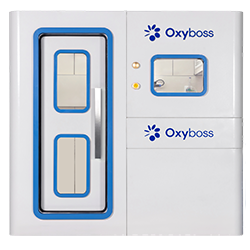
- Throughput. A single 1-person chamber delivers one user every 90–120 minutes (session + ramp + reset). A 2-person chamber roughly halves the per-session time cost but doubles the capital outlay. For 8–20 athletes rotating, plan 3–4 chambers or a combination of a 2-person unit and a queue.
- Electrical and HVAC. A hard-chamber room needs around 4–6 air changes per hour, a 10 A breaker with residual-current protection, and air conditioning sized for the heat the compressor puts into the room. Plan the room before you plan the chamber.
- Operating noise. The integrated compressor is about 60 dB(A) at 1 meter. Inside the chamber, the user hears roughly 45–48 dB(A). If your space shares a wall with an office or treatment room, plan for separation.
Other practical items — service continuity, intake filtration, fire-safety alignment with local codes, and operator training — are covered in the checklist below.
FDA, insurance, and "wellness device"
What the FDA has cleared
The U.S. FDA has cleared hyperbaric chambers for specific medical conditions — decompression sickness, carbon monoxide poisoning, certain wound-care indications, and a few others. The FDA has not cleared them for sports injuries, training fatigue, or exercise-induced muscle damage.
What "wellness device" means
Outside the medical-indication list, a hyperbaric chamber is sold as a personal wellness device — the same category as a massage chair or a red-light panel. That means:
- It is not a medical device.
- It is not a substitute for medical care.
- It should not be marketed with medical claims.
That is the honest category. Saying otherwise creates problems for both buyer and seller.
Insurance and reimbursement
Wellness hyperbaric sessions are an out-of-pocket expense. Health insurance, HSA, and FSA funds do not cover them. If a provider says otherwise, ask for the billing code and the carrier's written policy.
WADA and anti-doping
Hyperbaric oxygen was on the WADA prohibited list from 2006, was removed in 2009, and has not returned. Athletes can use it. If you compete under a testing pool, confirm with your sport's governing body.
Who should skip it
Do not use a hyperbaric chamber if any of these apply to you. Talk to a physician first, or look at a different recovery tool.
- You have an untreated ear, sinus, or lung condition (including a recent cold with congestion) — pressure equalization may not work.
- You have a collapsed lung (pneumothorax) history, or any active respiratory infection.
- You are pregnant.
- You have an implanted electronic device (pacemaker, defibrillator, insulin pump) — confirm with your cardiologist first.
- You have claustrophobia or panic-disorder symptoms that interfere with enclosed spaces — start at 1.0 ATA and build up, or skip.
- You have taken alcohol within the past several hours — wait until you are fully clear.
- You are under 18 and unsupervised — pediatric use requires adult accompaniment and lower starting pressure.
Pre-purchase checklist
For home users
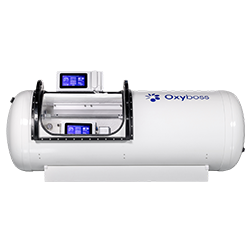
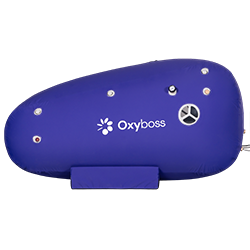
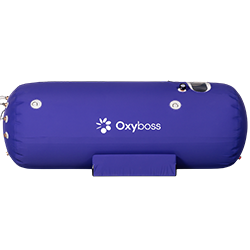
- Soft-side (≤1.5 ATA) or hard-side (up to 2.0 ATA)? Match to your physician's view on pressure.
- Single person or two-person? Two-person costs more up front but doubles throughput.
- Room size: measure the door, elevator, and corner clearances. The largest single-piece dimension has to physically reach the room.
- Electrical: confirm 110 V / 220 V / 240 V compatibility, dedicated breaker, and grounded outlet.
- Ventilation: 4–6 air changes per hour for hard chambers; the room should not be a sealed closet.
- Warranty: what is covered, what is excluded, how long for soft-side vs hard-side?
- Spare parts: filters, door seals, oxygen-concentrator sieve — stocked locally, or shipped from the factory?
- Support: 24/7 remote diagnostics, on-site repair, or both?
For teams and facilities
- Throughput calculation: athletes per day ÷ sessions per chamber per day = chambers needed.
- Operator training: who runs sessions, what is the documentation, who is the named safety lead?
- Local code alignment: pressure-vessel registration (where applicable), electrical inspection, fire-safety review.
- Room buildout: ventilation, sound separation, door and access, electrical service, drainage for condensate.
- Service contract response times: written SLA on parts and remote support.
- Decommissioning plan: who takes the chamber out when it reaches end of life?
FAQ
Is a hyperbaric chamber FDA-cleared for sports recovery?
No. The FDA has cleared hyperbaric chambers for specific medical conditions — none of which include sports recovery. Chambers sold for sports or wellness use are personal wellness devices.
How many sessions do athletes actually do?
Research protocols range from a single session after a match to 5–14 sessions across a training block. For personal use, buyers typically report 3–5 sessions per week. Individual responses vary.
Is a soft chamber as effective as a hard chamber?
Soft chambers top out at about 1.5 ATA; hard chambers can go to 2.0 ATA. Higher pressure means higher partial pressure of oxygen at the mask. Most sports-recovery research used higher pressures. Whether that translates to a meaningful difference for any individual is not settled.
Does insurance cover hyperbaric chamber sessions or purchase?
Not for sports-recovery or wellness use. Coverage applies only to FDA-cleared medical indications.
How loud is a hyperbaric chamber?
The integrated compressor is around 60 dB(A) at 1 meter. Inside, the user hears about 45–48 dB(A). Most people read or nap inside.
Can athletes use a hyperbaric chamber every day?
There is no fixed limit in published protocols. Common practice is 1–2 sessions per day with at least a few hours between, not exceeding 2 hours per session.
What about WADA — is hyperbaric oxygen banned?
No. Hyperbaric oxygen was removed from the WADA prohibited list in 2009. Always confirm with your sport's anti-doping authority if you are in a tested pool.
Can I bring electronics into the chamber?
Low-voltage consumer electronics (phones, tablets) below about 24 V are fine. Do not bring flammable materials, lighters, or anything with exposed high-voltage components.
What should I wear?
Loose, 100% cotton clothing. No synthetics, no shoes. Cotton reduces static and is comfortable across the pressure cycle.
How long does a session take end-to-end?
A 60-minute session usually takes 90 minutes total: 10–25 minutes to ramp up to pressure, 60 minutes at pressure, and 10 minutes to come back down.
What does it feel like inside?
Your ears need to equalize during the ramp — like on an airplane. The chamber is air-conditioned. The mask delivers cool, dry oxygen. Most users settle into reading, napping, or scrolling within 10 minutes.
Sources
- Systematic review: hyperbaric oxygen for delayed-onset muscle soreness and recovery after exercise. Cochrane Database Syst Rev. cochrane.org
- Meta-analysis: effects of hyperbaric oxygen on muscle damage, oxidative stress and inflammation after intense exercise. pubmed.ncbi.nlm.nih.gov
- Meta-analysis: HBOT for sport-related muscle recovery (2025 update). frontiersin.org
- Placebo and expectation effects in exercise recovery interventions. sciencedirect.com
- Open-access review: hyperbaric oxygen in sports medicine. mdpi.com
- Single-session pricing survey across U.S. recovery and wellness studios, 2025–2026. pmc.ncbi.nlm.nih.gov
- Hyperbaric facility design and operating-noise guidance. NFPA 99 · ASME PVHO-1
- FDA consumer update: Hyperbaric Oxygen Therapy — Get the Facts. fda.gov
- UHC provider coverage policy: Hyperbaric Oxygen Therapy. uhcprovider.com · CMS National Coverage Determination 20.29. cms.gov
- WADA Prohibited List and the history of hyperbaric oxygen. wada-ama.org
- Pre-session screening checklist for personal hyperbaric use. UHMS
- UHMS guidelines on hyperbaric exposure for minors. UHMS
Important. Oxyboss hyperbaric chambers are personal wellness devices. They are not medical devices and are not intended to diagnose, treat, cure, or prevent any disease. If you are pregnant, have a cardiac or pulmonary condition, an implanted electronic device, a history of pneumothorax, claustrophobia, or any other health concern, consult your physician before using a hyperbaric chamber.