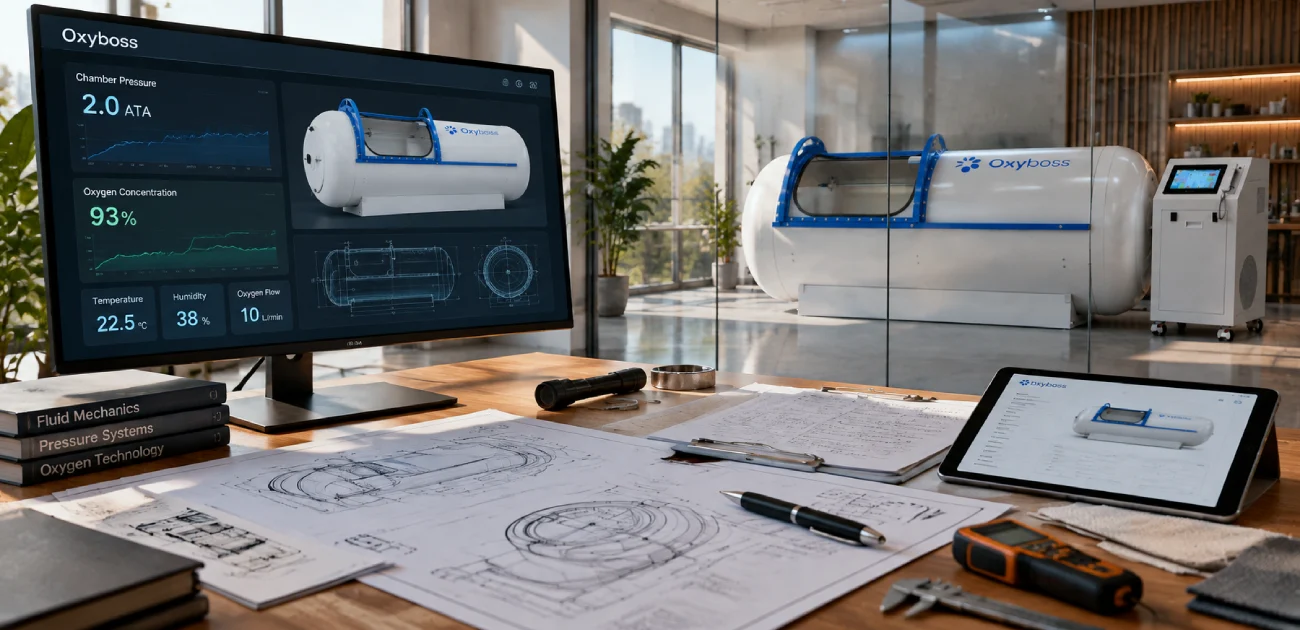







"Opening" and "closing" here mean the daily operations of the chamber: the checks you run before the first pressurization of the day, and the sign-off after the last session.
1. Three layers, not one long column
Most checklists you'll find online dump everything into a single column of tick boxes. They mix three different jobs. Those jobs run on different clocks, belong to different people, and fail in different ways.
Layer 1 — Start of day. Once, before the first pressurization. Chamber integrity, observation surface, communication, interlocks, instruments, ignition sources, grounding. Owned by the designated operator, with a second person verifying.
Layer 2 — Every session. Before, during, and after each pressurization. Occupant self-confirmation, in-session monitoring, oxygen concentration, alarm response, pressure and time. Owned by the operator on duty.
Layer 3 — End of day. After the last session, before the facility is secured. Depressurization confirmation, moisture and residue, cleaning, stowage, log sign-off. Owned by the operator on duty, countersigned by whoever's in charge.
The practical point of separating them is ownership. Most facility problems you read about publicly in this field are not missed checks — they're checks that belong to a layer nobody was assigned. If your current checklist is one long column of tick boxes, the most useful thing you can do today is split it into these three layers and write a name next to each line.
Three conditions have to be true before a checklist is worth running
Someone's designated, and there's a sequence behind them. Training, then supervised observation, then a documented competency verification, then authority to sign a shift independently, then periodic refresher. Each step leaves a record. Which specific certificates or course hours your jurisdiction expects is set by the body that licenses or accredits your facility. Requirements differ by state, and the expectations for a non-medical setting are not the same as for a medically supervised one. Confirm the current requirement with your licensing or accrediting body — don't rely on a list published by a supplier or another operator.
Two names where two names are needed. One person performs the check. A second person verifies it. The log shows both names. That single arrangement is what separates a checklist from a personal habit. A check performed by one person and verified by nobody is a record carrying one name — and that is the record that is hardest to defend later. Two-person verification properly belongs to any item whose failure would prevent pressurization, and to any decision to return a chamber to service after a defect.
The scenarios are named in advance, not improvised. At minimum, the following should each have a written first action and a named owner:
- fire or smoke at or near the chamber
- loss of communication with the occupant
- loss of electrical power during a session
- contamination of the breathing gas supply
- inability to hold or reach the intended pressure
- uncontrolled or rapid depressurization
- a change in the occupant's condition during the session
- failure of the oxygen system
A drill that's never been run on paper isn't a plan.
2. The opening checklist — eight items, what "pass" actually means
Eight checks. For each: what to look at, what counts as a pass, and what should stop the day. The items marked ◆ must be done before the first pressurization of the day, not before every session and not "sometime in the morning". That "before the first pressurization" framing is what you'll find if you go read NFPA 99's Chapter 14 directly: a visual inspection is required before each chamber pressurization commencing hyperbaric operations for that day. That language is quoted from NFPA 99-2024 First Revision No. 901, a proposed revision document — not a published edition. Treat it as a pointer, not as the authority. Verify the requirement against the current edition of NFPA 99, Chapter 14 (Hyperbaric Facilities), and against any written determination your authority having jurisdiction has made for your facility.
1. ◆ Chamber body, body material, and seals
Run your hand around the full circumference. On a hard-shell chamber: the shell, every seam, the door or hatch gasket. On a soft-sided chamber: the body material, every seam, the closure line.
A pass means: a continuous seal, no visible separation, the gasket seated in its groove and still pliable — not compressed, not deformed, not taken a set. Stop the day if there's any tear, any separation, or a gasket that's deformed.
2. ◆ Observation surface
Different rules for different materials.
Hard-shell chamber — acrylic viewport. A pass means: no cracks, no crazing or progressive whitening, no scratch deep enough to catch a fingernail, edge seal intact. Stop the day if there's a crack, crazing, or a scratch that catches a fingernail.
Soft-sided chamber — the transparent body panel. A pass means: no whitening of the material, no hard crease along a fold line, no seam lift, the closure fully closed and taut. Stop the day if there's seam lift or material whitening.
3. ◆ Communication system
Test the primary two-way voice path. Test the backup. Pass. Verify the sound is actually audible in both directions — by speaking, not by confirming that the equipment is plugged in. Stop the day if two-way communication cannot be established through the primary path. A comms system that "looks connected" and doesn't transmit is the worst kind of failure, because you find out at the worst time.
4. ◆ Interlocks, latches, and the relief path
Every safety pin present and seated. Every latch engaged. The path to the pressure relief unobstructed. Stop the day if any pin is missing, any latch not engaged, or the relief path is blocked.
5. ◆ Instruments, valves, and emergency equipment
The pressure gauge reads zero. Every valve in its marked position. The emergency depressurization control accessible and unobstructed. The backup gas supply connected. Stop the day and investigate if the gauge is not at zero, or emergency depressurization is obstructed — don't pressurize.
6. Ignition sources and prohibited items
You should be checking five classes of items every time. Run them in your head before the occupant enters:
- Electronics — phones, watches, tablets
- Flammable materials — alcohol-based sanitiser, aerosols, solvents
- Cosmetics and topical products — petroleum-based ointments, hair products
- Metal and sharp objects — keys, jewellery, pens
- Batteries of any kind — including vape pens and e-cigarettes
Stop the day if any prohibited item is present. Remove it before the closure is sealed.
7. Grounding and static control
Continuity confirmed at every grounding point. No ungrounded electrical device inside. The grounding strap available and undamaged. Stop the day if there's any grounding or bonding fault. Static is the ignition source that gets blamed after the fire, when in fact it could have been caught on a five-second check.
8. Documentation on hand, and equipment identity
The instructions for use are the current revision. The data plate matches the unit in front of you. The checklist you're holding is the current approved version, not a draft from last quarter. Stop the day and replace it if the checklist version is out of date — a checklist you can't tie to a revision isn't a record, it's a template.
A note on the occupant check
In a medically supervised setting, the pre-session assessment includes clinical screening and contraindication review, and it is performed by qualified staff in that supervised setting. That work is outside the scope of this page, and this page does not describe or reproduce it.
In a non-medical setting, what belongs in the daily routine is narrower: a short self-confirmation that the person has read the operating guidance, that they have removed prohibited items, and that they understand how to signal the operator. It's a communication and safety step. It's not a diagnosis. It should not be written up as one, and it should not be presented to the occupant as one.
3. The one number that matters most
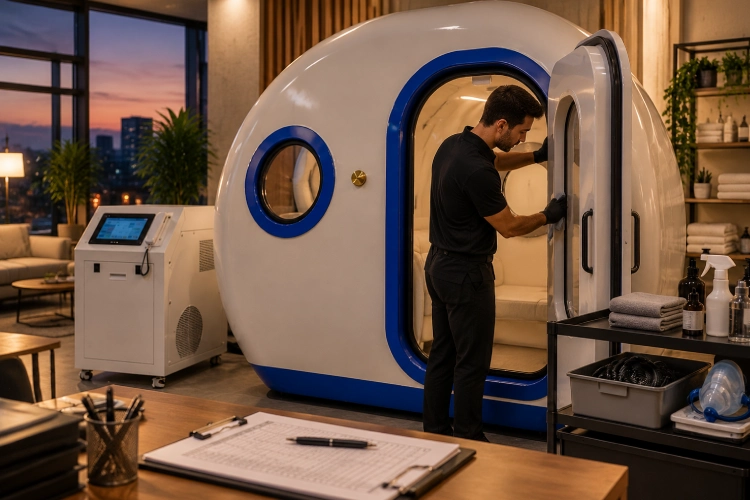
Of every parameter you can monitor during a session, the one you'll be defending in any incident report is the oxygen concentration in the chamber atmosphere. Keep it below 23.5% by volume.
Why 23.5? Above that threshold, ordinary materials — clothing, hair products, the occupant's own fabrics — start behaving differently in the presence of an ignition source. The number isn't an arbitrary line, it's the practical ceiling below which the chamber atmosphere stays in the regime where the existing fire-load controls actually work. NFPA 99 Chapter 14 frames this with the surrounding electrical, ignition-source and material controls; you should read the chapter, not the number, in isolation. (NFPA 99 Chapter 14 — Hyperbaric Facilities.)
Three rules that go with the number:
Monitor continuously, not once at the start. A single reading at the beginning of a session tells you nothing about what happened between sessions or after the occupant changed their position.
Set the alarm below the limit, not at it. If your limit is 23.5%, your alarm should fire somewhere comfortably below that. An alarm set at the limit tells you you're already over.
Make sure you can actually hear and see the alarm from where you stand. An alarm nobody can hear from the operator position isn't an alarm. Function-test it against a known reference before each shift — don't assume.
On calibration
Some guidance in circulation was written for diving and confined-space operations, and some of it was written for other jurisdictions. A standard in common use for oxygen concentration measurement is Canadian — CSA Z275.1 — and does not carry the same weight for a U.S. facility. Where a calibration standard is cited, note which jurisdiction it belongs to, and confirm that your jurisdiction recognises it. Calibration interval and method come from the analyser manufacturer; record both in the log.
On pressure values
This page doesn't publish session pressure values, and you shouldn't either. The number that matters for daily operations is your equipment's declared working pressure, plus the setting your own written procedure specifies. Both come from your equipment documentation and your procedure — not from a general article, and not from a supplier's page.
On the gas supply
Verify your gas output against the gas source manufacturer's own specification. Don't substitute a general purity figure for your source's actual specification — a 90% nominal output is not the same as a 90% minimum across the full session.
Three numbers worth remembering. 23.5 — the ceiling on chamber atmosphere oxygen, in percent by volume. 0 — what the pressure gauge should read before the first pressurization of the day. 2 — the number of names on any record where verification is required.
4. The closing checklist — and why most checklists' closing half is weak
Almost every published closing checklist is a list of verbs. Depressurize. Dry. Clean. Sign. Verbs can't be verified. There's no reading, no value, no condition that tells you whether yesterday's closeout was actually done, or done properly. That's why the closing half of the day is the weaker half of nearly every checklist you'll find on the internet. Most of them are written by people who never had to defend one to an inspector.
Six steps. Each step has a verdict you can read off an instrument or a piece of paper.
1. Confirm depressurization. Read the gauge. Check that the pressure relief has reset — it's not holding pressure, it's in its reset position.
2. Deal with moisture and residue. Drain or vent condensation. Dry the interior. Check the low points. The interior should be dry when you're done — no condensate sitting against the body material or lining.
3. Clean — with the right agent, the right dilution, the right contact time. Cleaning agents are not interchangeable between chamber types. An agent approved for a hard-shell interior lining is not automatically approved for a soft-sided body material. Petroleum-based products are a known ignition-source concern. Use the agent the manufacturer lists, at the dilution and the contact time the manufacturer specifies, and record what you used.
4. Stow (soft-sided chambers only). Fold and store in the configuration the instructions specify, protecting the closure and avoiding sharp edges. Body material that gets folded on the same line every day will eventually show it — vary or protect the fold, and keep weight off the closure.
5. Sign the log. Complete every line, or mark it explicitly not applicable. Describe exceptions rather than omitting them. Get the second signature where verification is required.
6. Secure. Power down as the instructions specify. Secure the gas supply and the space.
5. The cross-day check — the part that makes closing verifiable
This is the part almost every checklist leaves out. It's the part that turns yesterday's closeout from a memory into a measurement.
A closed chamber can only be confirmed by what the next morning's readings show.
If every reading matches, yesterday's closeout was done properly. This morning, you're confirming the chamber's condition rather than discovering it. That's the difference between a checklist that documents work and a checklist that controls it.
If any reading doesn't match, you're not looking at a paperwork problem. You're looking at an unclosed chamber. Do not pressurize. Go to the next section.
6. What to do when a check fails
A checklist with no stopping rule is a checklist that will eventually be signed with a known defect on it. Every stopping rule needs three pieces: what was found, what happens immediately, and who has the authority to release the chamber back into service.
Look at the middle column. Every row says the same thing: stop. The temptation in day-to-day operation is to classify a defect as something to monitor — and "we'll monitor it" isn't a stopping rule. If a defect has no named person who can release the chamber, it doesn't have a stopping rule either.
The defect record
Eight fields. A defect note with fewer than these can't answer the two questions that matter months later: what did we know, and when did we act.
date identified · what was found · immediate action taken · person responsible · target completion date · current status · who authorised return to service · date released
A discipline on language
This page lists common findings. We don't publish failure rates or a frequency ranking, because there's no public dataset that establishes them for daily chamber checks. If you're reading a page that presents a ranked table of "the most common chamber failures" as if it were industry data, ask where the numbers came from. In most cases, nobody collected them.
7. Records — what makes a daily log usable six months later
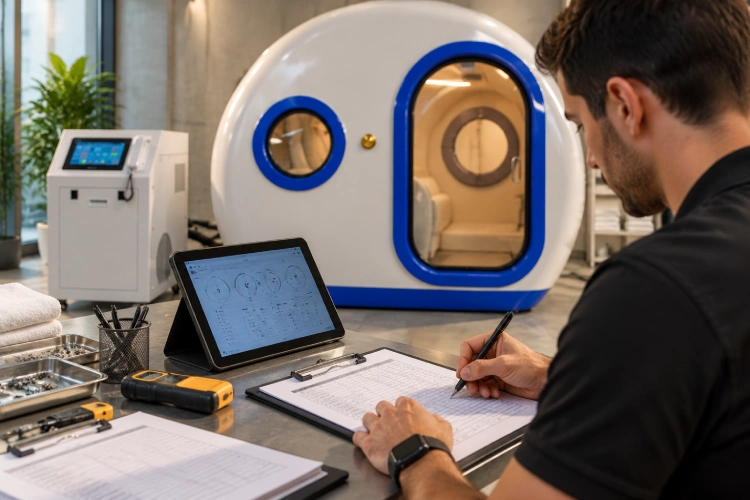
Most facility procedures say "maintain a log". Very few say what makes an entry usable. The difference isn't length. It's whether the entry can answer a question asked months later by somebody who wasn't there.
A complete daily entry carries eight fields:
chamber identity (serial number) · date · operator or technician · task completed · result · deficiencies noted · corrective action · release authorisation
A CMS survey appendix on hyperbaric facilities puts it bluntly: entering "Checked" is weak documentation. (CMS-2023-0121-18975, attachment 4 — example of how a regulator writes daily documentation expectations, including the point that "Checked" is weak documentation.) It records that a person was present. It doesn't record what that person observed.
One log per chamber
If you operate more than one chamber, a single facility-wide log won't do the job. Each chamber's checks should be documented against that chamber's own serial number. A shared log can't tell you which unit was inspected. When a unit leaves service, the history that matters is its own.
Tie the checklist to the unit
Before the first pressurization, confirm the equipment identity against the data plate, and keep that unit's acceptance or commissioning values on hand. A checklist not tied to a specific unit is a template, not a record.
The checklist itself is a controlled document
It should be tied to the manufacturer's current instructions for use revision, to the edition of the applicable standard your facility follows, to any written determination from your authority having jurisdiction, and to the revision of your own procedure that the checklist implements. Name who approves changes, and how often the checklist is reviewed. An undated checklist with no named owner is the most common weakness in the published examples we reviewed — and it's the one that makes every signature on it harder to defend.
On digital checklist tools
Tools of this kind exist, and some of them do useful things: timestamp entries on their own, require a value rather than a tick, attach photos to a defect, and produce an audit trail a paper log can't. If you adopt one, the same eight fields still apply. A tool that makes it easier to enter "Checked" hasn't improved your documentation — it's made weak documentation faster.
8. Maintenance — two clocks, not one
The daily routine and the equipment schedule run on two different clocks. Don't merge them into a single list.
The word "daily" in the operations clock comes from facility safety requirements — it's about the state of the facility before anyone goes inside. The weekly-and-beyond entries come from equipment maintenance practice. Some of the engineering references still cited in this field are decades old: a U.S. Navy facilities maintenance manual from 1990, NAVFAC MO-406, is still cited for chamber maintenance intervals. It's useful for the shape of a schedule — but it's not a substitute for your equipment manufacturer's instructions for use, and it wasn't written for a current commercial unit.
How the two clocks typically split
The boundary between you and your supplier is a contractual question, not a technical one
The manufacturer, the installer, and your own team may each own part of the equipment clock, and the split changes when coverage terms change. Confirm that split in writing with your equipment supplier before you build the schedule, and review it whenever the terms are renewed. A maintenance calendar that assigns an item to nobody will be skipped, and the skip won't be noticed until something fails.
What the schedule actually costs
The cost is rarely the service visit. It's the items that expire or wear whether or not the unit runs: filter elements, oxygen sensor or analyser replacement, calibration references, spare seals and closure components — plus installation, commissioning, and operator training. Build those into the calendar as line items with a named owner.
9. Soft-sided and hard-shell chambers — same duties, different weights
The most frequent question from operators building a first routine is which class of chamber to build the checklist around. Both classes carry the same three-layer obligation. What differs is where the weight sits.
On the claim that lower pressure means lighter regulation
This claim circulates widely in the market, and it deserves a direct answer. Our reading of the available material runs the other way. Lower working pressure changes the composition of the risk, not the existence of it. The items carrying the most weight shift — from shell and observation surface toward seams, closures, and stowage — but the obligation to inspect before the first pressurization of the day, monitor continuously during the session, and document the closeout applies to both classes. At least one U.S. state has applied the hyperbaric facility chapter of NFPA 99 to lower-pressure applications.
Be sceptical of any page that tells you the lighter path exists without naming the state, the document, and the date. Regulatory requirements vary by state, and — where relevant — by the class of application. Confirm your facility's position with your local fire marshal or state health department and with counsel.
A short guide if you're planning a chamber space
This section describes operating practice, not regulatory classification. Regulation of chamber operations varies by state, and — where relevant — by the class of application. Confirm the requirements that apply to your facility with your local authority having jurisdiction and with counsel. (U.S. OSHA general-duty and confined-space clauses apply where relevant; see osha.gov.)
10. Five things a daily checklist is not
A completed checklist is not compliance. Compliance depends on a chamber-specific written procedure, designated and competent personnel, the design and condition of the facility itself, maintenance performed on schedule, records that can be reconstructed, and a demonstrated response to failed checks. A fully signed daily log is one input to that set. It isn't the set.
A certification mark is not a safety guarantee. Some accreditation bodies in this field state their position plainly: their mark does not guarantee safety — it supports a risk-management process. (The UHMS facility accreditation program describes itself in these terms on uhms.org.) Read the body's own wording before treating a certificate as assurance.
Equipment-level testing is not operational safety. Pressure vessel testing and certification, like ASME PVHO-1 and PVHO-2, address the equipment. They don't address your staffing, your drills, your occupant procedures, your cleaning routine, or how you respond when a check fails. Those parts are yours, and no mark on a nameplate covers them.
Lower working pressure is not an exemption. The weights shift between chamber classes. The obligations don't. See the section above.
A tool is not a standard. Digital checklist platforms exist and can do specific things well. A vendor's feature list describes that vendor's product. It isn't a description of what the field requires, and it isn't evidence of what other operators do.
11. Frequently asked questions
Must a chamber be inspected before the first pressurization of the day? Yes. The requirement we are working from is that a visual inspection be performed before each chamber pressurization commencing hyperbaric operations for that day. That language comes from NFPA 99-2024 First Revision No. 901 — a revision document rather than a published edition. Check it against the current edition of NFPA 99, Chapter 14, and against any written determination your authority having jurisdiction has made for your facility.
Who should perform the daily checks, and what should they be trained to do? A designated operator, working to a written procedure, with a documented sequence behind them: onboarding training, supervised observation, competency verification, authority to sign a shift, and periodic refresher. Where a failed item would prevent pressurization, or where a chamber is returning to service after a defect, a second person should verify. Which certificates and course hours your jurisdiction expects is set by your licensing or accrediting body — confirm it there, not from a list published by a supplier or another operator.
What oxygen concentration should be maintained, and how should it be monitored? Keep the chamber atmosphere below 23.5% by volume. Monitor it continuously rather than once at the start of the session, and set the alarm below the limit rather than at it. The alarm should be audible and visible from where the operator stands, and function-tested rather than assumed. Calibration interval and method come from the analyser manufacturer — and where a calibration standard is cited, note which jurisdiction it belongs to, because they aren't interchangeable.
How long should daily logs be kept? Retention is set by the authority that regulates your facility and by the body that accredits it, and it varies by state. Before relying on any default, confirm two things: the period your state requires, and the period your accreditation or insurance terms require. Keep the longer of the two, and where your procedure allows it, keep the record for the life cycle of the equipment.
Do we have to stop operating if a daily check fails? Where a failed item would prevent safe pressurization — chamber integrity, observation surface, communication, interlocks, grounding — the hyperbaric chamber doesn't get pressurized. Where a defect is found that doesn't prevent pressurization, it still needs a named person who can authorise return to service, and a date by which it'll be resolved. "We'll monitor it" isn't a stopping rule.
Is a daily checklist enough on its own? No. It's one part of a set that includes a chamber-specific procedure, designated and trained personnel, facility design and condition, maintenance on schedule, records that can be reconstructed, and a demonstrated response to failed checks.
Sources and document references
This page is built on U.S. standards, federal and state material, and engineering references. Where a document is a revision draft rather than a published edition, that's stated below.
Reference
What it's used for here
NFPA 99, Chapter 14 — Hyperbaric Facilities (nfpa.org)
Pressurization, inspection, administration and maintenance requirements for hyperbaric facilities
NFPA 99-2024 First Revision No. 901 (docinfofiles.nfpa.org)
The quoted language on pre-pressurization visual inspection. A revision document — verify against the current edition
ASME PVHO-1 / PVHO-2 (asme.org)
Pressure vessel design and in-service inspection for human occupancy
U.S. FDA — hyperbaric chamber device information (fda.gov)
Device classification and requirements. A device classification isn't an endorsement of any operator's practice
U.S. OSHA (osha.gov)
Confined space and oxygen handling, where applicable to your operation
CMS-2023-0121-18975, attachment 4 (regulations.gov)
An example of how a regulator writes daily documentation expectations, including the point that "Checked" is weak documentation
NAVFAC MO-406 (WBDG)
Cited as a 1990 engineering reference for maintenance intervals — not a current standard for commercial equipment
WoundReference — NFPA 99 Chapter 14 commentary (woundreference.com)
Clause-level commentary on administration and maintenance that helps interpret the standard
UHMS facility accreditation program (uhms.org)
The accreditation body's own wording on what its mark does and doesn't guarantee
CSA Z275.1 (csagroup.org)
A Canadian standard commonly cited for oxygen concentration measurement — note jurisdictional applicability
U.S. Fire Administration, state fire marshal directory (usfa.fema.gov)
State-by-state AHJ contact points for hyperbaric facilities