


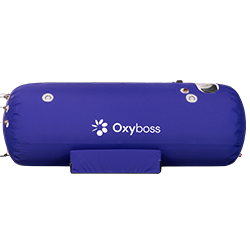

A practical guide for soft-shell and rigid-shell chambers — constraint sizing, equipment choice, load engineering, securing, documentation and final-mile delivery.
A bulk chamber order is not a standard container booking. A hyperbaric chamber is a heavy, large-envelope pressure vessel, and each of those three properties breaks a different assumption in a normal loading plan.
This guide walks through the five decisions that determine whether your order ships clean — and what it costs if any one of them is made late.
Key takeaways
- A chamber cannot take load through its shell, door, acrylic viewing ports, flanges, gauges, pipework or control panel — lashing and slinging points are limited to the manufacturer-specified lift points.
- Size the order by finding which limit binds first: cube, weight or shape.
- Flat racks and open tops are under 3% of the global fleet — carrier pre-approval takes 3–4 weeks, so start it before your cargo-ready date.
- Plan the centre of gravity before the loading sequence, and the securing plan before you book.
- Standard marine cover usually excludes open stowage — confirm the extension in writing.
Why standard loading logic fails for pressure chambers
Three physical facts:
Load path — A pressure vessel cannot be tied down through its shell, door, acrylic viewing ports, flanges, gauges, pipework or control panel. Load must transfer through designated support and lift points only. Apply force anywhere else and you risk cracking the viewing ports, distorting the door seal (the unit cannot hold pressure until it is rebuilt), or crushing instrument housings.
Payload — A single rigid-shell unit takes a significant share of a dry container's payload allowance. Soft-shell chambers in the low hundreds of kilograms are volume-limited. Rigid-shell chambers in the 300–1,000 kg range hit weight limits first. Room-style units can exceed 1,000 kg and consume most of the container's margin before you add packing, dunnage, oxygen concentrators and accessories.
Envelope — The outer dimensions leave very little clearance against the container walls. A standard 20-ft dry container has an internal width of 2.35 m and height of 2.39 m. A rigid-shell chamber in the 2.0–2.2 m width range and 1.8–2.0 m height range enters the zone where every centimetre matters. If the unit exceeds the container's through-clearance in any axis, you are already looking at flat racks, open tops or break bulk.
One comparison:
A containerised module (a folded soft chamber in a crate) and a pressure vessel secured inside a container (a rigid chamber on dunnage) are two different securing problems. The tie-down logic is not transferable. The first case treats the container itself as the unit of cargo. The second case treats the chamber as cargo inside a box, which means the chamber's internal structure, not the external envelope, defines where force can be applied.
What this means for your chamber: Every chamber we ship includes identified lift points marked on the unit. Centre-of-gravity calculations reference those points, not the geometric centre of the envelope. The packing specification, the dunnage layout and the lashing plan all follow from that constraint.
Step 1 — Size the order against the container
Three ways an order can bind:
- Cube-out — volume binds first. You run out of space before you run out of weight allowance.
- Weigh-out — payload binds first. The total weight exceeds the container's maximum payload before the volume is full.
- Shape-out — envelope or handling binds first. The unit does not fit through the door, exceeds internal clearance, or requires lifting equipment that a standard dry container cannot accommodate.
How to find which one applies:
Start with usable volume. Industry practice treats the rated capacity of a container as an upper limit, not a working target. Usable volume is typically 85–90% of rated CBM. For a 20-ft dry container (rated 33 CBM), working volume is roughly 28–30 CBM. For a 40-ft dry container (rated 67 CBM), working volume is roughly 57–60 CBM. The difference accounts for dunnage, void-fill, clearance to walls and practical handling limits.
Then check payload. A 20-ft dry container has a maximum payload of roughly 21,700 kg (the exact figure depends on the container's tare weight and is confirmed by the carrier). A 40-ft dry container has a maximum payload of roughly 26,700 kg. But the limit that binds is not always the container limit — it is whichever comes first between the container's rated payload, the floor load capacity and the concentrated load limit where the unit sits on the dunnage.
Floor load, flat-rack deck load and concentrated load are three different limits. A standard dry container floor is rated at roughly 2,700 kg/m² for distributed load. A flat rack deck is rated at 3,000–5,000 kg/m² depending on the model. Concentrated load — the force applied to a small contact patch where a heavy unit sits on dunnage — is limited by the local crushing strength of the floor material and the dunnage cross-section. Do not apply one figure to the other case. The carrier provides the floor load rating in writing. The dunnage specification (width, thickness, number of cross-members spanned) determines the concentrated load limit.
Finally check shape. Does the packed unit fit through a 2.34 m × 2.28 m door opening (standard 20-ft/40-ft dry container)? Does it fit within the internal envelope with 10–15 cm clearance on all sides for lashing and handling? If the answer to either is no, you are already in flat rack or open top territory.
Before loading checklist:
- Cargo weight certificate confirmed
- Floor load rating from carrier in writing
- Dunnage specification matches concentrated load requirement
- Packed dimensions confirmed to fit internal clearance with margin
- Lashing plan references lift points only

Step 2 — Choose the equipment
Decision path:
Flat rack specifications:
Note: Flat racks and open tops account for under 3% of the global container fleet. Carrier pre-approval takes 3–4 weeks in normal seasons and longer during Q4 peak. Submit your application before your cargo-ready date, not after.
Note: Flat racks rarely travel far inland. Confirm the final-leg plan before assuming a direct-to-site delivery. If the destination is more than 100 km from the discharge port and requires local permits or oversize escort, factor those costs and lead times into your booking.
Step 3 — Engineer the load plan
Centre of gravity:
Longitudinal CoG = Σ(weight × distance from front wall) ÷ total weight Vertical CoG = Σ(weight × height above floor) ÷ total weight
CoG is referenced to the manufacturer-specified lift and support points, not the geometric centre of the unit.
Three checks:
Loading sequence:
Heaviest units first, directly on the floor, centred and toward the front wall. Lighter items (accessories, concentrators, packing materials) fill around them as lateral support. This is not a packing puzzle where you optimise every cubic inch — it is load distribution where the goal is to keep the CoG low, centred and forward of mid-length.
Step 4 — Secure the load
Three jobs, three methods:
Parameters:
- Dunnage: Minimum 100 mm thickness, spanning several floor cross-members to spread the concentrated load. Keep 30–35 cm clearance to the end bulkheads to allow for container flex under load.
- Chains: 13–16 mm diameter, 10-tonne working load limit (WLL), or 5-tonne web lashings. Industry practice sizes the chain or web rating at 1.5× the cargo weight as a safety margin.
- Lashing points: 4–8 lashings per corner, 20+ lashing points total for a rigid chamber, tension roughly 500–1,000 kgf per lashing. The exact count depends on the unit's weight, centre of gravity and the angle of the lashing relative to vertical.
Note: These figures are subject to the carrier's securing plan. Do not treat them as a specification you can impose on the carrier — they are the baseline for a conversation about what the carrier requires and what the cargo can accommodate.
Reminder:
Lashing must not bear on the shell, door, viewing ports, flanges, gauges, pipework or control panel. The number of usable lashing points is limited by the manufacturer-specified lift points. More lashings do not always mean a better plan — if the additional lashings pull on parts of the unit that cannot take load, they create damage rather than security.
During loading checklist:
- Dunnage placed and confirmed to span multiple cross-members
- CoG calculated and confirmed within 60/50 and ±10% lateral limits
- Lashing points identified and marked on the unit
- No lashing applied to shell, door, viewing ports or fittings
- Tarpaulin or moisture barrier applied if required
Step 5 — Close out documentation and insurance
Documentation:
Insurance and regulatory:
Note on VGM responsibility: The shipper named on the bill of lading is legally responsible for providing the Verified Gross Mass to the carrier and the terminal before the container is loaded onto the vessel (IMO SOLAS Convention VI/2). That responsibility cannot be transferred to the freight forwarder or the carrier. If the VGM is missing or incorrect, the container will not be loaded.
Note on dangerous goods: Oxygen cylinders, refrigerants, batteries or pressurised accessories shipped with the chamber may fall under dangerous goods rules. If any component contains compressed gas, flammable refrigerant or lithium batteries, confirm the IMDG classification and declaration requirements with your freight forwarder before booking.
Note on moisture: Long ocean transits expose cargo to temperature swings that cause condensation inside the container (container rain). Moisture-sensitive components — electronics, control panels, upholstery — should be wrapped in moisture barrier film or packed with desiccant. The goal is to keep relative humidity inside the packaging below 40–50% for the duration of transit.

How chamber type changes the loading plan
The five steps above treat every order as the same generic decision chain. In practice, the chamber type decides which step is the hardest one. Three profiles cover most of what we ship. We use category names instead of model numbers on purpose — every chamber has its own envelope and weight, and the right way to plan the container is to start with the profile, not the catalogue page.
Soft-shell chambers
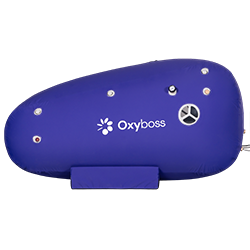
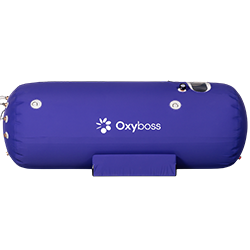
Shipping profile: foldable or rollable, packed volume in the low single-digit CBM per unit, unit weight in the tens of kilograms with the oxygen concentrator packed alongside.
Most soft-shell orders are cube-out. You fill the container before you fill its payload allowance. A standard 20-ft dry container holds a meaningful number of soft-shell units when packed correctly. The container itself behaves like a normal parcel — dunnage and lashing are routine, and the securing plan follows the standard CTU Code guidance.
The trade-off: per-unit volume is fixed, and the oxygen concentrator that goes with each unit adds both volume and weight. Run the cubic calculation with the concentrator included, not just the folded chamber.
Rigid-shell chambers
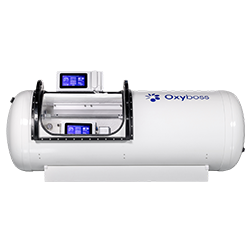
Shipping profile: fixed envelope, single-piece construction, unit weight in the hundreds of kilograms, packed dimensions approaching or exceeding the internal clearance of a dry container on at least one axis.
Most rigid-shell orders are weigh-out or shape-out. A single unit can take a large share of a 20-ft payload, and the packed envelope often leaves less than 15 cm of clearance to the walls or ceiling. Door height is the most common binding constraint — a tall rigid-shell unit can fail the 2.28 m door opening even when floor area and payload are fine.
The trade-off: floor load and concentrated load both matter here. A rigid-shell unit concentrates hundreds of kilograms onto a small dunnage footprint. Specify the dunnage to span several floor cross-members and confirm the concentrated load limit with the carrier in writing.
Room-style chambers
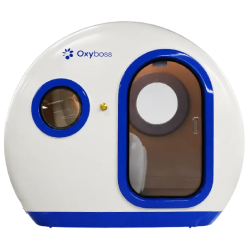
Shipping profile: the outer envelope approaches the internal section of a dry container. Most configurations exceed the door opening, and several exceed the internal height as well. Unit weights regularly exceed 1,000 kg.
Most room-style orders are shape-out. The chamber is the cargo, and the container — if there is one — is just the carrier. Plan for out-of-gauge from the start: deck stowage on a flat rack or platform, a securing plan designed for the unit's lift points, OOG surcharge, and an insurance extension that covers open stowage. Standard "FCL in a dry box" pricing and scheduling do not apply.
The trade-off: this profile is where most late-stage surprises happen. A room-style chamber that was quoted as a dry container booking in week one turns into a project-cargo booking in week six, and the cost and lead time move with it. Decide the profile before you request a quote.
What drives the landed cost — the full picture, not just ocean freight
Most importers compare two or three ocean freight quotes and call it a day. For bulk chamber orders, the base ocean freight is often less than half of the landed cost. The full list, in the order costs typically land:
The quote gap that opens between two forwarders usually lives in items 4 through 11 — not in the base ocean rate. If a quote only prices items 1, 3 and 7, the rest is coming.
From port to site: access, unloading, lifting and recommissioning
The container is on the ground at the destination. Now what?
Site access — confirm before the container moves inland
What to send the carrier: photos or short video of the access road, the gate, the turning radius, the final placement spot, and any overhead obstructions. "It looks fine" is not a site survey.
Unloading tiers
From cheapest to most supported:
- Dock-level delivery — the container is placed at ground level and the receiver unloads at their own pace.
- Liftgate + inside delivery — the chamber is lowered to a liftgate and brought inside the building through a standard door.
- White-glove delivery — the crew brings the unit into the room, removes packaging, and positions it.
- Delivery with commissioning support — same as white-glove plus a technician who walks the recommissioning checklist and confirms the unit holds working pressure before sign-off.
Lifting essentials
The crane or forklift capacity on the nameplate is the gross capacity. Subtract the rigging, the lifting beam and the hook block to get the net capacity at the chamber's lift points. A crane rated for the unit's weight with full rigging can still be undersized for the lift.
Three habits:
- Test-lift 100 mm off the ground and hold for 30 seconds before swinging.
- Use tag lines to control swing — never hold the load by hand.
- Confirm the unit is stable and the temporary ties are set before releasing the rigging.
On arrival — recommissioning is not optional
A chamber that has been on a flat rack for 28 days at sea has been through thermal cycling, salt spray and vibration. Before the first use:
- Re-inspect door seals, viewports and all instrument housings.
- Run a pressure-hold test to confirm the unit holds working pressure.
- Replace any desiccant that was inside the chamber at packing.
- Walk the recommissioning checklist provided by the manufacturer with the shipment.
After arrival checklist:
- Packaging removed and chamber exterior inspected
- Door seals and viewing ports visually checked
- Pressure-hold test passed before first use
- Desiccant replaced (if packed inside the chamber)
- Electrical and oxygen connections inspected by qualified personnel
- Recommissioning sign-off filed with the manufacturer
Ordering at scale: FCL, batch size and per-unit freight
FCL (Full Container Load) is the default for chamber orders. The seal stays unbroken from stuffing to unpacking, there is no co-loading with other cargo, and the per-unit freight improves as the container fills. For a rigid-shell or room-style chamber, FCL is rarely a choice — it is a physical requirement.
LCL (Less than Container Load) is cheaper per cubic inch at small quantities, and against most chamber orders it is the wrong tool. LCL means the chamber shares a container with cargo it has nothing in common with. The securing plan for the whole container cannot accommodate a no-load-zone constraint. For soft-shell orders under about 15 CBM total, LCL can still make sense — the units are light, cube-efficient and tolerant of shared stowage. Above that, FCL.
Incoterms that come up in chamber orders:
FOB and CIF still appear in older contracts but they assume a different set of risks than what a chamber actually carries. For pressure vessels, prefer the terms that put the securing plan, the VGM responsibility and the insurance extension in writing between named parties.
Frequently asked questions
Q: My chamber weighs 800 kg. Is a 20-ft dry container enough? A: Probably yes on weight, possibly no on size. Confirm the packed dimensions against the internal clearance (2.35 m wide × 2.39 m high × 5.90 m long for a standard 20-ft dry), and confirm the door opening (2.34 m × 2.28 m). The binding constraint is usually shape, not payload.
Q: What is OOG and how does it affect my booking? OOG stands for "out-of-gauge." It means the cargo exceeds the standard internal dimensions of a container on at least one axis. OOG cargo requires flat rack, open top or platform equipment, an OOG surcharge on the ocean freight, and a securing plan that the carrier reviews before stuffing.
Q: What is VGM and who has to provide it? VGM stands for "Verified Gross Mass" — the total weight of the container including cargo, packaging and dunnage. Under the SOLAS Convention, the shipper named on the bill of lading is legally responsible for providing the VGM to the carrier and the terminal before loading (IMO SOLAS Convention VI/2). If the VGM is missing or incorrect, the container will not be loaded onto the vessel.
Q: My order is small. Can I share a container with other cargo? LCL is feasible for soft-shell orders under about 15 CBM total, where the units are light and tolerant of shared stowage. For rigid-shell or room-style orders, LCL is not recommended. The securing plan for a shared container cannot accommodate the no-load-zone constraint of a pressure vessel.
Q: How long does carrier pre-approval take for a flat rack? In normal seasons, 3–4 weeks from application to equipment availability. During Q4 peak (October to December) it can run to 6 weeks. Apply before the cargo-ready date, not after.
Q: What is the CTU Code? The CTU Code (Code of Practice for Packing of Cargo Transport Units) is the joint IMO/ILO/UNECE publication that sets out the securing and packing rules for cargo in containers. Most carriers' securing plans reference it. It is the baseline document for any container-loading question that does not have a product-specific answer.
Q: What happens if the chamber arrives damaged? Document the damage on the spot with photos and note it on the delivery receipt before signing. Open a claim with the marine cargo insurer and notify the carrier in writing within the time window stated in the bill of lading. Keep all packaging until the survey is complete. The manufacturer can usually provide a damage assessment and a repair quote remotely if you send clear photos and the serial number.
Q: My shipment has been sitting at the destination port for a week. Who pays the storage? Demurrage (storage at the port) and detention (use of the carrier's container beyond the allowed period) are billed per the carrier's tariff, which is filed with the Federal Maritime Commission in the US and equivalent regulators elsewhere. Whoever holds the container at the time the clock runs out pays. Free time periods are typically 3–5 working days at destination. Confirm them in the booking confirmation, not on the invoice.
Q: What is open stowage and why does my insurance need an extension for it? Open stowage means the container is stowed on the deck of the vessel rather than below deck — typical for flat rack and open top cargo. Standard "all risks" marine cargo policies exclude deck cargo unless the extension is added in writing. Without the extension, a weather or sea-spray damage claim can be denied even if the underlying loss is covered.
Q: I see "heat-treated" on my wooden crate. Is that ISPM 15 compliant? Heat treatment is one of the two ISPM 15 approved treatments (the other is methyl bromide fumigation). The compliance is shown by the IPPC mark stamped on the wood — a wheat-stalk symbol plus the country code, the producer code and the treatment code. The stamp is what customs inspects, not the words on the crate.
References and sources
The standards and regulations that govern what is written above.
International Maritime Organization (IMO)
United Nations Economic Commission for Europe (UNECE)
U.S. Department of Agriculture — Animal and Plant Health Inspection Service (USDA APHIS)
U.S. Customs and Border Protection (CBP)
U.S. Federal Maritime Commission (FMC)
U.S. Occupational Safety and Health Administration (OSHA)
International Chamber of Commerce (ICC)