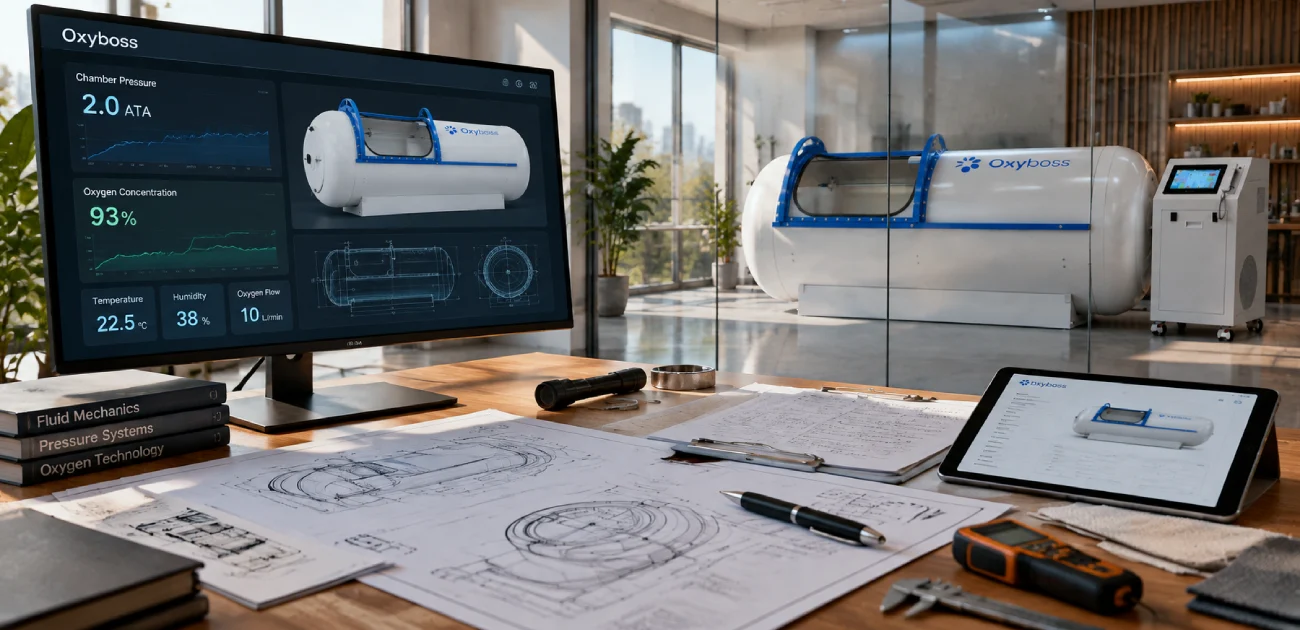
Why this is harder than translating a coffee machine manual
A coffee machine ships with a manual, a label, a warranty card. A hyperbaric chamber ships with all of that, plus a pressure-vessel data plate, an operator training program, a service log template, an emergency depressurization card, sometimes a room-side installation manual, and — depending on your buyer — a technical file that a regulator can ask to see years later.
Every one of those items is regulated by a different authority. Some by the health regulator. Some by the pressure-equipment regulator. Some by workplace safety. Some by the standards body that publishes ASME PVHO-1.[^pvho-scope]
Most localization guides pick one lane — usually the medical-device lane — and write as if the other lanes don't exist. That's how you end up with a beautifully translated IFU sitting next to a data plate that fails a Canadian pressure-vessel inspection. Neither of those failures is a translation problem. But both of them are a localization problem.
So here's what we're actually going to walk through: the documents you need to translate, the ones you don't, the sequence you translate them in, the trap you'll hit around cost, and the questions to ask before you hire anyone.
1. What actually needs translating before you export
Most vendors will hand you a shopping list at this point: manual, labels, packaging, training materials, marketing, software strings, and so on. That list isn't wrong. It's just missing the shape.
Because these documents don't have equal weight. Some of them hold safety information a user might die without. Some of them help someone install the chamber correctly. Some of them prove to a regulator that you did your job. And some of them help a distributor close a deal.
Group your documents into four layers before you send anything to translation:
Here's the observation the vendors won't give you for free: most manufacturers translate in the reverse order. They translate the sales collateral first because that's what unblocks the deal. Then they translate the manual because a customer asked for it. Then, three days before shipment, they realize the shell labels are still in English and scramble.
Don't do that. Safety layer goes first. It's the layer where a translation error can hurt someone.
2. The two rulebooks that apply to your chamber at the same time
Ask a translation vendor about "hyperbaric chamber localization" and they'll give you a medical-device answer. Ask a pressure-vessel inspector and they'll give you an ASME answer. Both are right. Both are incomplete.
Depending on intended purpose, design, operating pressure, and destination, a hyperbaric chamber may be regulated as a medical device, pressure equipment, electrical equipment, and/or equipment used in a workplace. These regimes are not automatically all applicable; assess each one independently before preparing labeling.
Here's how they line up in the biggest markets we see exporters ship into:
Here's the catch. These are not five copies of the same rule in different languages. Each one asks for slightly different content on the label, different retention requirements for records, different ways to reference the standard the chamber was built to. You can't write one IFU and swap the language layer.
And here's the second catch. The EU Machinery Regulation 2023/1230 generally applies from 20 January 2027, but a non-medical chamber is not automatically machinery under that regulation. Assess its scope and exclusions alongside other potentially applicable legislation.[^eu-mr] If your product doesn't make medical claims, don't assume you're off the map. You may just be on a different map.
3. Does "wellness" or "non-medical" change any of this?
Short answer: the marketing claim changes the market-access path. It doesn't change the physics.
The FDA classifies full-body hyperbaric chambers used for medical purposes as Class II devices under product code CBF, 21 CFR 868.5470.[^fda-cbf] Regulatory classification depends on intended use and the full presentation of the product, not just the absence of explicit medical claims; seek a documented market-specific assessment.
But — and this is where a lot of exporters get burned — stepping outside the medical-device classification does not step you out of the pressure-vessel classification. The chamber is still a pressure vessel with a person inside it. Its design and conformity obligations must be established under the standards and legislation applicable in the destination market. It still needs labels that meet durability and legibility requirements. It still needs a nameplate that doesn't fall off in three years.
The Undersea and Hyperbaric Medical Society has been publishing consumer warnings on this exact point since long before wellness chambers became a category. Consumer safety concerns remain relevant regardless of marketing positioning, but any binding pressure-equipment obligation must be traced to applicable law and jurisdiction; the cited UHMS warning was not independently accessible during this review.[^uhms-consumer]
So when someone on your team asks "do we need all this if we're a wellness brand?" — the honest answer is:
- You may not need the medical-device paperwork.
- You still need the pressure-equipment paperwork.
- You still need translated safety labels and operator materials.
- And you still need to be careful how you word the claim itself, because a claim that drifts toward medical benefit pulls you back into the first bucket.
Which brings us to the language you use on your own site. That's a separate conversation, and it's one you should have with a regulatory advisor before you write anything user-facing.
4. Four localization traps that quietly eat time and money
These are the mistakes we see repeatedly in shipments coming out of Asia, Europe, and North America. All four are avoidable if you know they exist.
Trap 1: The nameplate you didn't translate — and shouldn't have
The metal data plate on the chamber shell is not a translation problem. It's a compliance problem that looks like a translation problem.
Three things are true about nameplates at the same time:
- Do not translate nameplates mechanically. Some identifiers, symbols and standard designations should remain unchanged; required wording and language may differ by jurisdiction. Validate each field and its presentation against the applicable market requirements.[^pvho-scope]
- They still have to be legible, durable, and permanently affixed — meaning they survive cleaning, disinfection, pressure cycling, and years of operation. Every regulator inspects for this.
- The fields themselves change by market. Canada wants a CRN. Some EU markets want the notified body number. Some jurisdictions want the pressure-relief device set point on the plate.
So the "localization" of the nameplate is a field engineering problem, not a translation problem. Get your regulatory advisor to give you a market-by-market field list before you order the plates. If you order them in a batch of 500 and then discover Canada needs an extra field, you're re-tooling.
Trap 2: "AI can do this" — where it can, where it can't
We keep hearing "we'll just run it through AI." Sometimes that works. Sometimes it will get someone hurt.
Here's the honest breakdown:
The rule of thumb: safety-critical content should receive qualified translation and independent technical review; back-translation can be an added risk-control measure where appropriate. Anything a user reads before they buy can go through an AI-first pipeline. Do not describe a universal regulator-mandated back-translation or AI-review procedure without a specific legal basis. Document validation and controls proportionate to the risks; a translation provider's article is not regulatory authority.[^welo-mt]
Trap 3: The per-word quote
If a vendor tells you they'll translate your operator manual for a per-word rate, you're not getting a quote. You're getting the cheapest possible number the vendor can put in front of you.
The real cost of localizing a chamber manual lives in the thirteen line items a per-word quote doesn't include:
- Engineering review of the source manual (finding errors before they get translated into six languages)
- Terminology glossary development
- Translation memory setup and ownership rights
- Independent linguistic review
- Back-translation of high-risk content (warnings, alarms)
- DTP (desktop publishing) to keep page layouts consistent after language expansion
- Label artwork production and proofing
- eIFU hosting and version control, if you use one
- Certified translations for regulatory submissions
- Change-order pricing for engineering revisions
- Symbol glossary updates when standards revise
- Distributor sign-off and correction cycle
- Annual maintenance for markets you keep selling into
Ask any vendor to quote each of these as a separate line item. If they refuse or bundle them into one number, walk away.[^ils-export]
Trap 4: The engineering change that broke six languages
Your engineering team ships an ECO (engineering change order). They update the English manual. Two weeks later, someone in France asks why the French manual doesn't match the machine they just received.
This is the trap that costs the most money over time, and no localization vendor writes about it because it's an ongoing cost, not a one-time revenue.
Bake these six things into your ECO process before you sign the localization contract:
- Every ECO triggers an impact assessment against all localized documents.
- The vendor prices changes per changed word, not per revised page.
- Translation memory (TM) belongs to you, not the vendor. Get that in writing.[^welo-mt]
- The vendor keeps a change log per language, per document.
- Distributors get an automatic notification when their language version updates.
- Old versions are archived and retrievable — regulators may ask to see the manual as it existed on a specific ship date.
If your vendor won't sign up to those six, they don't understand your business. Find one who does.
5. Training materials: the two-line problem
Here's where a lot of exporters get confused. Training materials feel like a "nice to have" — until a distributor's operator gets hurt and someone asks who was responsible for the training.
Two lines run in parallel on training materials, and they don't intersect the way people assume:
Line 1 — the regulatory line. Some jurisdictions treat operator training material as part of the "information supplied with the device." If it is, then all the language and durability rules apply to it. If it's not, then it isn't formally regulated as labeling.[^r-training]
Line 2 — the professional-practice line. In the medical-hyperbaric world, there are respected training bodies — UHMS, NBDHMT — that publish curriculum and hour requirements. These aren't laws. They're professional norms that some hospitals and clinics require their operators to meet.[^uhms-training]
Four things must stay separate in your mind, because vendors will bundle them and buyers will confuse them:
- Translation certification — a linguist signs that the translation matches the source. A translation service provider may work under ISO 17100; certification of a provider is distinct from certification of a particular translation.[^iso17100]
- Manufacturer completion certificate — you certify that a named operator completed your training program on your equipment.
- Observed competency — a supervisor certifies the operator can actually run the machine safely, in practice.
- Local professional license — issued by the country's health authority, if applicable. Neither you nor your translation vendor can grant this.
You can localize training materials. You cannot localize professional competence. Bake this distinction into every distributor contract.

6. Symbols: what they replace, and what they don't
Every localization guide mentions EN ISO 15223-1. Very few explain the practical rule.
Symbols on medical-device labeling can replace text for a defined set of concepts (manufacturer, date of manufacture, single-use, "consult IFU," and so on), provided the symbol is recognized by the market. In the U.S., FDA lists 15223-1 as a recognized consensus standard.[^us-801-15]
Four decision rules you can actually use:
- Symbols can sometimes replace adjacent label text, subject to jurisdiction-specific conditions. Required IFU content and symbol glossaries must still satisfy the relevant rules; for US medical devices, consult 21 CFR 801.15(c).
- A symbol glossary or explanatory text may be required. US 21 CFR 801.15(c) permits certain standardized symbols without adjacent wording only when specific conditions, including a glossary, are met.
- Some markets add extra rules. Australia's TGA, for example, asks for a written statement alongside non-standardized symbols and identification colors.[^tga]
- Symbols do not shrink your language obligation. They shift where the language lives — from the label onto a glossary page or into the IFU.
7. What to check before you hire a translation vendor
Vendors advertise the same things: "regulatory-grade," "200+ languages," "AI-assisted," "faster approvals." None of those are things you can verify.
Here's what you can verify. Ask every vendor these eight questions in writing:
- What's the scope of your ISO 17100 or ISO 13485 certification, and can I see the certificate?[^iso17100]
- Who will be the named translator and reviewer on my project? Not a company — a person.
- Can you provide a sample of the same content type (chamber IFU, pressure-equipment manual) that you've done for another client, with permission?
- What's your error correction and rework policy when a mistake ships? Who pays for reprint costs?
- Do you have experience with pressure-equipment terminology specifically? Ask for names of clients (or a category, if under NDA).
- What's your change management process? Per-word, per-page, or per-file for ECO revisions?
- Who owns the translation memory at the end of the project?
- What's your data security posture — where do the source files live, who has access, retention policy?
Two things are worth noting about ISO certifications specifically. ISO 17100 covers translation service processes. ISO 13485 covers medical-device quality management. They are not laws. They are procurement thresholds — table stakes for working with serious buyers, but neither one certifies the quality of any specific translation. A vendor can be certified to ISO 17100 and still make errors on your file.
Sources and references
Additional reference
Editorial verification notice (19 October 2026): Regulatory statements are informational, not product-specific legal clearance. Some external sources (particularly EU legislation PDFs, UHMS documents and the ANVISA PDF) could not be inspected directly by the web retrieval system; their accessibility/content should be confirmed manually before publication. Secondary industry articles do not establish legal mandates.
[^pvho-scope]: ASME, PVHO-1-2023: Safety Standard for Pressure Vessels for Human Occupancy
[^us-801-15]: 21 CFR § 801.15, Prominence of required label statements
[^us-fda-labeling]: eCFR, 21 CFR 801.15 (current regulation)
[^mdr-art10]: EU Regulation 2017/745 (MDR), Article 10(11) and Annex I Chapter III
[^eu-ped]: Directive 2014/68/EU (PED)
[^ec-lang-table]: European Commission, Overview of Language Requirements for Manufacturers of Medical Devices
[^health-canada]: Health Canada, Guidance on the Labelling of Medical Devices
[^anvisa]: ANVISA, RDC 751/2022
[^tga]: TGA, Labelling Medical Devices to Meet Regulatory Requirements
[^eu-mr]: EU Regulation 2023/1230 (Machinery Regulation)
[^fda-cbf]: FDA, Product Classification Database: CBF, 21 CFR § 868.5470
[^uhms-consumer]: Undersea and Hyperbaric Medical Society, Consumer Warning
[^welo-mt]: Welo Life Sciences, Medical Device Localization
[^ils-export]: International Language Services, Documents to Translate Before Exporting Equipment
[^r-training]: Internal research note: “03_you-research,” §4, Training certification. No public URL was supplied.
[^uhms-training]: UHMS, Credentialing and Privileging Guide (2022)
[^iso17100]: ISO 17100, Translation Services — Requirements for Translation Services
[^canada-reg]: Canada, Medical Devices Regulations, section 23
[^uk-pressure]: UK Government, Pressure Equipment (Safety) Regulations 2016: Great Britain