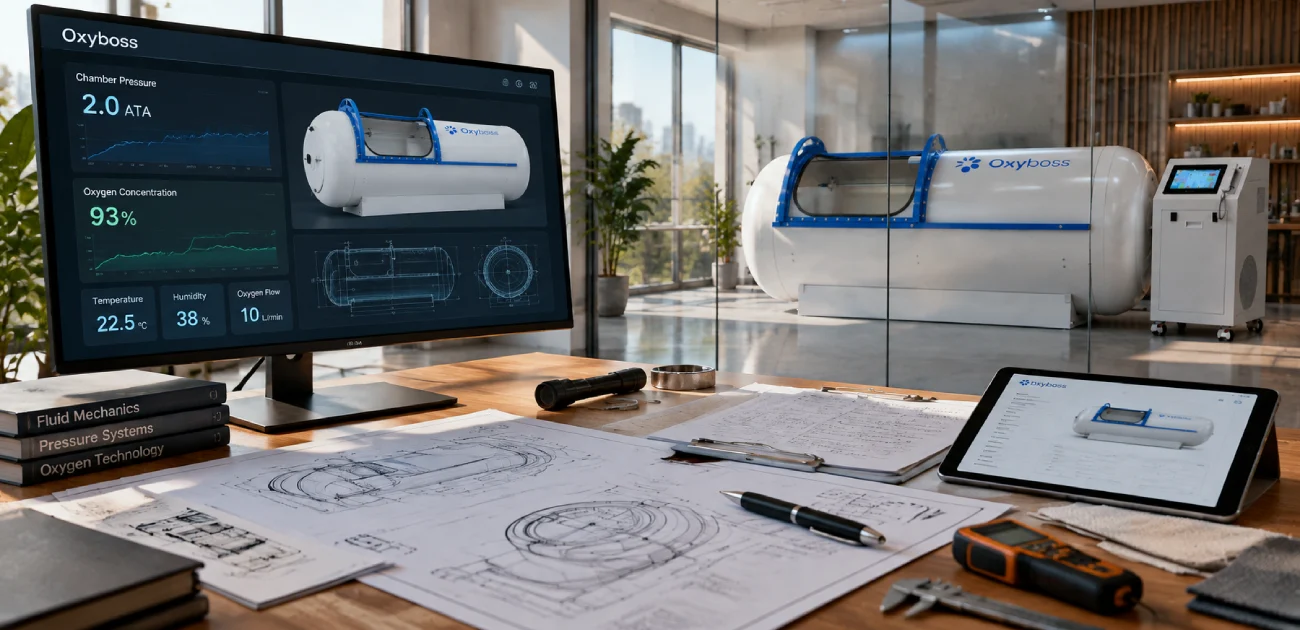
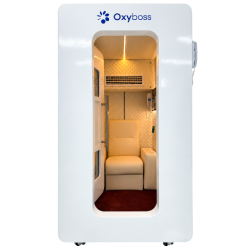
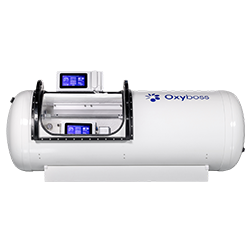
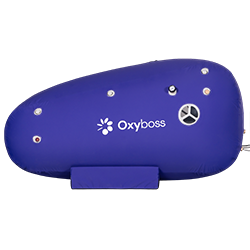
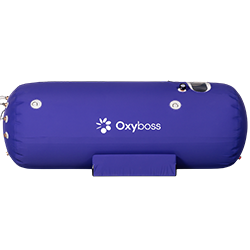
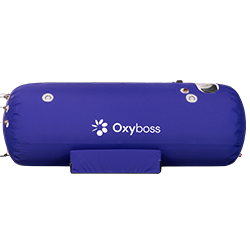

The short answer (the one nobody gives you)
A hyperbaric chamber does two things at once, not one. It bumps the air pressure around you to about 1.5 times the pressure at sea level, and it gives you air with much more oxygen than the stuff you're breathing right now. Either one alone would barely move the needle. Together, they change how much oxygen actually gets into your blood — including the part that doesn't need red blood cells to carry it.
That's the whole trick. The rest of this page explains what that means for you in the next hour, why your ears feel funny, why sessions aren't all the same length, and the questions the brochures hope you won't ask.
Why "more oxygen" alone isn't the point
You've probably seen pages that say hyperbaric chambers "deliver more oxygen to your tissues." That's technically true. It's also kind of useless without context, because just breathing pure oxygen through a mask at sea level doesn't get you much further than your hemoglobin can carry.
Here's the part the brochures skip:
- Your red blood cells carry oxygen bound to hemoglobin. Hemoglobin tops out at roughly 1.34 mL of O₂ per gram. Past that point, it can't carry any more, no matter how hard you breathe.
- Plasma — the liquid part of your blood — can carry oxygen too, but only when the air around you is pressurized. That's the only way to push extra oxygen to dissolve directly into plasma.
- So the chamber's job isn't to give you "more oxygen" in a vague sense. It's to put oxygen somewhere it normally can't go.
When you sit inside a chamber pressurized to around 1.5 ATA and breathe air that's around 90% oxygen, the plasma in your blood ends up carrying significantly more oxygen than it would at sea level on regular air. That extra plasma-dissolved oxygen reaches areas where blood flow is sluggish — places that don't get fully served by your red blood cells alone.
That's the mechanism. It's not magic, and it's not a treatment. It's physics, and it's why chambers exist at all.
Sources:
- Cleveland Clinic — What is hyperbaric oxygen therapy?: https://my.clevelandclinic.org/health/treatments/17811-hyperbaric-oxygen-therapy
- ScienceInsights — What Does a Hyperbaric Chamber Do to Your Body?: https://scienceinsights.org/what-does-a-hyperbaric-chamber-do-to-your-body/
- Strength Warehouse USA — What Is a Hyperbaric Chamber?: https://strengthwarehouseusa.com/blogs/resources/what-is-a-hyperbaric-chamber
What a session actually feels like, minute by minute
Most pages skip this. We think it's the part you care about most, so here it is without the marketing glaze.
The first 10–15 minutes: pressure rising
You'll notice your ears feel full, the same way they do when a plane starts its descent. That's because the air around you is now pushing harder on the eardrums from the outside. To clear it:
- Swallow
- Yawn
- Or do a gentle Valsalva maneuver — pinch your nose, close your mouth, and gently blow against the closed nose. Don't force it.
Most people get the ears to "pop" within a minute or two. Some take longer. It's not painful. It's mildly annoying, like flying.
Some people notice a soft, warm sensation around the face and chest as the air compresses. Nothing dramatic.
The middle 60–75 minutes: you're just sitting there
This is where most of the time goes, and it's also where there's nothing dramatic to report. You're breathing, you're sitting or lying down, maybe you're reading or using your phone (depending on chamber rules). The chamber isn't doing anything exciting — it's just keeping the air around you at the higher pressure while the oxygen does its slow work in your blood.
Common sensations during this part:
- Mild warmth
- A slight feeling of fullness in the sinuses
- Occasional ear-clearing twinges if you shift your head
- Light-headedness if you breathe fast or hold your breath — slow your breathing down
The last 10–15 minutes: pressure dropping
As the chamber depressurizes, your ears will pop again — this time the other direction. Same drill: swallow, yawn, gentle Valsalva. Some people hear a small "crackling" sound in their ears as they equalize. That's normal.
The biggest mistake here is rushing the depressurization phase. Let the chamber do its thing. Don't try to force the valve open faster.

The risks nobody talks about (because the brochures want you to buy one)
We're going to be straight with you here, because most pages on this topic aren't.
Common, mild, mostly annoying
- Ear discomfort or barotrauma. This is by far the most reported side effect. A systematic review found ear discomfort was about 3.4 times more likely in people undergoing hyperbaric sessions than in control groups. https://pmc.ncbi.nlm.nih.gov/articles/PMC8103971/
- Sinus pressure. Same mechanism as your ears, just in your face.
- Temporary nearsightedness (myopia). Your eye lens changes shape slightly under pressure. This usually reverses within days or weeks after you stop. Don't panic if your reading vision gets weird.
- Fatigue and mild headache. Common. Drink water.
- Claustrophobia. Real and underreported. If you've never been in a tight space before, your first session is not the time to find out how you feel about it.
Less common, more serious
- Middle ear injury. If you can't clear your ears and the pressure keeps rising, the eardrum can be injured. This is why the "don't force it" rule matters.
- Lung injury (barotrauma). Rare, but real. Happens when air is trapped in the lungs during pressure changes — relevant if you have certain lung conditions.
- Oxygen toxicity (seizures). Rare at lower pressures and shorter durations. Higher risk with longer sessions or higher pressures.
- Fire hazard. The chamber is an oxygen-enriched space. Things that wouldn't normally catch fire — like a spark from a phone battery or a hand sanitizer on your hands — can become problems. The FDA issued a public warning about fires in home hyperbaric chambers in 2025. https://www.fda.gov/medical-devices/safety-communications/hyperbaric-oxygen-devices-and-fires-fda-safety-communication
Sources:
- URMC Rochester — Hyperbaric Oxygen Therapy: https://www.urmc.rochester.edu/encyclopedia/content?contenttypeid=134\&contentid=148
- Frontiers in Medicine — Adverse effects of HBOT: https://www.frontiersin.org/journals/medicine/articles/10.3389/fmed.2023.1160774/full
- NCBI Bookshelf — Hyperbaric Oxygen Therapy: https://www.ncbi.nlm.nih.gov/books/NBK459191/
"Should I be doing this?": questions to answer before your first session
We're not doctors. We're not your doctor. We can't tell you whether hyperbaric sessions are right for you, and we're going to be the first ones to say so. Here's the honest version of the questions worth thinking through.
Talk to your doctor if any of these are true:
- You're pregnant or trying to get pregnant
- You have any lung condition (collapsed lung, COPD, emphysema, recent chest surgery)
- You have a history of ear surgery, sinus problems, or eardrum issues
- You have epilepsy or a seizure disorder
- You're on certain chemotherapy drugs
- You have claustrophobia that you haven't dealt with
- You have a pacemaker or other implanted medical device
- You've been told you have a collapsed lung at any point in your life
- You're diabetic and your blood sugar is poorly controlled
- You take any medication that affects your breathing or oxygen response
This list isn't complete. It's not a substitute for medical advice. But it covers the stuff people most often forget to mention when they're excited about getting a chamber.
Important note on what this chamber does and doesn't do. We make hyperbaric chambers for everyday wellness use. We are not a medical device manufacturer. Our products do not hold FDA 510(k) clearance, and they are not intended to diagnose, treat, cure, or prevent any disease. The information above is provided for general educational purposes. If you are looking for hyperbaric oxygen as part of medical care for a specific condition, that requires a different kind of provider, a doctor's prescription, and clinical oversight.
"How long does a session take?": the part that varies more than you'd think
Here's something the marketing pages gloss over: there's no single answer. What gets called "a session" can range from 45 minutes to over two hours depending on what you're doing, where, and why.
For wellness-style use at pressures in the 1.1–1.5 ATA range (which is where most consumer-grade soft chambers operate), sessions typically run 60 to 90 minutes under pressure. Add another 10–15 minutes on each end for pressurization and depressurization.
For clinical use at higher pressures in medical settings, sessions are typically 90 to 120 minutes under pressure, with the same ramp-up and ramp-down time on top of that.
About frequency — every source has a different opinion, and most of the people writing them are trying to sell you a package. Here's what we think is honest: there's no single right number. People using chambers for general wellness often do anywhere from a few times a week to a few times a month. The clinical-style protocols used in hospitals (20, 30, 40+ sessions) are built around specific treatment goals and aren't directly comparable.
"Why do chambers come in different pressure ratings?"
If you've been shopping, you've seen the term ATA everywhere. It's just shorthand for "atmospheres absolute." One ATA is the air pressure at sea level. Two ATA is twice that. Three ATA is three times that. Simple.
Where it gets complicated is that consumer-grade soft chambers typically operate in the 1.1 to 1.5 ATA range, while medical-grade hard-shell chambers in hospitals go up to 2.0 to 3.0 ATA. Those aren't small differences. The amount of oxygen that ends up dissolved in your plasma scales with pressure, so doubling the pressure roughly doubles that effect.
There's a separate conversation about whether higher-pressure chambers in medical settings produce different results than lower-pressure chambers at home — a meaningful and contested one. We won't wade into it here. What we'll say is this: if you're buying a chamber for general wellness use, you should know which pressure class you're buying and what it actually does at that pressure.
Sources:
- ScienceInsights — What Does a Hyperbaric Chamber Do to Your Body?: https://scienceinsights.org/what-does-a-hyperbaric-chamber-do-to-your-body/
- HyperbaricPro — Understanding ATA Levels Before You Buy a Hyperbaric Chamber: https://www.hyperbaricpro.com/understanding-ata-levels-before-you-buy-a-hyperbaric-chamber/
"Do I need a prescription to buy one?": the boring answer that saves you a lot of trouble
In the United States, hyperbaric chambers are classified as FDA Class II medical devices, and a valid prescription from a licensed physician is required to purchase one for home use. That's true for soft-shell chambers and hard-shell chambers alike. Any legitimate manufacturer or distributor will ask for your prescription before shipping. https://www.hbotblog.com/can-i-buy-my-own-hyperbaric-chamber-rx-hidden-costs/
The reason we're telling you this up front, instead of burying it in the footer, is that we'd rather you go in with both eyes open. If a website is selling you a chamber without asking for a prescription, that's a red flag — it either means they aren't following the rules or they're trying to avoid the question. Either way, you don't want to be the one holding the bag if anything goes wrong with customs, with your homeowner's insurance, or with the FDA.
If you don't have a prescription but think a chamber might make sense for you, the process is straightforward. Talk to your doctor, or use one of the telemedicine services that specialize in this. Most people get one within a day or two.

"What does my house need to handle?": the part nobody writes down
We're including this because it's the question people only think to ask after the chamber shows up. So here's the answer now.
Electrical
A typical soft-shell chamber system runs on a standard 15-amp household outlet. No special wiring. No panel upgrade. Plug it in like a microwave.
A hard-shell chamber system draws more power — usually more than a standard 15-amp outlet can safely provide on a 120V household circuit. If you're going with a hard-shell chamber, plan on having an electrician look at your panel. Some models can run on 240V, which sidesteps the problem entirely.
Floor load
A soft-shell chamber, including its compressor and oxygen unit, weighs in around 60 to 75 kilograms total. Spread over the floor area it occupies, that's a load well within what any residential floor is built to handle. You can put it on a wooden second floor without worry.
A hard-shell chamber can weigh anywhere from 300 to 1,000 kilograms, depending on the model. The heavy ones can put serious point loads on smaller floor areas. If you're going with one of those, and it's going on anything other than a ground-floor concrete slab, talk to a structural engineer first.
Doorways and stairs
Soft-shell chambers fold up. They go through standard doorways. They go up stairs. They go in the back of a regular SUV. This is one of the big practical advantages of going soft.
Hard-shell chambers don't fold. Some of the smaller ones (the "capsule" style) can fit through a wide doorway. The larger ones need to be crated, hoisted, and in some cases the door frame has to come off. Plan for this before you buy.
Noise and heat
Compressors make noise and generate heat. Soft-shell systems are quieter than hard-shell systems. None of them are silent. If your planned location is a bedroom or a shared wall, think about this ahead of time.
Sources:
- Live5DHealth — What Is a Soft Hyperbaric Chamber? Your Guide: https://www.live5dhealth.com/what-is-a-soft-hyperbaric-chamber-your-guide/
- Peak Primal Wellness — How to Choose the Right Hyperbaric Chamber: https://peakprimalwellness.com/blogs/wellness/how-to-choose-the-right-hyperbaric-chamber
"How is this different from what I read elsewhere?": a few things worth saying out loud
If you've been reading other pages on this topic, you've probably noticed a few things we want to call out:
Some pages make claims that go beyond the established indications. Things like reversing aging, boosting brain function, accelerating recovery after intense exercise. We won't make those claims here. Most of the strongest "evidence" comes from the people selling the chambers or the sessions, and these uses are not on the FDA-cleared indications list. If you've seen those claims and want to dig in, the UHMS position on mild hyperbaric (below 1.5 ATA) is clear: it's not established for the listed indications, and the insurer position lines up with that. https://ihausa.org/resources/clinics
Some pages compare brands and rank them by safety. The methodology in those comparisons is usually thin. The safe move is to learn how to verify any brand's regulatory status yourself — the FDA 510(k) database is searchable, and you can look up any cleared device by its product code. https://www.accessdata.fda.gov/scripts/cdrh/cfdocs/cfpmn/pmn.cfm
Some pages give you prices. We're not going to. Not because we're hiding anything, but because the price of a chamber depends on the configuration, the destination, the quantity, and the support terms — and giving you a number that doesn't reflect your specific situation would be a disservice. If you want a quote, we'll send you one that actually applies to your situation.
"What should I ask before I commit?": a checklist
If you've read this far, you're probably seriously considering it. Good. Here's the list we wish every buyer had before they pulled the trigger.
- Which pressure range do I want? Soft-shell chambers in the 1.1–1.5 ATA range cover general wellness use. Hard-shell chambers at 2.0+ ATA cover the medical-grade space.
- What's my space actually look like? Door widths, stair turns, floor type, outlet location, room ventilation. Measure twice.
- What's actually included in the price? Chamber, compressor, oxygen unit, masks, training, warranty, shipping, installation guidance. Get it in writing.
- What happens if something breaks? Response time, who pays for shipping, how long are parts available, what's not covered. Read the warranty.
- Can I verify this product's regulatory status myself? If the seller can't or won't tell you how, that's your answer.
Sources we used for this page
- Harvard Health Publishing — https://www.health.harvard.edu/staying-healthy/what-is-hyperbaric-oxygen-therapy
- MedlinePlus — https://medlineplus.gov/ency/article/002375.htm
- Strength Warehouse USA — https://strengthwarehouseusa.com/blogs/resources/what-is-a-hyperbaric-chamber
- HyperbaricPro — https://www.hyperbaricpro.com/understanding-ata-levels-before-you-buy-a-hyperbaric-chamber/
- Peak Primal Wellness — https://peakprimalwellness.com/blogs/wellness/how-to-choose-the-right-hyperbaric-chamber
- URMC Rochester — https://www.urmc.rochester.edu/encyclopedia/content?contenttypeid=134\&contentid=148
- Frontiers in Medicine — https://www.frontiersin.org/journals/medicine/articles/10.3389/fmed.2023.1160774/full
- NCBI Bookshelf — https://www.ncbi.nlm.nih.gov/books/NBK459191/
- FDA Safety Communication — https://www.fda.gov/medical-devices/safety-communications/hyperbaric-oxygen-devices-and-fires-fda-safety-communication
- FDA 510(k) Database — https://www.accessdata.fda.gov/scripts/cdrh/cfdocs/cfpmn/pmn.cfm
This page is for general educational purposes only. It is not medical advice. Always consult a licensed physician before starting any new health-related practice.